
300+ managed connectors
Connect SaaS apps, databases, files, ad platforms, and APIs with prebuilt, managed connectors that are designed to sync data into warehouses and other destinations.

Weld is a data movement platform for moving, transforming, and activating data across warehouses, analytics tools, and operational systems.
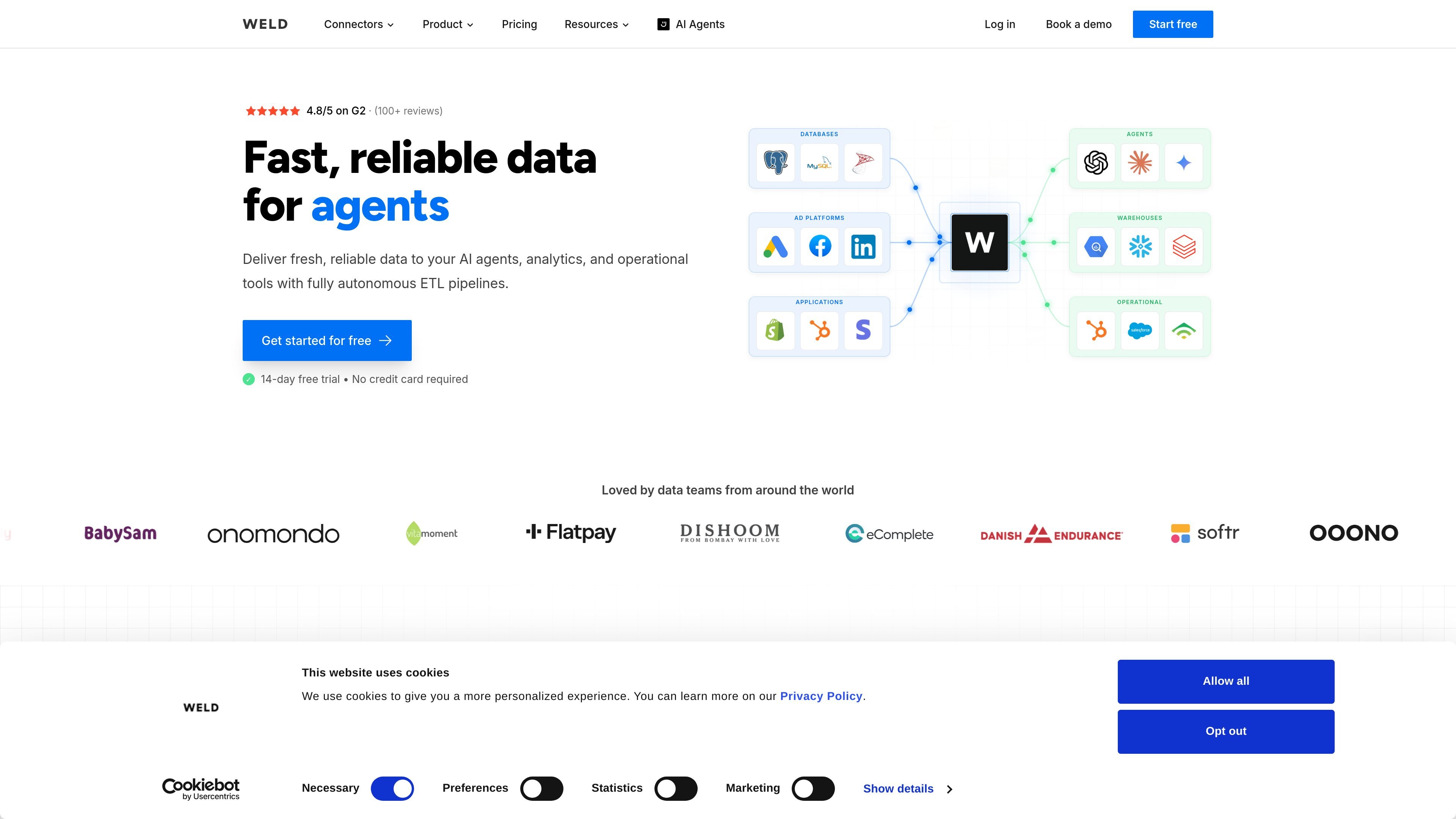
Weld is a data movement platform for teams that need to move, transform, and activate data across analytics, AI, and operational systems. Its site describes fully managed ETL pipelines that bring together SaaS apps, ERPs, databases, and other sources, then load them into warehouses or other destinations.
The product combines prebuilt connectors, replication options such as incremental and CDC syncs, transformation workflows, reverse ETL, and programmatic APIs. The pricing page also shows a free trial and tiered plans with different connector counts, user limits, and sync frequencies, indicating that the platform is designed to scale from smaller setups to larger operational deployments.
Connect SaaS apps, databases, files, ad platforms, and APIs with prebuilt, managed connectors that are designed to sync data into warehouses and other destinations.
Use incremental, full, or CDC replication to move source data into destinations with schema-aware handling and type-safe defaults.
Capture inserts, updates, and deletes from supported databases in near real time with log-based change data capture.
Run transformations with dbt Cloud, dbt Core, GitHub-based deploys, Weld’s SQL workspace, or the Transforms API.
Activate modeled warehouse data back into CRMs, ad platforms, and internal tools with row-level diffing and configurable sync cadence.
Manage connections, syncs, schedules, and embedded pipelines programmatically through the Weld Connect REST API and related tooling.
Centralize SaaS, database, and application data into a warehouse for BI and analytics workflows, using managed connectors and incremental or CDC syncs.
Keep AI agents and LLM workflows current by feeding structured warehouse or source data into downstream vector and model-facing systems through Weld’s automation tooling.
Sync modeled warehouse data back into CRMs, ad platforms, and internal tools so teams work from the same governed source of truth.
Run dbt Cloud, dbt Core, or GitHub-based transformation projects after syncs, or manage SQL-based transforms through Weld’s workspace and API.
Embed source onboarding and pipeline management inside a product or internal platform with the Weld Connect REST API and white-label connection flows.
Yes. Weld offers a 14-day free trial with full access and no upfront credit card requirement, according to the pricing and connector pages.
Weld is set up to move data between sources and destinations rather than store it permanently. The connector page says it does not store your data and helps transfer and prepare it for analysis.
Weld provides managed connectors, a Weld Connect API for programmatic connection management, a Transforms API for data transformations, and a Weld MCP Server for conversational workflows with AI tools.
Weld supports databases, SaaS applications, files, ad platforms, APIs, and destinations such as warehouses. The home page highlights 300+ prebuilt connectors and the connectors page describes a broad data-source directory.
The pricing page shows plan differences in connector counts, user counts, sync frequency, and supported features such as dbt integration, custom connectors, Weld Connect REST API, and the Weld MCP Server.