
PagedAttention
Uses PagedAttention as a core serving technique for improving memory efficiency during LLM inference.

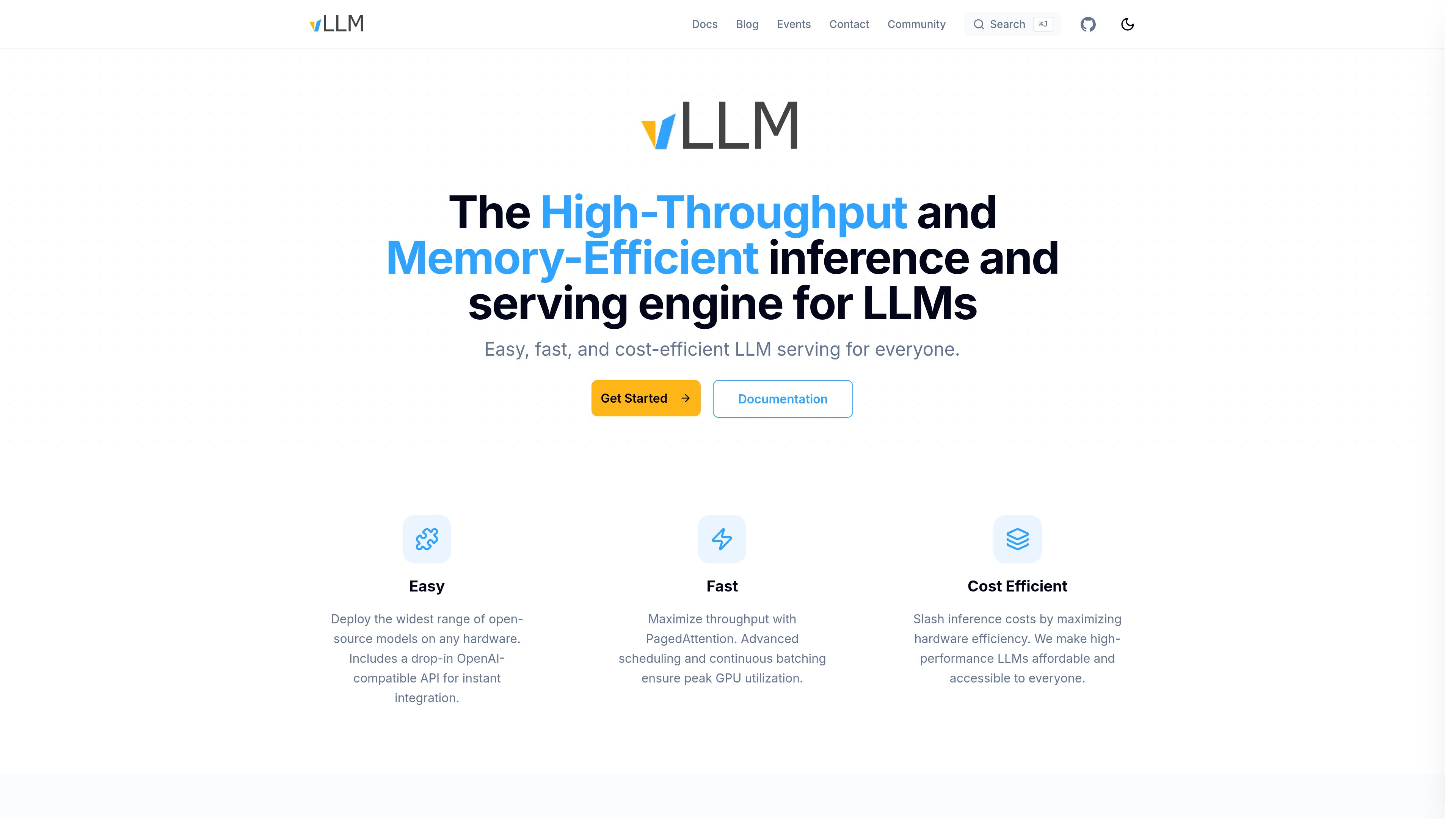
vLLM is an inference and serving engine for large language models, designed for high-throughput, memory-efficient deployment. It helps developers and infrastructure teams run open-source models through an OpenAI-compatible API across supported compute platforms.
vLLM is an inference and serving engine for large language models. It is built to run open-source models with high throughput and efficient memory use, giving developers and infrastructure teams a serving layer for deployed LLM applications.
Its central performance approach combines PagedAttention with advanced scheduling and continuous batching. These mechanisms are intended to improve hardware utilization when handling multiple inference requests. vLLM also includes a drop-in OpenAI-compatible API for connecting applications that already use that API pattern.
The site provides installation choices for CUDA, ROCm, XPU, and CPU environments, as well as Python and Docker-oriented options. A documented quick start uses uv pip install vllm --torch-backend auto; Python 3.10 or later is required, and Python 3.12 is recommended.
Uses PagedAttention as a core serving technique for improving memory efficiency during LLM inference.
Combines incoming inference requests into ongoing batches to help maintain throughput while a serving process is active.
Provides scheduling mechanisms intended to keep available accelerator capacity productively used across inference workloads.
Offers a drop-in API compatible with the OpenAI API style, reducing the changes needed when connecting existing client applications.
The quick-start flow presents options for CUDA, ROCm, XPU, and CPU environments, with Python and Docker package paths.
Users can choose the currently tested stable release or a nightly build when they need newer development builds.
A development team can install vLLM, launch a supported model, and connect an application through the OpenAI-compatible API instead of implementing a custom inference interface.
An inference operator handling multiple users or application requests can use continuous batching and scheduling to organize work across the serving process.
A team constrained by accelerator memory can evaluate vLLM's PagedAttention-based serving approach when deploying a large language model.
Infrastructure teams can select the installation path that matches their environment, including CUDA, ROCm, XPU, or CPU options shown in the product's setup flow.
A team can use the stable build for the most currently tested version or select nightly builds to evaluate newer changes before updating its serving workflow.
vLLM is used to run inference and serve large language models. It is aimed at high-throughput, memory-efficient deployment of open-source models.
Yes. The site describes a drop-in OpenAI-compatible API for integrating applications with a vLLM-served model.
The quick-start information states that Python 3.10 or later is required and recommends Python 3.12 or newer.
The site lists CUDA, ROCm, XPU, and CPU installation options. It also presents Python and Docker package paths, with the exact compatibility depending on the selected setup.
The supplied pricing URL returns a 404 page and does not provide plan, usage, or price information. The available evidence therefore does not establish a pricing model.

www.sglang.io
SGLang is an open-source serving framework for large language and multimodal models. It helps developers deploy model servers and query them through OpenAI-compatible endpoints across supported GPU, CPU, TPU, NPU, and XPU platforms.

cloud.sambanova.ai
SambaNova Cloud is an AI inference platform that provides API access to open-source language and vision models. Developers can use its OpenAI-compatible API, playground, and model catalog to build and test AI-powered applications.

sambanova.ai
SambaNova is an AI inference platform for developers, enterprises, and infrastructure operators running large open-source models and agentic workloads. It combines cloud services with deployable hardware and software for cloud, on-premises, hybrid, and air-gapped environments.

parasail.io
Parasail is an inference cloud for AI-native startups that provides access to open and frontier models through an OpenAI-compatible API. It offers serverless, elastic, dedicated, and batch deployment options with per-token or GPU-based pricing.

chutes.ai
Chutes is a decentralized, serverless AI inference platform for deploying, running, and scaling open-source models. Developers can access hosted models through an API or deploy private custom workloads on confidential GPU capacity.

www.ray.io
Ray is an open-source, Python-native framework for distributing and scaling AI, machine learning, and other compute-intensive workloads. It helps developers run workloads from a laptop to clusters with thousands of GPUs and supports data processing, training, serving, inference, and reinforcement learning.