
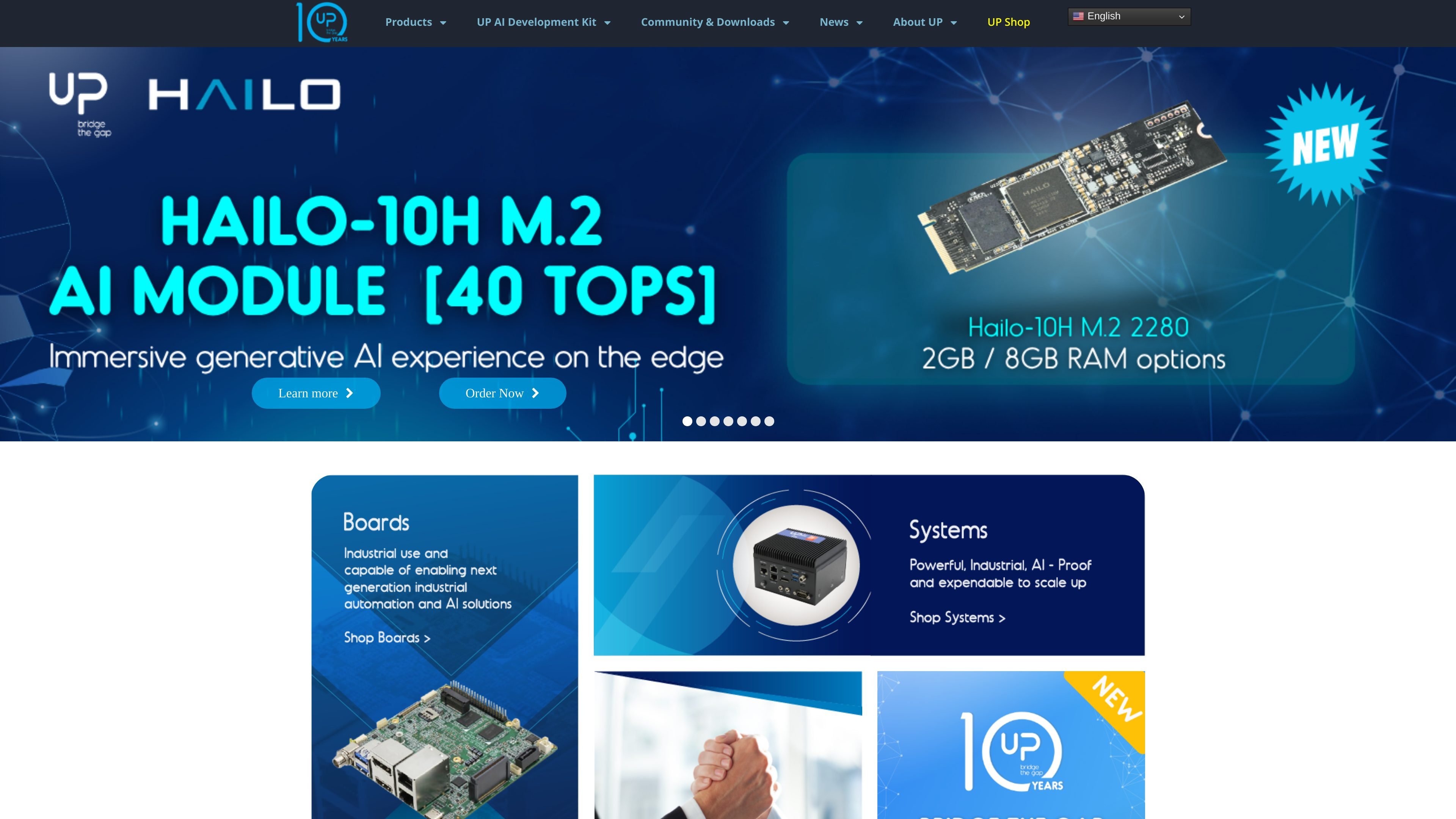
Intel-based edge computing
UP dev kits and computing platforms use Intel technologies to provide local processing for embedded, industrial, and AI workloads.

Industrial single-board computers and edge AI platforms built on Intel technology for professional developers.
UP Bridge the Gap is a product brand offering Intel-based single-board computers, edge AI platforms, and solution kits for professional developers. Its hardware is intended for industrial automation, computer vision, transportation, smart-city, and other embedded applications that need local processing and a broad set of interfaces.
The product range supports project development from evaluation through deployment. UP boards use a 40-pin HAT interface compatible with Raspberry Pi applications, while the broader portfolio includes board-level and system-level form factors. Depending on the selected model, the platform can support AI inferencing, graphics, and connected industrial workflows at the edge.
UP also provides design and manufacturing services covering product conceptualization, development, manufacturing, and aftercare. This positions the brand as both a hardware supplier and a development partner for teams moving an embedded or edge AI application toward mass production.
UP dev kits and computing platforms use Intel technologies to provide local processing for embedded, industrial, and AI workloads.
UP products feature the same 40-pin HAT interface as Raspberry Pi, helping developers adapt existing applications while adding Intel processing and other platform capabilities.
The product line includes platforms and accelerator configurations intended to run inferencing models and computer-vision workloads at the edge.
The portfolio spans ten form factors across board-level and system-level solutions, supporting different enclosure, integration, and deployment requirements.
UP Design Manufacturing Service covers concept development, engineering, manufacturing, and aftercare through a monitored end-to-end process.
Use UP computing platforms as the local processing layer in industrial equipment and automation systems that require embedded Intel compute and application-specific interfaces.
Build applications such as inspection and recognition systems that process visual data locally, including AI-assisted workflows demonstrated with UP hardware and Intel acceleration.
Deploy edge systems for transportation scenarios such as automatic number plate recognition, where local inference can reduce connection latency and support operation across varied environments.
Integrate compact UP boards into connected equipment such as smart locker systems, using the platform's interface selection and small form factors for space-constrained deployments.
Use UP's hardware, community, and design manufacturing services to move a proof of concept through development, manufacturing, and post-launch support.
UP Bridge the Gap is a brand offering Intel-based single-board computers, edge AI platforms, and solution kits for professional developers and industrial applications.
UP products use the same 40-pin HAT interface as Raspberry Pi, which can support migration of existing applications. The specific software and hardware compatibility depends on the selected UP model.
Yes. UP offers Design Manufacturing Service covering product conceptualization, development, manufacturing, and aftercare for applications progressing toward mass production.
Published examples include AI-assisted license plate recognition, smart airport access control, smart lockers, and AI inspection for wind-turbine applications.
Traffic data is for reference only.

www.sglang.io
SGLang is an open-source serving framework for large language and multimodal models. It helps developers deploy model servers and query them through OpenAI-compatible endpoints across supported GPU, CPU, TPU, NPU, and XPU platforms.

vllm.ai
vLLM is an inference and serving engine for large language models, designed for high-throughput, memory-efficient deployment. It helps developers and infrastructure teams run open-source models through an OpenAI-compatible API across supported compute platforms.