
OpenAI-compatible gateway
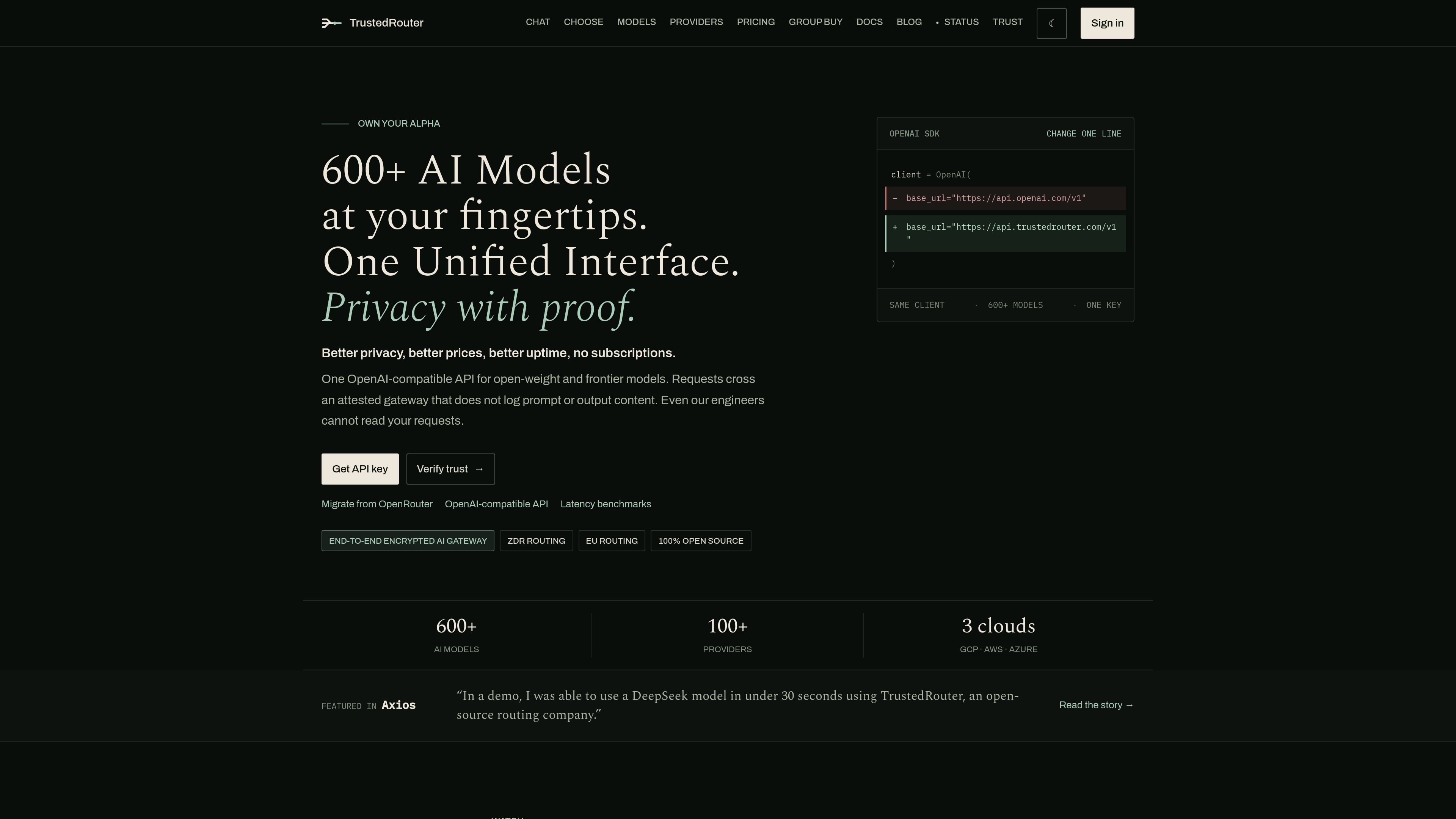
Use the endpoint at `https://api.trustedrouter.com/v1` with existing OpenAI SDK applications, chat or Responses calls, and many compatible agents. The documentation also lists an Anthropic-compatible base URL.

TrustedRouter is an OpenAI-compatible AI gateway for routing requests across hundreds of models and providers. It is designed for developers and teams that need configurable privacy routing, provider failover, and a verifiable prompt path.
TrustedRouter is an OpenAI-compatible AI gateway that routes applications to hundreds of open-weight and frontier models across more than 100 providers. Developers can preserve OpenAI-shaped calls and migrate by changing the API base URL; the site also documents an Anthropic-compatible endpoint and agent setup for Claude Code, Codex, Cursor, and similar tools.
The service separates its production prompt path from the dashboard and billing control plane. Requests pass through an attested gateway running in a Trusted Execution Environment, with published evidence connecting the running image to public source. TrustedRouter states that prompt and output content are not logged and that the gateway fails closed when attestation cannot be verified.
Routing aliases let teams choose a policy as well as a model. Available examples include trustedrouter/auto for provider rollover, trustedrouter/zdr for zero-retention routes, trustedrouter/e2e for confidential provider routes, and trustedrouter/eu for Europe-focused routing. BYOK is supported for customers that need to use existing provider commitments or rate limits.
Use the endpoint at `https://api.trustedrouter.com/v1` with existing OpenAI SDK applications, chat or Responses calls, and many compatible agents. The documentation also lists an Anthropic-compatible base URL.
Select routing behavior through named aliases such as `trustedrouter/auto`, `trustedrouter/zdr`, `trustedrouter/e2e`, and `trustedrouter/eu`, or choose a direct model ID when exact selection is required.
The production gateway runs in a Trusted Execution Environment and publishes evidence connecting its running image to public source. TrustedRouter states that prompt and output bodies are excluded from control-plane and metadata systems.
Health measurements and explicit fallback support routing across providers and GCP, AWS, and Azure. The service states that it does not silently fall back to an unverified prompt path.
Bring provider keys for existing commitments or enterprise rate limits. Prepaid text and embedding routes are billed at provider cost plus 5.5%, while asynchronous video generation is billed at the provider quote plus 20%; there is no monthly subscription.
The site identifies public frontend, backend, gateway, infrastructure, SDK, and deployment repositories, alongside public status, latency, availability, and attestation information.
Teams can create a key, change the base URL, run the documented PONG smoke test, and continue using OpenAI-shaped chat or Responses calls while selecting models from the catalog.
Legal and other sensitive-data applications can use the zero-retention or confidential routing aliases. The customer case study describes document extraction, retrieval preparation, and multi-stage legal reasoning for litigation materials.
Developers using Claude Code, Codex, Cursor, eval runners, or other compatible agents can configure the documented base URL and environment variables, then choose a privacy, regional, or fallback policy.
Organizations with provider credits, negotiated rates, or enterprise limits can use BYOK while retaining TrustedRouter's unified API, routing controls, and gateway trust boundary.
Teams can compare direct model IDs and measured routes across a broad catalog, using `trustedrouter/auto` for healthy-provider rollover or cost-oriented route pools where appropriate.
Create a TrustedRouter API key, set the base URL to `https://api.trustedrouter.com/v1`, and run the documented PONG smoke test. Existing OpenAI SDK applications can then keep their current call structure while selecting a catalog model or routing alias.
TrustedRouter states that prompt and output content is not logged and is excluded from its control-plane and metadata systems. Any content export is described as requiring explicit destination-level configuration.
The service states that the gateway fails closed rather than silently routing prompts through an unverified fallback path.
Yes. BYOK is available for providers where a team already has committed spend or enterprise rate limits, while TrustedRouter supplies the unified API and routing layer.
There is no monthly subscription or seat fee. Prepaid text and embedding routes are charged at provider cost plus 5.5%, subject to a stated $0.01 per million token floor; asynchronous video generation is the direct provider quote plus 20%. BYOK and usage-based billing are also supported.
Traffic data is for reference only.

docs.litellm.ai
LiteLLM lets teams call and manage 100+ LLMs through an OpenAI-compatible SDK or proxy, with request routing, spend tracking, and multi-provider access.
aimlapi.com
AIMLAPI provides one API and billing key for accessing a catalog of AI models for chat, reasoning, image, video, audio, voice, search, embeddings, code, and related tasks. It is intended for developers and teams that want to compare and use models from multiple providers through a common platform.

zenmux.ai
ZenMux is an enterprise LLM platform with one API for multiple models, automatic prompt routing, flexible pricing, cost visibility, and model-failure compensation.

www.newapi.ai
New API is an open-source, self-hosted AI gateway for developers and teams. It provides a unified OpenAI-compatible endpoint for connecting multiple AI providers, selecting models, configuring channels, and monitoring usage on their own infrastructure.

router.com
Router by Ramp is an LLM gateway that gives applications one API endpoint for accessing models from multiple providers. It routes eligible requests based on cost, quality, and availability while providing usage and spend visibility.

cometapi.com
CometAPI is a unified, OpenAI-compatible API layer for accessing more than 500 text, image, video, and audio models through one key. It helps developers and teams compare models, centralize billing, and switch providers without maintaining separate vendor integrations.