
Browser-based experiment design
Create experimental designs in the browser without code, then iterate before taking them into the lab. The site says you can define plate layouts, dilution conditions, and the devices you plan to use.

Synthace is a software and services platform for designing, automating, and analyzing multivariate experiments in discovery biology. It helps teams produce structured, high-dimensional experiment data that is easier to analyze and use for AI.
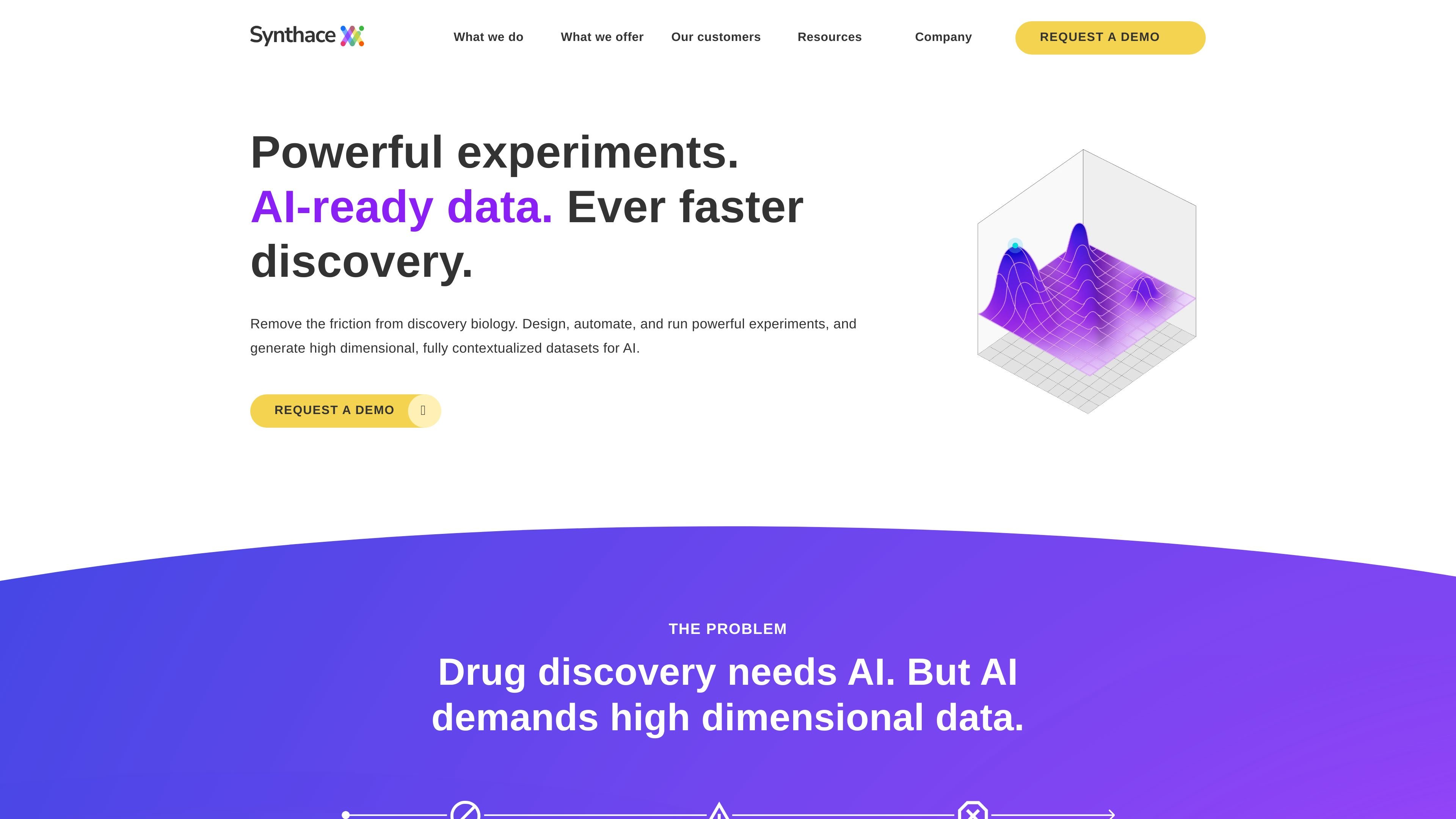
Synthace is a software and services platform for designing, automating, and analyzing multivariate experiments in discovery biology. Its public messaging focuses on helping teams run more powerful experiments, generate high-dimensional data, and keep that data structured with the experimental context needed for modern analysis.
The product combines browser-based experiment design, automatic planning, and automation instruction generation with support from field application scientists. Synthace says this helps teams move from manual or rigid workflows to a more systematic way of exploring experimental variables, transferring methods, and producing data that is easier to use for downstream analysis and AI.
The site positions the platform for discovery teams that need more robust, transferable assays and better insight from fewer experiments. It also emphasizes practical adoption through starter projects, on-site support, and use of the scientists and lab hardware already in place.
Create experimental designs in the browser without code, then iterate before taking them into the lab. The site says you can define plate layouts, dilution conditions, and the devices you plan to use.
Let the platform calculate volumes and concentrations and produce an overview of materials, setup, and automation instructions. This reduces manual planning work for multivariate studies.
Turn designs into execution instructions for lab equipment without scripting. The site says the same workflow can be run on different liquid handlers with minimal changes.
Preserve context when methods move between people, devices, or sites. Synthace says it shares methods while taking device differences into account when preparing execution instructions.
Store data and metadata in the context of the experimental design so results are immediately accessible in the cloud. The site describes the output as high-dimensional and AI-ready.
Use software plus services support from field application scientists. The site describes specialists who help teams adopt multivariate methods and implement them in existing projects.
Plan multivariate studies that test several variables at once, then translate the design into execution instructions for the lab. The site frames this as a better alternative to one-variable-at-a-time experimentation when biological systems are complex.
Develop and optimize assays with support from Synthace specialists who understand assay workflows and automation. The home page and product pages present this as a starter area for the platform.
Explore media compositions systematically to identify conditions that support cell differentiation or expansion. The source highlights media optimization as a concrete discovery workflow.
Transfer methods between devices, people, and sites while preserving contextual data. This is useful for teams that need reproducible workflows across different liquid handlers or locations.
Generate contextualized data sets that are easier to analyze after the experiment. The site emphasizes structured data that can support downstream modeling and AI use cases.
Synthace is presented as software and services for designing, automating, and analyzing powerful multivariate experiments. The site emphasizes helping discovery biology teams produce high-dimensional, contextualized data that is easier to analyze and use for AI.
The source describes a browser-based, code-free workflow for designing experiments, automatically turning designs into automation instructions, and structuring resulting data with its experimental context.
Synthace highlights assay development, media optimization, and purification optimization as practical areas where automated multivariate experiments can help teams explore conditions more systematically.
The site says Synthace uses the scientists and dispensers you already have in the lab, and it positions the platform as a way to share methods across people, devices, and sites.
The pricing page evidence only shows a 404 page and navigation links, so no public pricing details are confirmed in the provided sources.