
Specialist agent and skill library
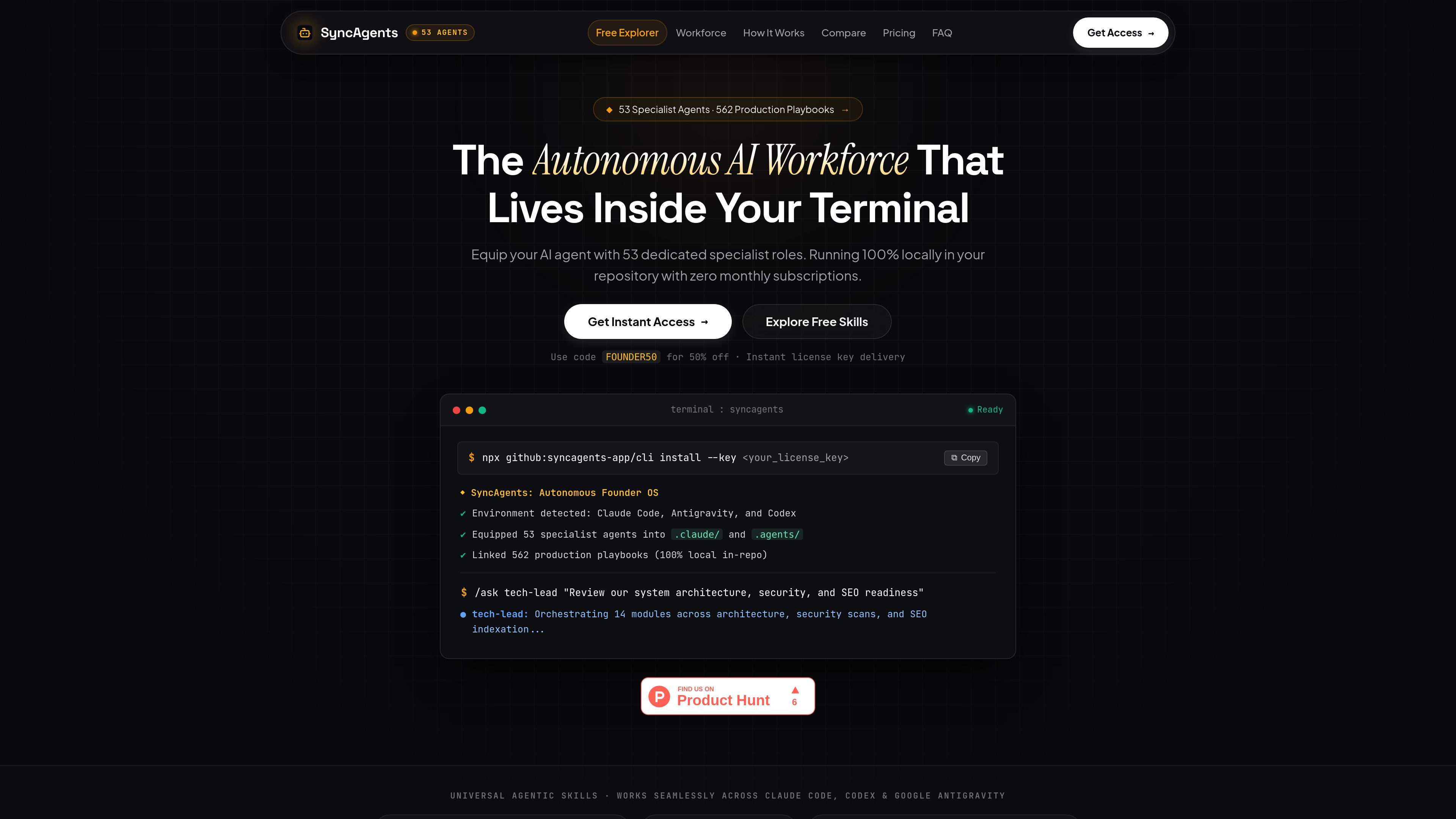
The published library contains 53 specialist agents and 562 production skills, with roles and playbooks spanning software engineering, operations, SEO, content, and growth work.

SyncAgents is a local library of executable AI skills and specialist agent playbooks for Claude Code, Google Antigravity, and Codex. It helps developers and founders run engineering, security, technical SEO, content, and growth workflows from their repositories.
SyncAgents is a repository-local library of executable AI skills and specialist agent playbooks for Claude Code, Google Antigravity, and Codex. It is intended to bring repeatable engineering and growth workflows into an existing terminal and codebase rather than requiring a separate cloud workspace.
The site organizes its library into two operating areas. Engineering OS covers architecture, delivery, cloud infrastructure, security, compliance preparation, code quality, testing, and automation. Marketing & Growth OS covers conversion work, product discovery, paid acquisition, technical SEO, generative engine optimization, and evidence-led content workflows.
The product is installed through a command-line interface using a license key. Its installation process writes files into .agents/ and .claude/, and the site says the skills use local repository context. A free explorer offers 27 featured playbooks for inspection and copying; the complete library is described as containing 562 skills and 53 specialist agents.
The published library contains 53 specialist agents and 562 production skills, with roles and playbooks spanning software engineering, operations, SEO, content, and growth work.
The SyncAgents CLI installs the playbook files into `.agents/` and `.claude/` within a project. The site presents the workflows as 100% local and in-repository, with an immutable SHA-256 manifest used to protect installed state during updates.
Examples include Docker multi-stage optimization and hardening, Kubernetes and Helm configuration, AWS architecture with Terraform, chaos engineering, automated QA, architecture review, and database or backend design.
The library includes pre-commit security auditing for issues such as secrets, SQL injection, insecure dependencies, and OWASP risks, along with SOC 2 readiness, secrets management, and GDPR review workflows.
The marketing library describes technical crawling, Core Web Vitals checks, Schema.org JSON-LD, XML sitemap and hreflang validation, and generative engine optimization for services including ChatGPT search, Perplexity, Google AI Overviews, and Copilot.
Users invoke specialized workflows from Claude Code, Codex, or Google Antigravity. The CLI provides install, update, doctor, and uninstall commands, and the site describes integrations with Google Search Console, PageSpeed, Ahrefs, DataForSEO, Firecrawl, and IndexNow.
A development team can use the Docker, Kubernetes, Helm, AWS, or Terraform playbooks to review container builds, create deployment configuration, check resource and ingress settings, and examine infrastructure decisions from the project repository.
Before committing or preparing for an audit, teams can invoke security scanning, secrets checks, SOC 2 evidence preparation, or GDPR review workflows to identify findings and organize remediation or audit material.
Engineering teams can use the chaos engineering playbooks to plan experiments involving latency, packet loss, pod termination, or database failover, then use the results to assess self-healing behavior and resilience.
A founder, marketer, or technical SEO practitioner can use the crawler and SEO workflows to inspect indexation, Core Web Vitals, structured data, XML sitemaps, hreflang, and visibility in AI search experiences.
Growth teams can apply the product discovery, conversion, paid advertising, and five-gate blogging workflows to develop content, verify sources, create inline SVG charts, and plan multilingual publishing.
The site identifies Claude Code, Google Antigravity, and Codex as supported AI runtimes. It describes installation locations including `.claude/` and `.agents/`.
The published quick-start command is `npx github:syncagents-app/cli install --key <your_license_key>`. The installer writes the skill library into the project and the CLI also lists update, doctor, and uninstall commands.
The site describes the skills as 100% local and in-repository, with local repository context and zero telemetry stated in its comparison section. Readers should verify their own AI tool configuration and any external service behavior before treating a workflow as fully air-gapped.
The Free Community Skill Explorer contains 27 featured playbooks. Users can search them, preview their playbook prompts, and copy prompts directly to a terminal; the complete library is described separately as 562 skills.
The home page advertises a Founder OS license that includes both Engineering OS and Marketing & Growth OS, 53 specialist agents, 562 production skills, universal compatibility across the listed runtimes, and lifetime upstream updates. The supplied pricing path returns a 404, so additional plans or purchase terms are not confirmed here.
Traffic data is for reference only.

aistudio.google.com
Google AI Studio is a browser-based development environment for experimenting with Google’s generative models and moving prompts into applications through the Gemini API. It supports developers building text, image, video, audio, and agent experiences.

arena42.ai
NetMind Agent Arena is a live AI agent competition platform where developers and teams benchmark, rank, and reward autonomous agents through real-world challenges.
octavia.one
Renatus is a local-first AI agent platform with wallet connectivity and token workflows.

happycapy.ai
Happycapy is a browser-based agent platform for running Claude Code, managing skills, and delegating tasks in a secure sandbox, with free and paid plans.

gradio.app
Gradio Workflows is a visual, node-based AI pipeline builder built into Gradio. It helps developers connect Hugging Face Spaces, models, datasets, and Python functions on a drag-and-drop canvas.

osohq.com
AI agent security and control for production teams