
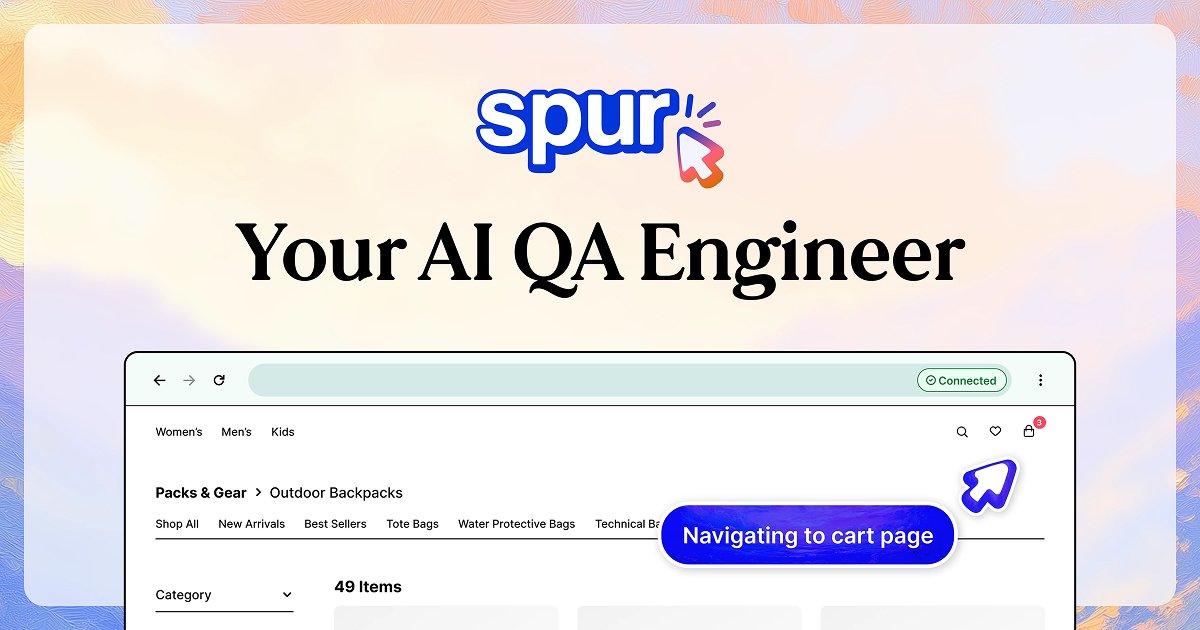
Agentic test execution
Spur's autonomous agents plan, execute, and report tests so teams can validate release readiness without manually stepping through every scenario.

AI QA platform for end-to-end e-commerce testing
Spur is an AI QA platform for e-commerce teams. It is described as an agentic testing system that plans, executes, and reports tests end to end so products can ship with fewer manual regression cycles.
The site positions Spur around real customer behavior and complex storefront workflows. Its pages highlight support for exploratory testing, localization, UI/UX testing, functional testing, and AI feature testing, along with parallel execution across web and native mobile tests.
Spur's autonomous agents plan, execute, and report tests so teams can validate release readiness without manually stepping through every scenario.
The product can simulate actual customer behavior and adapt to site changes such as pop-ups, cookies, promotions, and out-of-stock items.
The homepage says teams can run hundreds of tests in parallel across web and native mobile tests, which is positioned as a scale feature for larger test suites.
Feature pages describe coverage for exploratory testing, localization, UI/UX testing, functional testing, and AI feature testing.
Functional testing is described as supporting complex multi-step journeys and chaining tests together, such as sign in, checkout, and return flows.
Case studies and homepage testimonials indicate Spur returns detailed feedback that helps with dev handoff and ongoing test creation, though the exact report format is not shown.
Use Spur to automate regression coverage for release-critical storefront flows, reducing the manual burden before each deployment.
Use Spur to validate multi-step journeys like sign in, checkout, and returns, where the test path depends on prior actions and state.
Use Spur to check localized experiences, including translated UI, currency formatting, and regional date, time, number, and address formats.
Use Spur to inspect UI problems such as typos, broken links, layout overflow, and misaligned elements across real user flows.
Use Spur to exercise AI-driven product surfaces such as search, chat, recommendations, and assistants where responses can vary from run to run.
Spur is presented as an agentic QA platform for e-commerce sites. The source emphasizes that its agents plan, execute, and report tests end to end, rather than requiring teams to script every step manually.
The source shows Spur being used for exploratory testing, localization, UI/UX testing, functional testing, and AI feature testing. It also highlights e-commerce release validation and regression coverage across core flows.
The homepage says Spur's autonomous agents plan, execute, and report tests, and the case studies show teams using it across release and regression workflows. A case study also describes high-volume daily test runs, but the exact setup process is not detailed in the provided pages.
The source does not provide public pricing on the pricing page, which currently returns a not found page. No plan structure or price points are stated in the provided materials.
Traffic data is for reference only.
| Jun | 10540 |
|---|---|
| Jul | 9633 |
| Aug | 14169 |
Traffic analytics are not available yet.
Traffic analytics are not available yet.

blopai.com
Blop writes browser tests as code, runs them in CI, clusters repeated failures, and opens pull requests to fix broken tests.

testim.io
Automated testing for web, mobile, and Salesforce teams

getbluejay.ai
Bluejay is a QA platform for testing, monitoring, and improving AI voice and chat agents before and after deployment.

argminai.com
Argmin AI helps teams evaluate AI features before release using workflows, rules, docs, and a few examples—without requiring an ML team or custom evaluation code.

www.replay.io
Replay QA is an agentic web application testing platform with an automated Security Scan for penetration testing. It explores live apps, tests authenticated journeys, captures runtime evidence, and produces reports that teams can use to remediate security and other software defects.

mrge.io
AI code review for pull requests and codebases