
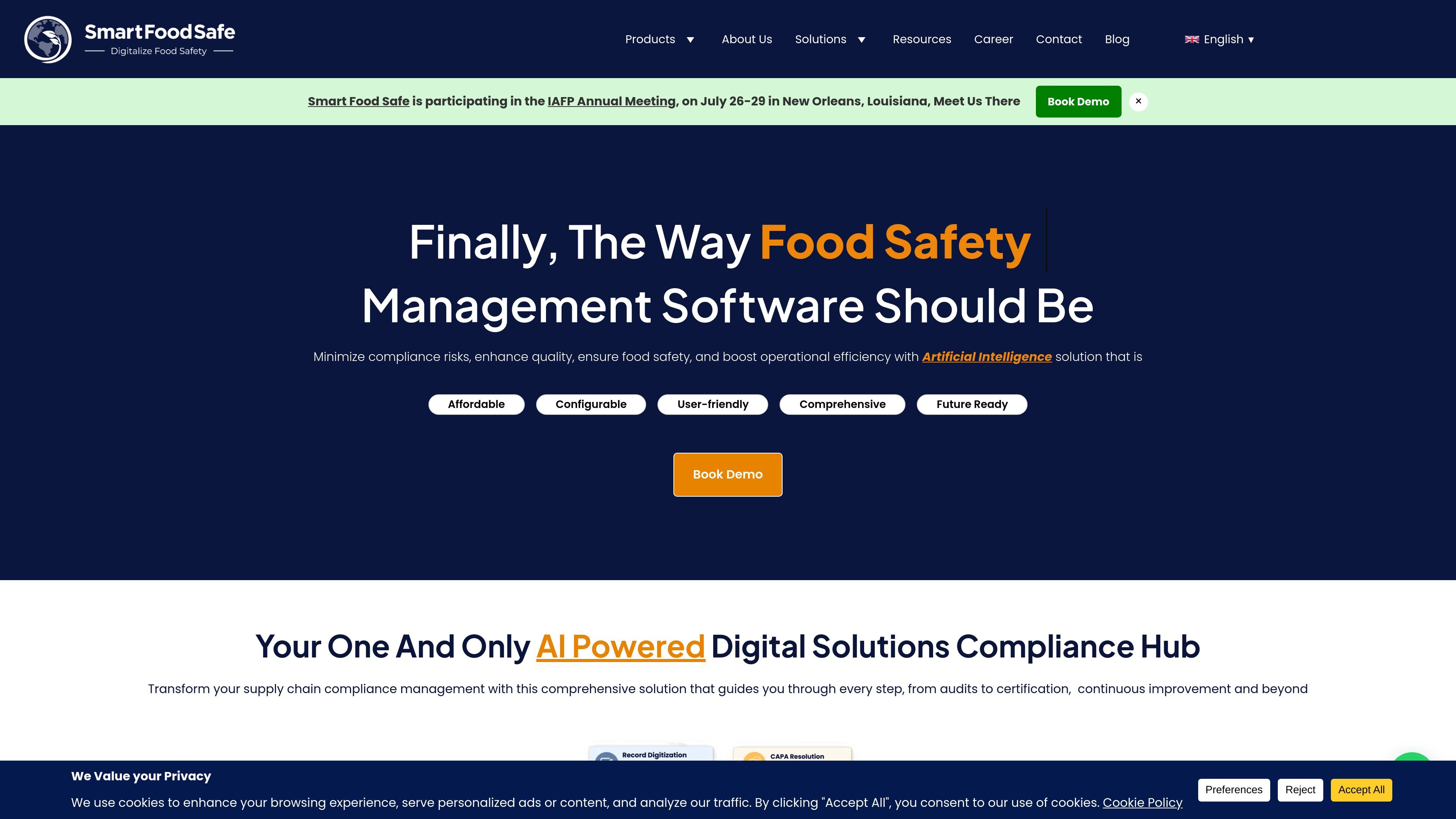
Compliance management hub
The homepage positions the product as a hub for compliance, quality, traceability, and regulatory management, with support for moving from audits to certification and continuous improvement.

Food safety software for compliance, audits, certifications, and AI-assisted documentation
Smart Food Safe is a food safety and quality management software platform for organizations that need to manage compliance, audits, certification readiness, traceability, and regulatory workflows in one place. The site positions it as an AI-powered digital compliance hub for food safety programs.
The public pages emphasize support for standards and frameworks including HACCP, ISO 22000, FSMA, SQF, BRCGS, and GFSI-related requirements. The product is presented as configurable and user-friendly, with an emphasis on helping teams move from paper-based or fragmented processes into a more organized digital workflow.
A separate Smart GPT page highlights AI-assisted capabilities such as automated checklists, COA verification, document summarization, AI reporting, and predictive horizon scanning. The overall message is that the platform is intended to reduce manual work while keeping food safety and audit processes organized.
Testimonials on the homepage suggest the software is used by food manufacturing and related operations, including teams that need help with SQF documents, audit readiness, and broader food safety program management. The site also claims 500+ sites and counting, but does not publish a detailed customer list or pricing breakdown on the pages reviewed.
The homepage positions the product as a hub for compliance, quality, traceability, and regulatory management, with support for moving from audits to certification and continuous improvement.
The site says the software helps manage food safety audits and supports certification-related work across standards such as HACCP, ISO 22000, FSMA, SQF, and BRCGS.
The AI product page highlights automated checklists, COA verification, document summarization, AI reporting, and predictive horizon scanning.
The homepage emphasizes configurable and user-friendly software, and testimonials repeatedly mention ease of use and intuitive operation for production and quality teams.
Public pages and testimonials reference digitizing food safety and quality management workflows, including document organization and workflow tracking.
The site refers to managing supply chain compliance and food safety operations across multiple sites, with 500+ sites claimed on the homepage.
Use the platform to organize audit tasks, supporting documents, and readiness checks around food safety standards and certification preparation.
Use the software to centralize food safety and quality workflows that are otherwise spread across documents, spreadsheets, or separate tools.
Use the AI-oriented capabilities to create or summarize documentation, generate reports, and verify COAs more quickly than manual review alone.
Use the system to track compliance across more than one site, especially when standardizing food safety processes across facilities.
Use the software in production, quality, or operations teams that need a more structured way to manage traceability, regulatory tasks, and recurring checks.
Smart Food Safe is positioned as a food safety and quality compliance platform that helps manage HACCP, ISO 22000, FSMA, SQF, BRCGS, and related workflows. The site also presents an AI-focused version, Smart GPT, for automated checklists, document summarization, COA verification, reporting, and audit support.
The site presents the product as configurable, user-friendly, comprehensive, and future-ready. Its public pages emphasize support for audits, certification, continuous improvement, and food safety management rather than a narrow single-purpose tool.
The source does not publish a detailed pricing table. The homepage and related pages include a prominent "Book Demo" call to action, so visitors appear to evaluate the product through sales contact rather than self-serve pricing detail.
The public pages mention food safety and quality management, compliance, traceability, regulatory management, GFSI standards, and AI-assisted workflows. They do not provide a full integration list or detailed platform architecture on the pages reviewed.
Traffic data is for reference only.

famori.my
Famori is an AI-powered family assistant for coordinating schedules, reminders, meals, fitness, and everyday household information in a shared family space. It works through an installable web app, with WhatsApp available as an optional add-on.

dishgen.com
AI recipe generator and meal planner for cooks and food brands

robotrecipes.co
Mise is a browser-based meal-timing planner that schedules multiple dishes backward from a chosen serving time. It helps home cooks coordinate preparation, cooking, resting, and serving so a meal is ready together.
bargpt.app
BarGPT is a web product at bargpt.app; features and plans are unverified.

cliprecipe.com
Extract and organize recipes from YouTube, TikTok, Facebook, Instagram, and Pinterest videos.

cookaifood.com
cookAIfood is an AI recipe platform for creating recipes, food images, and event menus, with tools for ingredients, PDF exports, image downloads, and nearby restaurants.