
ASL fingerspelling recognition
Recognizes the American Sign Language manual alphabet, covering letters A through Z, in real time from webcam input.

signspell is a Python package for live American Sign Language fingerspelling recognition from a webcam, with CLI, library API, bundled model, and webcam UI.
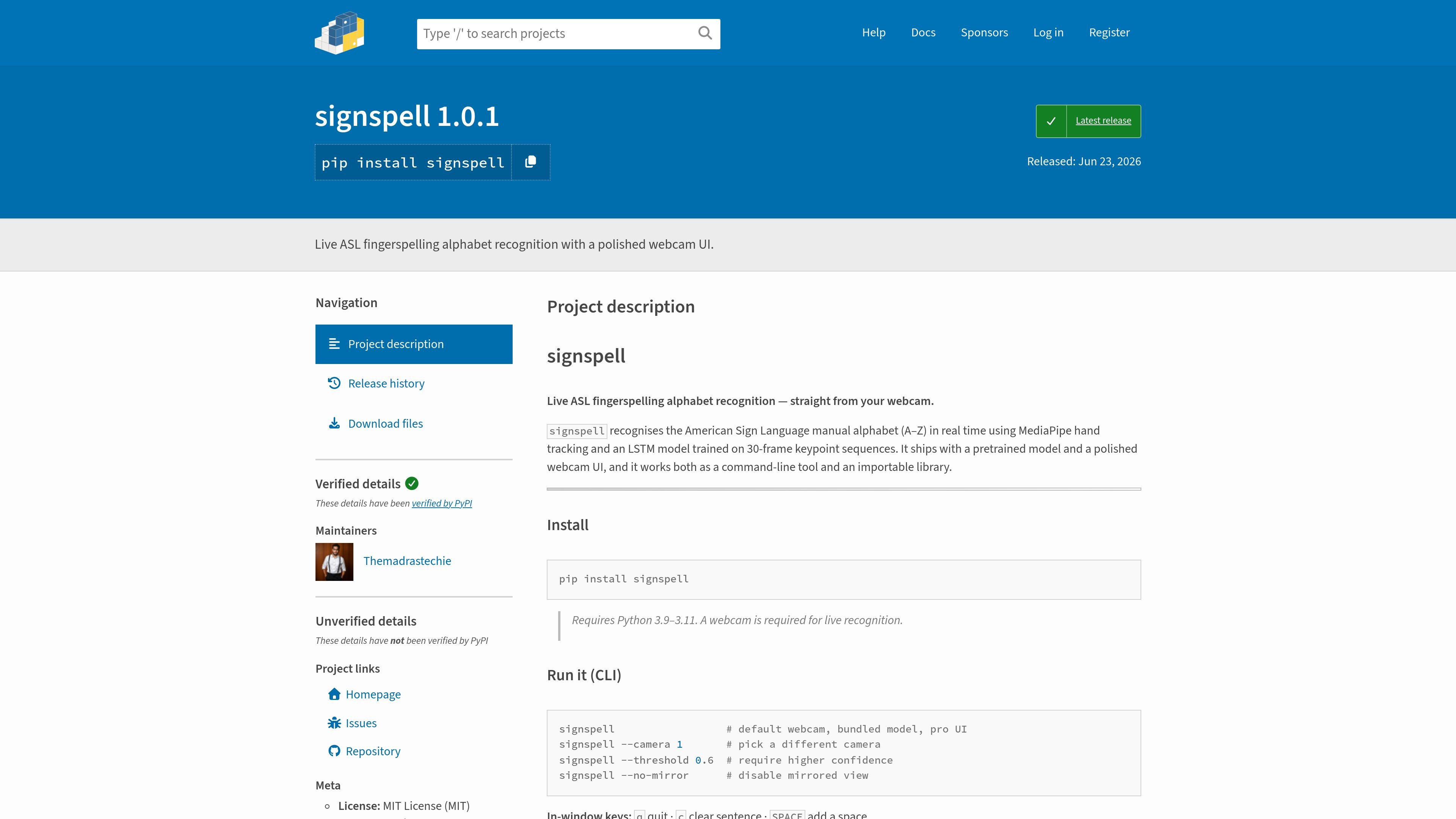
signspell is a Python package for live American Sign Language fingerspelling recognition from a webcam. It focuses on the manual alphabet, identifying A–Z in real time and presenting the result through a polished on-screen interface.
The project combines MediaPipe hand tracking with an LSTM model trained on 30-frame keypoint sequences. It ships with a pretrained model, can be used from the command line or as an importable library, and is intended for users who want live webcam-based recognition rather than offline image classification.
Recognizes the American Sign Language manual alphabet, covering letters A through Z, in real time from webcam input.
Uses MediaPipe hand tracking and an LSTM model trained on 30-frame keypoint sequences, according to the project description.
Includes a pretrained model and a polished webcam UI so it can run without wiring up a model yourself first.
Works as a command-line tool with options for camera selection, confidence threshold, mirrored view control, and custom model paths.
Can be imported as a library, with `signspell.run()` for the full UI and `Recognizer` for programmatic frame-by-frame predictions.
Uses a rolling 30-frame buffer and a short stability window to help avoid flicker before a letter is committed.
Run signspell from the terminal to recognize fingerspelled letters from your default camera or a selected webcam index, then adjust the confidence threshold or mirror mode as needed.
Import the package in a Python application and call `signspell.run()` to embed the full webcam UI in your own workflow.
Use the `Recognizer` class with OpenCV frame capture when you want to process frames yourself and handle the predicted letters in code.
Replace the bundled model with a custom `.h5` file when you already have a compatible model that matches the expected input and output shape.
Use the package for accessible demos, classroom examples, or prototypes where real-time ASL manual alphabet recognition is the main interaction pattern.
It provides a command-line interface and an importable Python library. The CLI can use the default webcam or a selected camera, and the library exposes `signspell.run()` plus a `Recognizer` class for frame-by-frame predictions.
The project description says it requires Python 3.9–3.11 and a webcam for live recognition.
The source says it recognizes the American Sign Language manual alphabet (A–Z) in real time and includes a stability window to reduce flicker before a letter is committed.
PyPI lists an MIT License (MIT) for the project.
You can point it at a custom model with `--model path/to/your_model.h5` or `Recognizer(model_path=...)`. The source says the model must accept input shape `(1, 30, 63)` and output 26 class scores.