
Hybrid extraction
Sensible combines LLM parsing with layout-based rules so the extraction method can adapt to document variation while still using deterministic logic for precision.

Sensible is a document extraction API for turning PDFs, images, spreadsheets, emails, and other documents into structured data with validation and audit trails. It is designed for teams that need to embed document processing into production workflows.
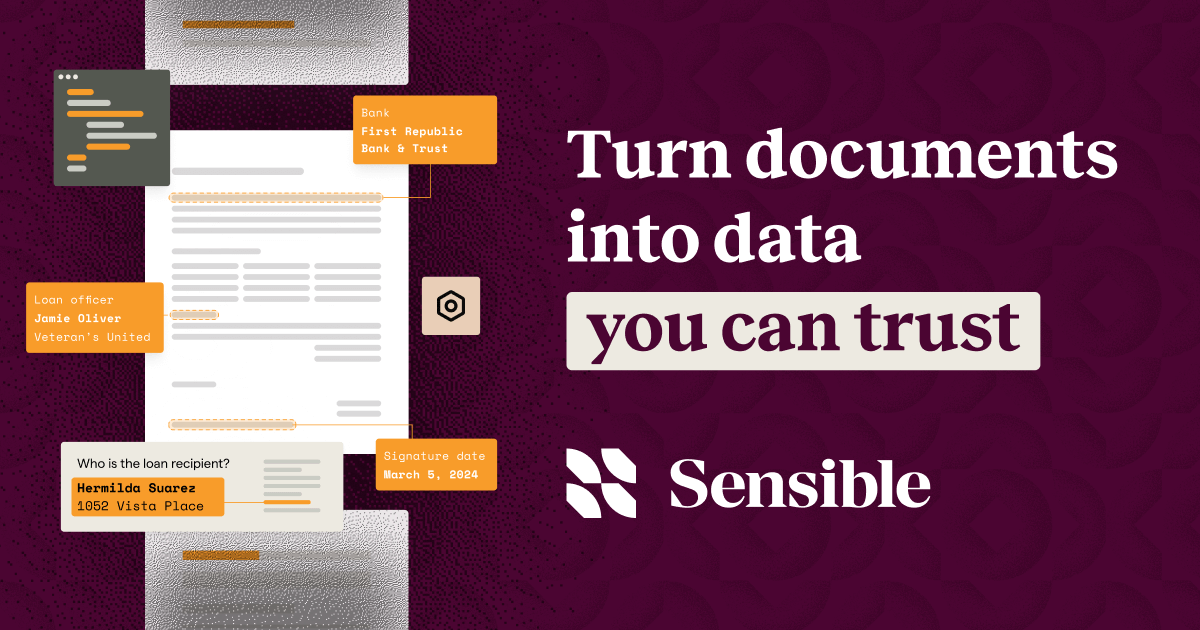
Sensible is a document extraction API for pulling structured data from PDFs, images, spreadsheets, emails, and other document types. The product is built for teams that need validated output, auditability, and a way to ship document processing into production without relying on manual entry.
Its core approach is hybrid extraction: LLM parsing is combined with layout-based rules and schema validation so outputs are checked against an expected structure. The site also emphasizes SenseML for defining extraction logic as code, along with confidence signals and full audit trails for monitoring and review.
Sensible combines LLM parsing with layout-based rules so the extraction method can adapt to document variation while still using deterministic logic for precision.
You define the output structure and Sensible checks extractions against it, so mismatches fail fast instead of quietly entering downstream systems.
Extraction logic lives in SenseML, which the product page describes as version-controlled config that can be tested and deployed through CI/CD.
The platform includes confidence signals, source coordinates, and extraction logs so teams can inspect where a value came from and how certain the system was.
Sensible supports RESTful APIs, SDKs, and webhooks for embedding document extraction into existing products and workflows.
The home page says the platform includes 150+ pre-built configurations for common document types, which can shorten setup before customization.
Teams can extract structured fields from contracts, forms, reports, and other long documents while validating the output against a defined schema.
Product teams can embed Sensible into an application using APIs, SDKs, and webhooks to expose document processing inside their own workflow.
Operations teams can reduce manual review by using confidence signals, source coordinates, and audit trails to inspect uncertain extractions.
Companies processing document-heavy onboarding or reporting flows can use pre-built configs and SenseML to set up extraction logic faster and then adjust it over time.
Organizations with regulated or sensitive documents can use the platform’s validation, encryption, region controls, and retention options to fit controlled data workflows.
Sensible offers document extraction through an API-first workflow. The product page says you can integrate it into your product using RESTful APIs, webhooks, and SDKs, with SenseML used to define extraction logic.
The pricing page says Sensible bills per document rather than per page. It offers Growth, Scale, and Enterprise plans, with a 14-day trial starting on the Growth plan and enterprise options available on request.
The pricing FAQ says Sensible can process long documents, including mortgage applications spanning over 100 pages. It also notes processing can take from about 6 seconds up to 1 minute depending on whether OCR or an LLM is required.
Yes. The pricing FAQ says Sensible can extract data from handwritten documents, although accuracy depends on the legibility of the handwriting.
Yes. The pricing FAQ says Sensible supports sensitive documents and notes HIPAA, SOC 2, encryption in transit and at rest, custom regions, and configurable retention. Enterprise plans can also include SLA and additional controls.