
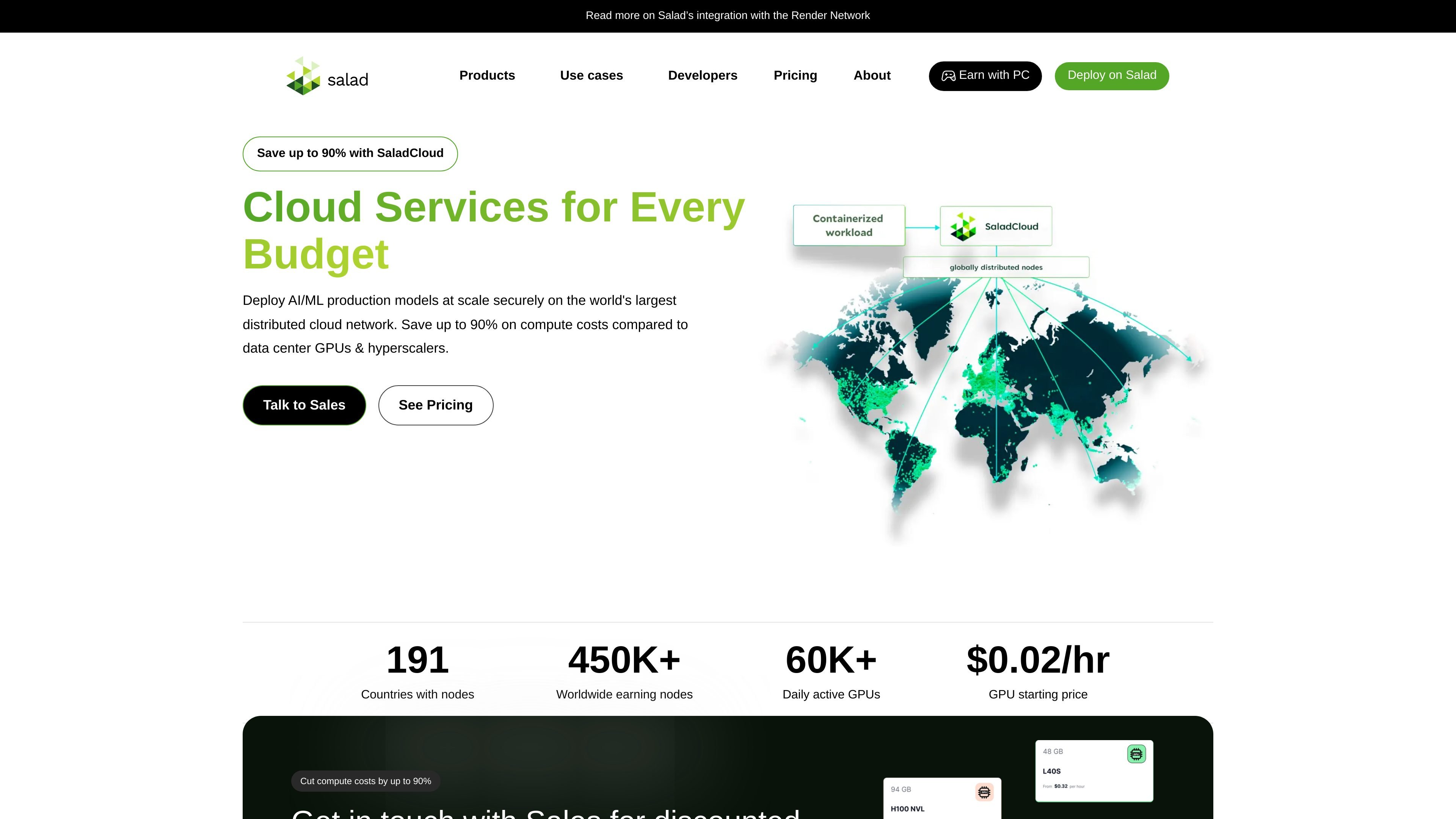
Distributed GPU infrastructure
Deploy AI and other containerized workloads on a distributed cloud of consumer GPUs, with the pages highlighting inference at scale, batch processing, rendering queues, and LLM workloads.

Salad is a distributed GPU cloud for AI, offering usage-based pricing with no contracts or pre-payment for inference, transcription, image generation, and batch processing.
Salad is a distributed GPU cloud for AI and other compute-heavy workloads on consumer GPUs. The site positions it as a lower-cost alternative to hyperscale clouds, with pay-as-you-go pricing and no contracts or pre-payment.
The product is presented as a managed container service rather than a VM management platform. The source pages emphasize scaling inference, batch jobs, computer vision, language models, voice AI, and image generation without managing individual machines, while exposing customizable GPU, RAM, and vCPU options.
Deploy AI and other containerized workloads on a distributed cloud of consumer GPUs, with the pages highlighting inference at scale, batch processing, rendering queues, and LLM workloads.
Scale workloads without managing individual VMs or instances, using a fully managed container service and usage-based execution model.
Choose from customizable GPU, memory, and vCPU configurations, with pricing pages showing several GPU classes and general-purpose, CPU-optimized, and memory-optimized instance types.
Support for image generation workflows is highlighted with pre-built containers and benchmarks for Stable Diffusion XL, Flux.1-Schnell, and other image models.
Voice AI pages highlight transcription, translation, captioning, and text-to-speech workloads, including the Salad Transcription API powered by Whisper Large v3.
The platform is positioned as globally distributed, with geo-distributed nodes across many countries and low-latency edge placement for workloads.
Run text-to-image or image-to-image inference on consumer GPUs when image output volume and per-image cost matter. The source highlights Stable Diffusion XL, Flux.1-Schnell, and pre-built container workflows.
Deploy speech-to-text, text-to-speech, translation, captioning, or subtitle workflows on GPUs instead of managed voice APIs. The source pages emphasize lower cost and the Salad Transcription API.
Serve language-model workloads, including self-hosted LLMs and token-based inference, without managing your own VM fleet.
Run distributed batch jobs, HPC-style workloads, or rendering queues across many GPU nodes when the task can be parallelized.
Build production AI services that need elasticity, such as teams scaling inference on demand without over-provisioning their own hardware.
Salad Cloud is a distributed GPU cloud for running AI and other GPU-heavy workloads on consumer GPUs. The source pages show use cases such as image generation inference, voice AI, transcription, language models, computer vision, batch processing, and rendering queues.
The pricing page shows pay-as-you-go instance pricing with no contracts or pre-pay, and the FAQ says you only pay for the time the hardware is available to your application. Charges do not start during cold boot or initialization.
The source pages indicate SaladCloud is a fully managed container service, and Salad Container Engine workloads can run alongside hybrid or multi-cloud configurations. The pages also note that additional options are available through the SaladCloud API.
SaladCloud is described as SOC2 certified on the home page. The same page also says its patented approach isolates customer environments and data across the network.
The source mentions a free trial for the Salad Transcription API: a 5-audio-hour trial is automatically applied when you create your organization. The pricing page says Salad Container Engine does not have a free trial.
Traffic data is for reference only.

www.hyperstack.cloud
Hyperstack is a cloud GPU platform for running AI and machine learning workloads, including training, inference, data analytics, and model development. It also provides AI Studio, virtual machines, and managed Kubernetes for deploying and operating GPU-backed workloads.
radiant.co
Radiant is an integrated AI infrastructure platform that finances, builds, and operates data centers, GPU systems, networking, storage, and managed services. It helps AI teams and infrastructure operators provision and run compute through a unified platform and FlightDeck control plane.

together.ai
Together AI is an AI cloud platform for inference, fine-tuning, GPU clusters, sandboxes, and managed storage.
www.paperspace.com
Paperspace is a cloud platform for developing, training, and deploying machine learning applications with managed notebooks, GPU machines, and deployment workflows. It serves ML developers, data scientists, researchers, and teams that need on-demand accelerated computing.

deepinfra.com
DeepInfra provides hosted machine-learning model inference and on-demand GPU instances for developers and teams. Its catalog covers text, image, audio, video, embedding, reranking, and other model workloads with pay-as-you-go pricing.

rescale.com
Rescale is a digital engineering platform for HPC, simulation, agentic engineering, and AI physics.