
Lifecycle governance
Robovision is designed to monitor, control, and standardize vision systems so performance can be managed as production conditions change over time.

Industrial vision infrastructure for reliable inspection at scale
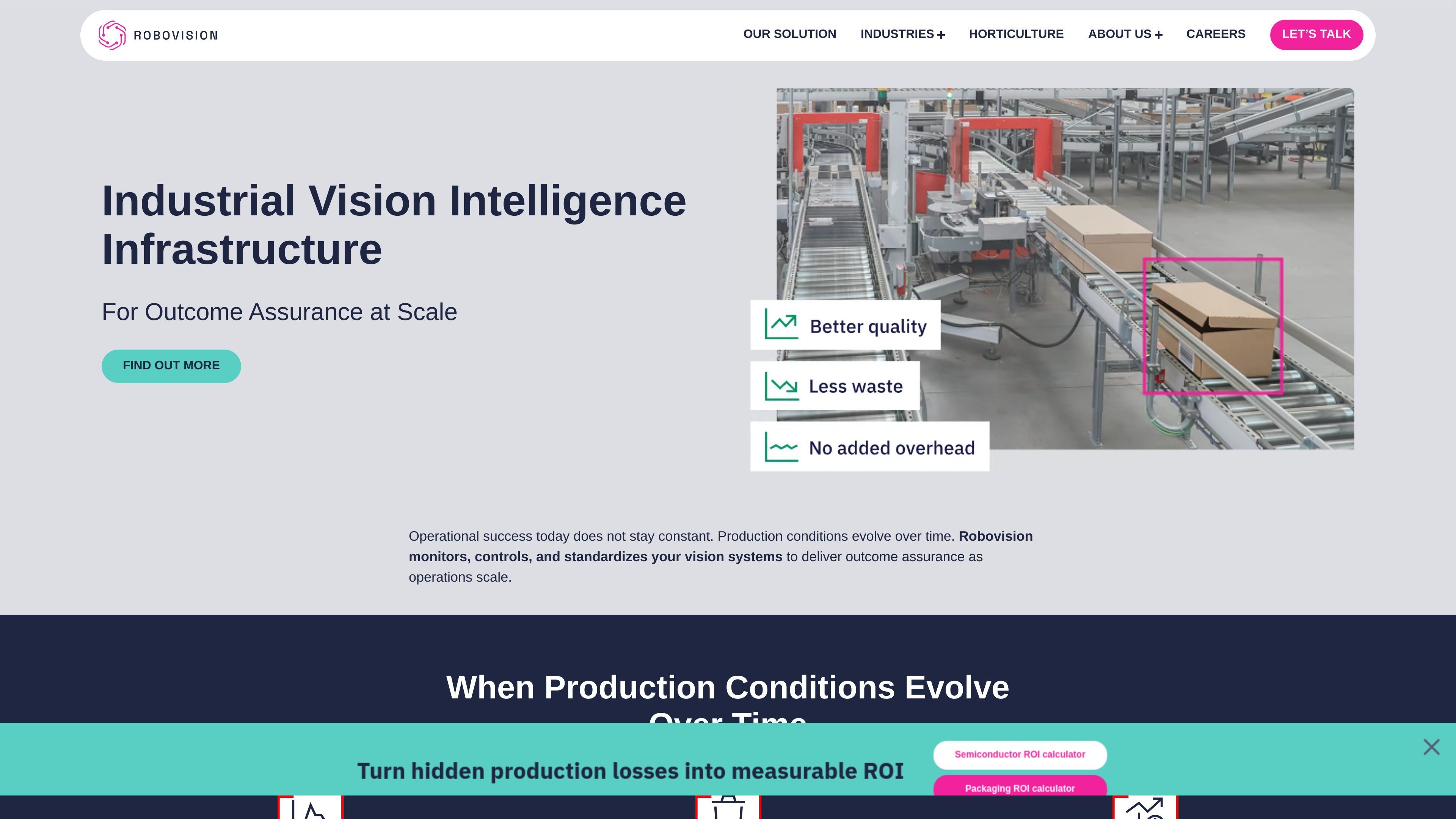
Robovision is Industrial Vision Intelligence Infrastructure for organizations that run vision systems in production environments. The product is positioned to monitor, control, and standardize inspection and automation systems so they remain useful as operating conditions, materials, and production demands change.
The site frames the product as a governed foundation for vision rather than a one-off machine vision tool. Its stated purpose is to reduce waste, limit quality drift, and lower operational overhead by managing vision performance through assessment, governance design, deployment, and support.
Robovision is designed to monitor, control, and standardize vision systems so performance can be managed as production conditions change over time.
The platform frames vision as infrastructure that should be assessed, designed, deployed, and supported through a structured three-stage process.
The site says Robovision standardizes performance across machines, sites, and deployments to limit drift and inconsistent quality as operations scale.
The food page says the system can maintain inspection accuracy as raw ingredients vary across seasons and suppliers, including visual signals such as Brix levels and tissue variation.
The packaging and logistics page emphasizes maintained reliability, compliance, and auditability as materials, regulations, and operating conditions evolve.
Use Robovision to keep inspection systems stable when raw ingredients change across seasons, suppliers, or growing conditions in food and beverage processing.
Use it to reduce false rejects and protect yield when visual quality shifts in living or organic materials create instability on processing lines.
Use it for packaging inspection and identification where material changes, sustainability regulations, and traceability demands can erode predictability.
Use it when a single vision deployment needs to be standardized across multiple machines or sites instead of remaining custom to one line.
Use it to support compliance and auditability requirements where recurring performance evidence matters as much as inspection output.
Robovision is presented as Industrial Vision Intelligence Infrastructure for governing vision systems across their lifecycle. The source describes a three-stage process: assess vision infrastructure readiness, design future-proof governance, and deploy and support.
The site positions Robovision for industrial vision use in packaging, food, semiconductor, healthcare, and horticulture. The detailed pages shown focus on food and beverage processing plus packaging and logistics.
The source describes a value assessment flow rather than self-serve pricing. The pricing page returns a 404, while the assessment page asks users to submit an intake request to initiate the Value Assessment.
The pages emphasize governed infrastructure, lifecycle governance, and standardized performance across machines, sites, and deployments. The exact software integrations or supported systems are not described in the provided source.
Traffic data is for reference only.

reka.ai
Reka is a multimodal AI platform for video, image, audio, and text, supporting visual search, inference, and training-data generation for enterprises, creators, and developers.

www.selfjev.dev
SelfJev is a self-hosted 4B decision model for turning text, images, and questions into typed answers with probabilities. It helps developers run structured classification, routing, review, and policy workflows on infrastructure they control.
thehive.ai
Hive provides APIs for understanding, searching, moderating, and generating text, image, video, and audio content. Developers can use its pre-trained and open-source models for content workflows such as moderation, classification, brand protection, and media generation.

suppixel.ai
Web-based image enhancement and upscaling for sharper, clearer visuals

aiwatermarkremover.io
AI Watermark Remover removes watermarks from photos and videos online.
www.leadjarvis.com
LeadJarvis is an AI-powered event lead capture tool that scans business cards, enriches contact data, and sends personalized follow-ups via WhatsApp and email for faster handoff and CRM-ready records.