
Typed decision outputs
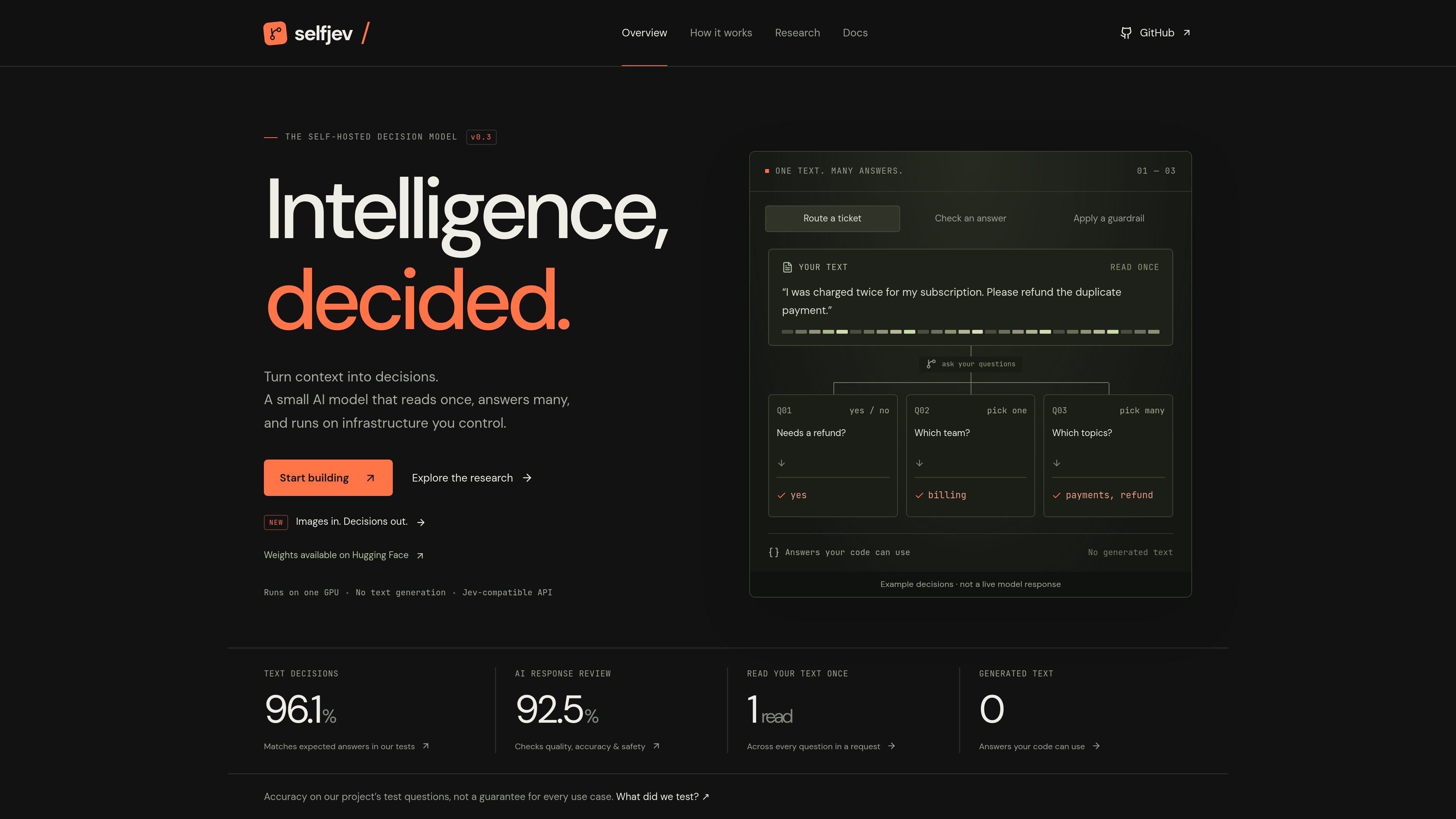
Returns structured answers for yes/no questions, single-choice selection, ratings, and multi-select questions, along with probabilities that application code can use.

SelfJev is a self-hosted 4B decision model for turning text, images, and questions into typed answers with probabilities. It helps developers run structured classification, routing, review, and policy workflows on infrastructure they control.
SelfJev is a self-hosted 4B decision model for applications that need structured choices rather than generated prose. It accepts text, images, or both with a set of questions, then returns typed answers and probabilities. Supported answer formats include yes/no, pick one, rate a result, and select all that apply.
Its shared-prefix inference engine reads the common input once and reuses that work across multiple questions. This makes it suitable for extracting several decisions from one support message, document, AI response, or image. The model runs as an HTTP service on infrastructure controlled by the user, with a Python client available for application integration.
The default release supports vision and text through SelfJev’s native engine. SelfJev also provides fine-tuning tools, public model weights, evaluation datasets, scoring tools, and recorded experiment reports. Published scores are limited to the project’s test suites and should be treated as evidence for evaluation, not a guarantee of performance on new data.
Returns structured answers for yes/no questions, single-choice selection, ratings, and multi-select questions, along with probabilities that application code can use.
Reads a shared text or image input once and branches several questions from that work, supporting multi-question requests without separately processing the same context for every question.
The default SelfJev-4B release accepts images and text through the native tree engine. Images can be provided as paths, bytes, PIL images, or base64 data URLs over HTTP.
Runs on a user-controlled Linux machine with an NVIDIA GPU and exposes an API for applications. The documented setup includes health checks, API-key configuration, and a lightweight client that does not require a GPU.
Supervised fine-tuning tools let users train lightweight adapters on verified examples from their own workflow, including image-based training rows, before evaluating and serving the result.
The project publishes model releases, Decision Bench data, scoring tools, methodology, and recorded experiments so users can inspect how reported results were produced.
Ask whether a customer needs a refund, which team should handle the request, and which topics apply, then pass the resulting fields into routing or workflow automation.
Evaluate an AI-generated answer for quality, accuracy, supporting evidence, safety, or attempts to bypass instructions before it reaches a user or downstream system.
Turn a policy into explicit questions and use the returned choices and probabilities to filter requests, apply controls, or flag cases for human review.
Ask several questions about a photo, such as category or condition, using the same image as shared context. The site documents examples involving pets, clothing, plants, rice, satellite land use, and waste.
Fine-tune an adapter on verified examples containing a team’s labels, policies, vocabulary, or edge cases, then compare results on held-out examples before deployment.
It returns typed answers and probabilities. The documented answer types are yes/no, pick one, rate a result, and select all that apply; it does not generate a conversational text response.
The quickstart calls for a Linux machine with an NVIDIA GPU and recommends starting with 24 GB of VRAM, 4 vCPUs, 16–32 GB of system RAM, and 50 GB of free disk. These figures are planning recommendations, not a tested minimum.
Yes. The default vision-and-text release accepts images through the native engine. The Python client accepts a path, image bytes, or a PIL image; HTTP requests can use a base64 data URL or text and image parts.
SelfJev runs as an HTTP server, and applications can use the lightweight Python client. The quickstart also documents pointing an existing TypeSafe Python SDK installation at the SelfJev server by changing its base URL and API key settings.
Yes. The site documents supervised fine-tuning with verified examples from a workflow, including image training rows. Users are advised to evaluate on held-out examples before serving the adapted model.

reka.ai
Reka is a multimodal AI platform for video, image, audio, and text, supporting visual search, inference, and training-data generation for enterprises, creators, and developers.

aws.amazon.com
Amazon Bedrock is a fully managed AWS platform for building generative AI applications and agents with access to foundation models, customization tools, safety controls, and production-oriented workflows. It supports teams that want to experiment through the console or build applications through AWS APIs and SDKs.

autoloops.ai
Autoloops provides speech infrastructure for voice agents, combining streaming speech-to-text with realtime serving for open-weight language models. It offers serverless APIs and on-demand clusters for teams building or testing realtime voice and agent workloads.

azure.microsoft.com
Microsoft Foundry is an enterprise AI platform for building, grounding, deploying, and governing AI applications and agents. It helps development and data teams connect models, organizational knowledge, business tools, and lifecycle controls in Azure.

www.alibabacloud.com
Alibaba Cloud Model Studio is an enterprise-oriented large-model service and application development platform. It is positioned for organizations and developers building generative AI applications with Alibaba Cloud’s model and AI services.
thehive.ai
Hive provides APIs for understanding, searching, moderating, and generating text, image, video, and audio content. Developers can use its pre-trained and open-source models for content workflows such as moderation, classification, brand protection, and media generation.