
Layout-aware document parsing
Parse reads documents like a human would, preserving layout, structure, reading order, bounding boxes, and confidence scores so downstream systems can reference exact regions on the page.

Reducto is an agentic document platform for parsing, extracting, splitting, classifying, and editing documents via Studio and API workflows at production scale.
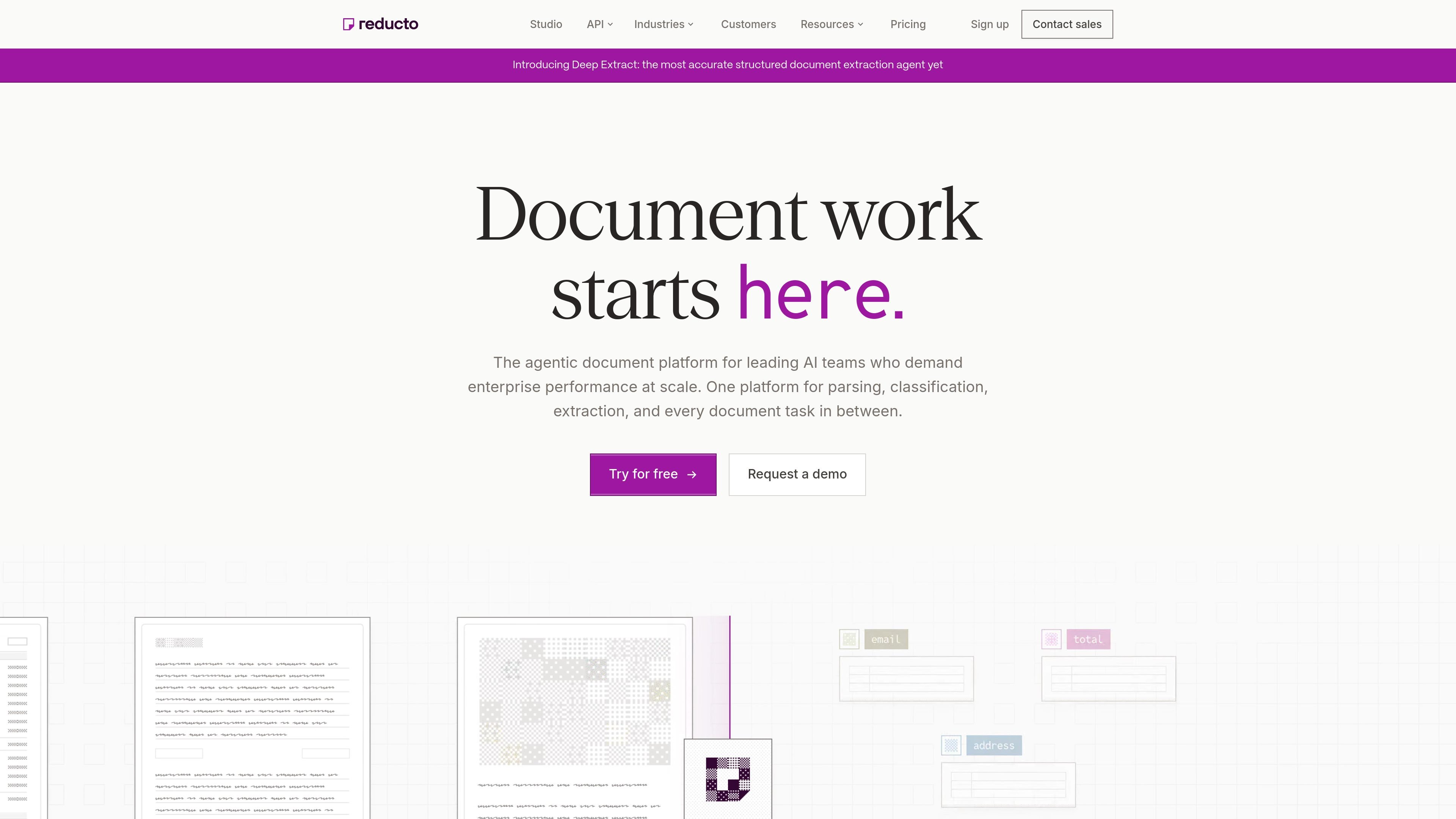
Reducto is an agentic document platform built for teams that need to parse, extract, split, classify, and edit documents at production scale. The product is positioned as a toolkit for document-heavy AI workflows, with Studio and API access for building pipelines around PDFs, scans, spreadsheets, slides, forms, and Office files.
The platform combines layout-aware document understanding with agentic OCR and schema-driven extraction. Its Parse workflow produces structured chunks with bounding boxes and confidence scores, while Extract returns typed JSON for defined fields. Split separates multi-document files into logical units, and Edit writes data back into documents without relying on fixed templates or bounding boxes.
Parse reads documents like a human would, preserving layout, structure, reading order, bounding boxes, and confidence scores so downstream systems can reference exact regions on the page.
Extract returns schema-typed JSON for defined fields, with optional citations on every value and support for both fixed schemas and prompt-based prototyping.
Split identifies section boundaries in long or multi-document files and returns page ranges so each section can be processed separately.
Edit fills detected blanks, tables, and checkboxes or updates DOCX files without requiring bounding boxes or pre-defined templates, then outputs an edited file and reusable form schema.
The platform uses agentic OCR and VLM review to correct issues such as faded scans, unusual fonts, handwriting, misaligned columns, and other edge cases that traditional OCR can miss.
Reducto supports synchronous and asynchronous processing, webhook delivery for batch jobs, and presigned URL uploads for larger files.
Use Parse when you need a structured representation of documents for RAG, document AI agents, or any pipeline that benefits from typed blocks, page positions, and confidence scores.
Use Extract when the output needs to match a fixed schema, such as invoice fields, contract clauses, onboarding records, or financial statement data that downstream code expects in typed JSON.
Use Split to break long files or multi-document packets into logical sections before parsing or extraction, especially when a single upload contains several forms or reports.
Use Edit when a workflow needs data written back into a PDF form or DOCX file, including blank fields, tables, and checkboxes, without hand-building templates.
Use the platform for table-heavy and scan-heavy documents where layout, merged cells, handwriting, faded text, or unusual formatting can make conventional OCR unreliable.
Reducto exposes Parse, Extract, Split, Classify, and Edit workflows through its API and Studio. Parse turns documents into structured chunks with typed blocks and bounding boxes; Extract returns schema-typed JSON; Split separates multi-document files into logical sections; Edit writes data back into documents.
The source describes Reducto as available through the API and Studio, with support for synchronous and asynchronous workflows. Parse also mentions uploading files directly or passing public or presigned URLs, and async jobs can use webhooks.
The pricing page describes credit-based plans with Standard, Growth, and Enterprise tiers. It also notes free credits, up to 5 seats on Reducto Studio for the lower tier, and expanded enterprise options such as VPC or on-prem deployments, custom agreements, and RBAC.
The source explicitly mentions HIPAA, SOC 2 Type II, zero data retention, regional endpoints, VPC and on-prem options, and SSO/SAML on enterprise plans. Those details appear on the pricing and Parse pages, but any compliance requirement should still be confirmed with Reducto directly for a specific deployment.
The product pages say Reducto supports PDFs, images, spreadsheets, Office documents, slides, forms, scans, and long multi-document files. It is aimed at workflows such as RAG, document AI agents, table extraction, invoice processing, and form handling.