
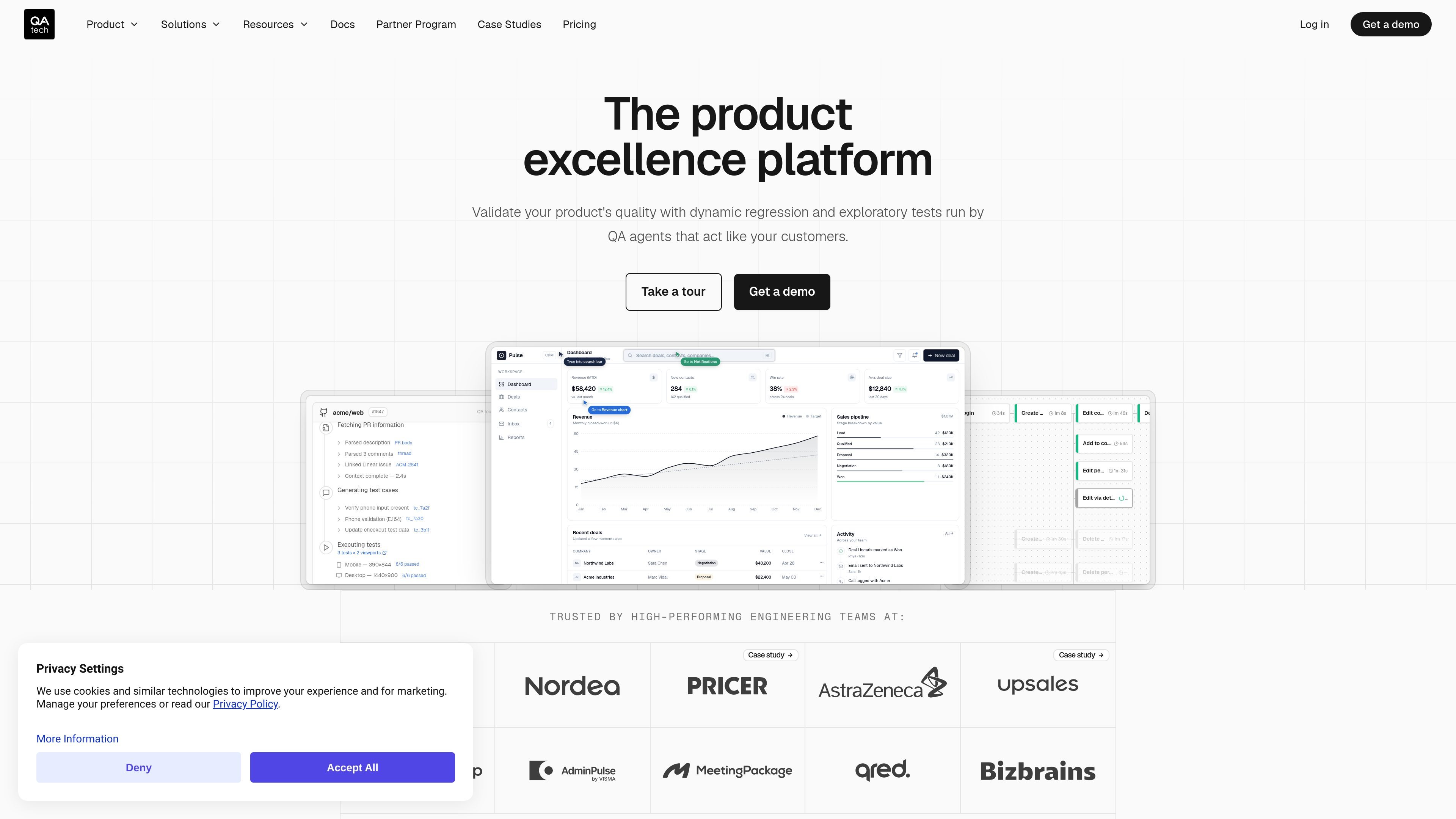
Natural-language test creation
Describe a user journey in plain English and let QA.tech shape it into a test, rather than writing or recording scripts.

AI testing platform for web, pull request, and mobile testing
QA.tech is an autonomous AI testing platform for web applications, pull requests, and mobile apps. It is designed for teams that want to describe test intent in natural language and have agents validate flows across the live product instead of maintaining brittle scripts.
The product page says the agents test by intent and learn the app over repeated runs, so coverage compounds as the product changes. Across the site, QA.tech positions itself for E2E, regression, exploratory, PR, and mobile testing, with cloud execution and outputs that help teams review failures and act on them quickly.
Describe a user journey in plain English and let QA.tech shape it into a test, rather than writing or recording scripts.
Use the same AI testing engine across web apps, pull requests, and mobile, so coverage spans the surfaces teams change most often.
Test against live environments and get a video, step-by-step trace, and network and console activity for each run.
Receive failure tickets in Linear or Jira to move from detection to follow-up without manual handoff.
Run tests in the cloud with no infrastructure setup, and point them at development, staging, production, or configured app builds and URLs.
Use mobile-specific support for iOS and Android, including React Native, Flutter, native apps, APK uploads, TestFlight, and emulator or real-device runs.
Use QA.tech to validate critical customer journeys such as checkout, authentication, subscriptions, dashboards, file uploads, search, and multi-user flows on the live product UI.
Run tests on every PR or merge to catch breaks before staging, using the product’s PR testing and CI/CD-oriented workflow.
Exercise the same flows across iOS and Android, including React Native, Flutter, and native apps, to reduce device-specific surprises before release.
Have the agents return videos, traces, and backend activity, then file Linear or Jira tickets when something fails so teams can triage without reproducing by hand.
Use one platform across development, staging, and production, with configurable app builds, URLs, and environment-specific testing for release confidence.
QA.tech is set up from the outside: the source says agents test your product without reading your code, and the web-testing page says you can describe a flow in plain English and get test scenarios back without framework expertise.
Yes. The product pages say QA.tech supports PR testing and CI/CD workflows, and mobile testing explicitly mentions running tests on every PR or merge for feedback before staging.
The mobile-testing page says QA.tech supports iOS and Android flows, including APK uploads, internal testing builds, and TestFlight distributions.
The pricing page lists Starter, Growth, and Enterprise plans. Starter includes one user and self-serve onboarding, Growth adds collaboration and built-in integrations, and Enterprise adds custom users, SLAs, custom integrations, and contract terms.
The web-testing page says runs return a video, a step-by-step trace, and network and console activity, and failures can open Linear or Jira tickets.
Traffic data is for reference only.

saucelabs.com
Sauce Labs is a continuous testing cloud for web and mobile apps, combining cross-browser and device testing, app distribution, error reporting, visual testing, and AI-assisted workflows.

testim.io
Record application flows, add checks and run end-to-end tests. Testim combines AI-assisted element locators with visual test editing and team workflows for web, mobile and Salesforce testing.

argos-ci.com
Argos is a visual and snapshot testing platform for pull requests. It helps teams and AI agents review changes to pixels, Markdown, JSON, and other files before merge and deployment.

reflect.run
No-code, AI-assisted testing for web, mobile, and APIs.

meticulous.ai
Auto-generated visual browser tests from recorded app interactions, with pull-request review for frontend teams.

qodex.ai
Continuous testing for real scenarios across pull requests and deploys