
Define and capture the playbook
Capture scattered decisions, patterns, and conventions and turn them into a living, versioned engineering playbook.

Packmind is an engineering playbook platform that helps teams turn standards and rules into context, guardrails, and governance for AI coding assistants. It is positioned for teams using tools such as Cursor, Claude, Copilot, and Kiro.
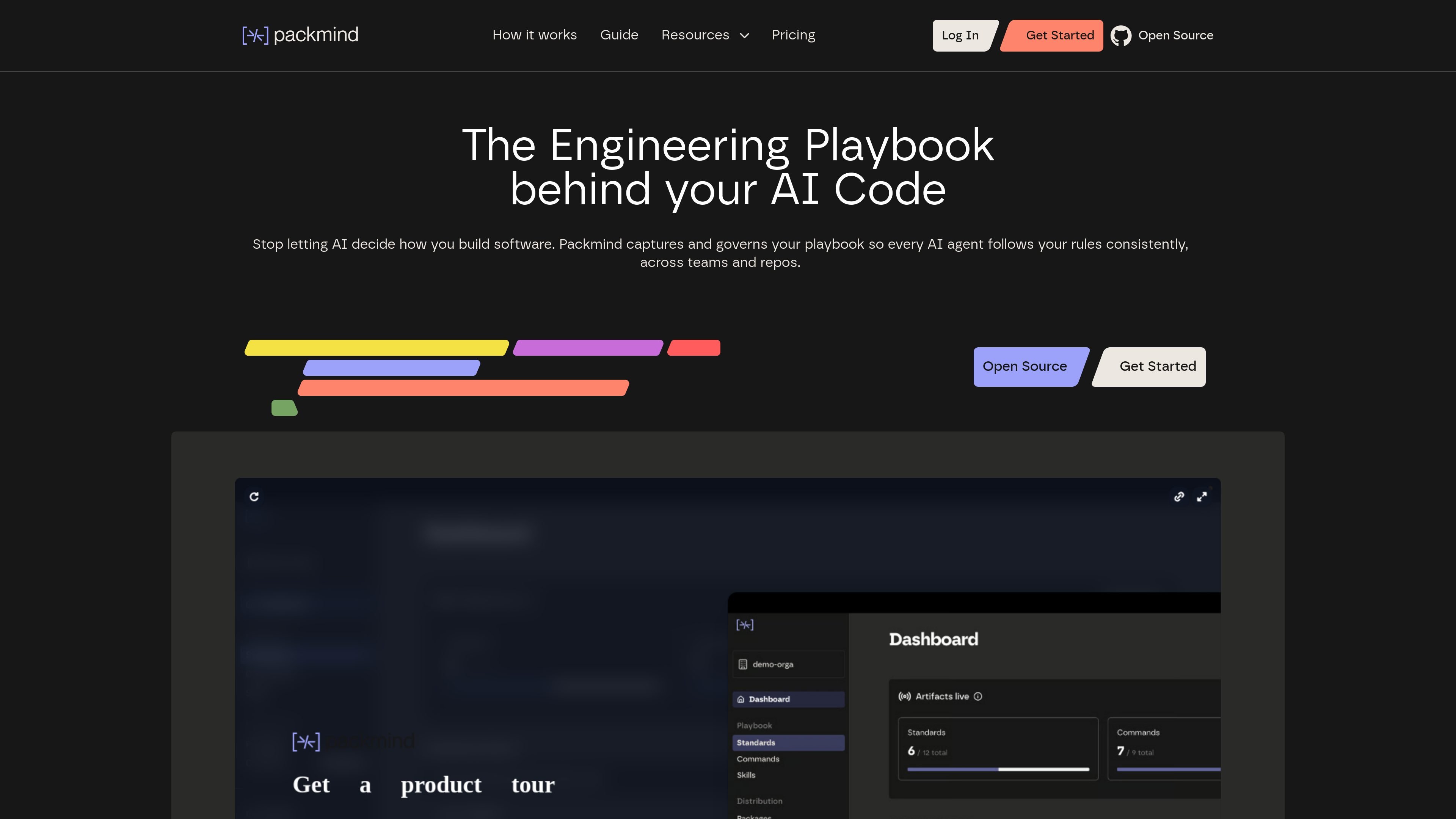
Packmind is an engineering playbook platform for teams that want AI coding assistants to follow their internal standards instead of improvising. It captures decisions, rules, and conventions, then turns them into optimized AI context, guardrails, and governance that can be distributed across repositories and agents.
The product is positioned for teams using tools such as Cursor, Claude, Copilot, and Kiro. Its homepage emphasizes three workflows: defining the playbook, distributing it across repos and AI agents, and governing rollout with visibility into where rules are applied and where drift appears.
Capture scattered decisions, patterns, and conventions and turn them into a living, versioned engineering playbook.
Distribute the playbook across repositories and AI agents so assistants can use the same rules instead of guessing.
Catch violations before they reach commit history and automatically rewrite them to reduce review churn and rework.
Roll out standards and prompts with scopes and drift repair to keep adoption controlled as teams scale.
Provide visibility into where rules are applied so teams can track adoption and detect misalignment.
Extend the workflow around existing AI tools such as Cursor, Claude, Copilot, and Kiro.
Teams can capture coding conventions, architecture choices, and review rules in one place so AI assistants have a shared reference instead of relying on individual memory.
When developers use AI to draft code across multiple repositories, Packmind can distribute the same playbook and reduce drift between repos and assistants.
Teams that want fewer review loops can catch violations before commit and rewrite them automatically, reducing rework before code reaches reviewers.
Engineering leaders can roll out standards gradually, monitor where they are applied, and use drift repair to keep AI-generated code aligned as adoption grows.
Organizations with security or infrastructure constraints can deploy Packmind in the cloud or on-premise, including air-gapped environments mentioned on the site.
Packmind is described as a way to structure and distribute an engineering playbook so AI assistants follow a team’s rules consistently. The homepage says it complements tools such as Copilot, Cursor, Claude Code, and Kiro rather than replacing them.
Yes. The homepage states that Packmind’s core platform is open source and free for structuring and distributing an engineering playbook across unlimited developers and repos. It also says paid editions add enforcement, governance, and enterprise features such as SSO/SCIM and RBAC.
The homepage states that Packmind supports public cloud and on-premise deployment, and also mentions a Kubernetes-ready on-premise option. It also says air-gapped deployment is available if needed.
Packmind’s homepage says it supports all programming languages, and explicitly lists Python, JavaScript, Java, TypeScript, C#, C++, PHP, Ruby, Scala, YAML, and Terraform.
The homepage describes Packmind as a playbook, rules distribution, and governance layer for AI coding. The source does not provide pricing details, and the pricing page currently returns a 404.