
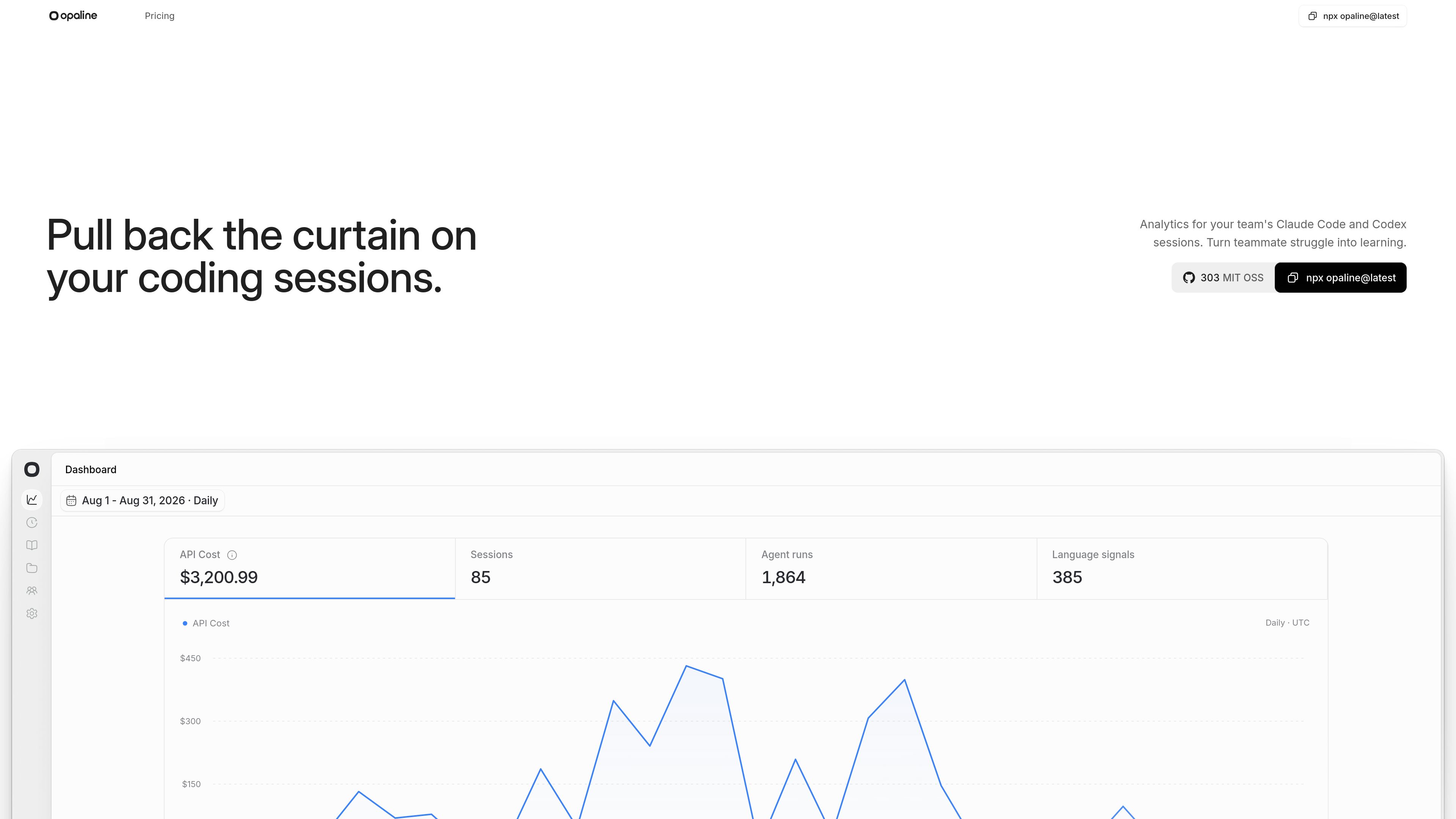
Organization-level coding-agent analytics
See coding-agent adoption, activity, token volume, and estimated spend across the organization.

Opaline provides team-wide analytics for Claude Code and Codex sessions, tracking token costs, time, and skill usage at the message level. Teams can review organization-wide activity and detailed session traces to understand coding-agent adoption and usage patterns.
Opaline is an analytics product for teams using coding agents, with documented support for Claude Code and Codex. It records message-level session activity so teams can examine token volume, estimated spend, time, and skill usage rather than relying only on aggregate usage totals.
The product combines organization-level reporting with a detailed session trace viewer. Teams can inspect prompts, responses, tool calls, commands, and subagent activity, while paid Business functionality adds analysis of recurring patterns, blockers, failures, and opportunities across sessions.
See coding-agent adoption, activity, token volume, and estimated spend across the organization.
Review token cost, time, and skill usage for individual messages across team sessions.
Inspect the full timeline of prompts, responses, tool calls, commands, and subagent activity for each session.
On the Business plan, Opaline surfaces recurring patterns, blockers, failures, and opportunities across an organization’s agent sessions.
The Business plan includes a weekly digest covering agent adoption, performance changes, notable sessions, and team trends.
Engineering or technical leaders can use organization-level analytics to see how coding-agent activity and adoption develop across their teams.
Teams can examine token volume, estimated spend, time, and message-level usage when they need more detail than a high-level usage summary provides.
A session trace gives users a chronological view of prompts, responses, tool calls, commands, and subagent activity for investigating a specific session.
Business-plan users can use Advanced Session Intelligence to look for repeated blockers, failures, and opportunities across their organization’s sessions.
Business-plan users can use the weekly digest to review adoption, performance changes, notable sessions, and broader team trends.
The homepage specifically mentions Claude Code and Codex. The available product materials do not document additional supported agents.
Opaline’s deep session trace viewer covers the timeline of prompts, responses, tool calls, commands, and subagent activity. The homepage also describes tracking token cost, time, and skill usage for each message.
Yes. The pricing page lists a Free plan at $0, with up to three workspace members and up to 50,000 agent runs per workspace each month.
The pricing page lists Basic at $21 per member per month and Business at $42 per member per month, both billed yearly. Basic and Business are shown with unlimited workspace members and unlimited agent runs.
The pricing comparison lists Advanced Session Intelligence and weekly agent reports as unavailable on Free and Basic and included on Business. It also lists organization-level analytics and the deep session trace viewer as included on all three displayed plans.
Traffic data is for reference only.

www.kodwai.com
Coding challenges that score how developers guide Claude Code, Cursor, or Codex.

devglobe.app
An open-source coding activity tracker and developer directory with a real-time globe.

mobilebuilds.app
Mobile Builds is a native app for iPhone, iPad, Mac, and Apple Vision Pro that lets Apple-platform developers monitor and manage Xcode Cloud runs. It provides run status and history, build controls, workflow editing, and optional access for Xcode and Claude Code through a local read-only MCP server.

termphin.dev
Termphin is an Android SSH client for connecting to existing servers, with persistent remote sessions that can be resumed after network drops or a locked phone. It combines terminal access with SFTP, SSH keys, port forwarding, snippets, and support for AI coding-agent workflows.

plugintracker.dev
PluginTracker helps WordPress.org plugin authors monitor daily install estimates, rankings, reviews, support activity, competitors, and opt-in telemetry in one dashboard. It combines directory-based tracking with an optional SDK for site-level environment and deactivation data.

webdecoy.dev
WebDecoy monitors automated traffic reaching a Vercel site or app, identifying crawlers, AI bots, tools, and requests without a user agent. It verifies published IP ranges or signed requests, flags forged well-known user agents, and reports activity without changing application code on supported Vercel plans.