
Centralize vendor context
Aggregate vendor information from procurement systems, shared AP inboxes, contracts, journal entries, Slack, and Teams so accrual work starts from one consolidated view.

Mesh is a finance automation product for mid- to enterprise teams to replace manual accrual spreadsheets with repeatable, auditable workflows.
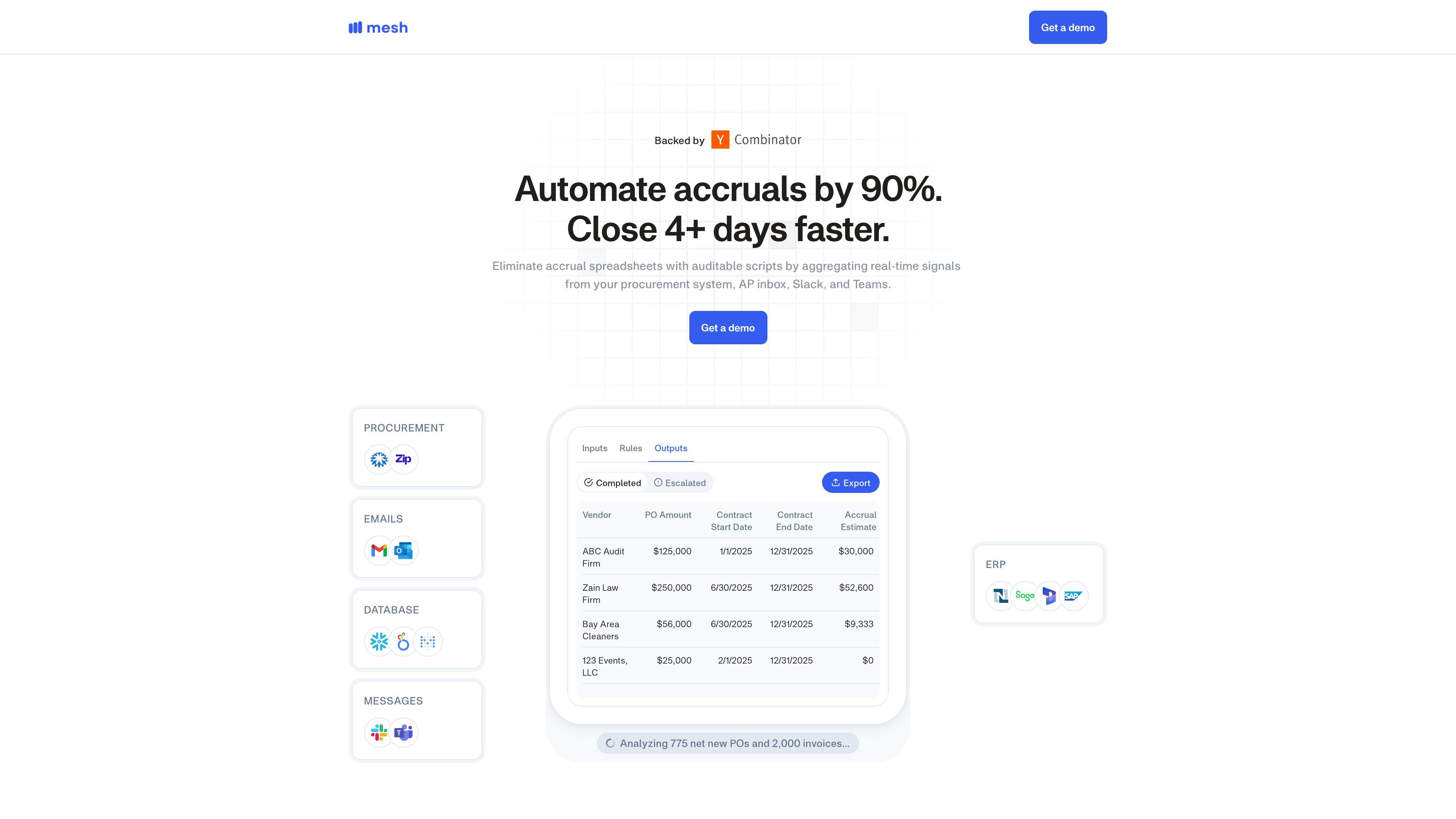
Mesh is a finance workflow product for eliminating manual accrual spreadsheets. It is presented as a way to automate accruals by using real-time usage and service signals across systems, then applying accounting logic consistently month after month.
The site positions Mesh for mid-to-enterprise finance teams that need to close faster with less manual reconciliation. Its workflow centers on centralizing vendor context, encoding accounting judgment, flagging exceptions for review, and preserving an audit trail for every number.
Aggregate vendor information from procurement systems, shared AP inboxes, contracts, journal entries, Slack, and Teams so accrual work starts from one consolidated view.
Turn accounting rules into reusable logic that Mesh applies consistently from one close cycle to the next.
Flag missing assumptions, material period-over-period changes, and other items that need a person’s review instead of requiring manual inspection of every line.
Explain how each number was produced with embedded formulas and evidence, while tracking who changed what and when.
Save user overrides and use them to train the agent over time so the workflow can incorporate accountant feedback.
Support uploads such as purchase orders and invoices as part of the accrual workflow shown on the site.
Finance teams can replace month-end spreadsheet work with a process that aggregates vendor context, applies repeatable logic, and outputs accrual estimates for review.
When invoices arrive late or in batches, the team can use procurement, AP, and contract signals to identify vendors that still need to be accrued.
Teams that manage complex vendor terms can encode policy once and reuse it across recurring accrual and prepaid decisions.
Controllers and accountants can focus on exceptions such as missing assumptions or material changes instead of manually checking every line item.
Finance teams can keep an auditable record of inputs, formulas, overrides, and rule changes for close review and follow-up.
Mesh is built to automate accrual workflows for mid-to-enterprise finance teams by turning manual accounting logic into repeatable scripts and reviewing only flagged exceptions.
The site shows Mesh working from procurement systems, shared AP inboxes, contracts, journal entries, Slack, and Teams to consolidate vendor context and estimate accruals.
The product emphasizes auditable scripts, embedded formulas and evidence, version-controlled rule sets, and tracked user overrides so teams can review how each number was produced.
The source does not provide pricing details. The pricing URL currently returns a page-not-found response.