MarsX logo

MarsX

Claim

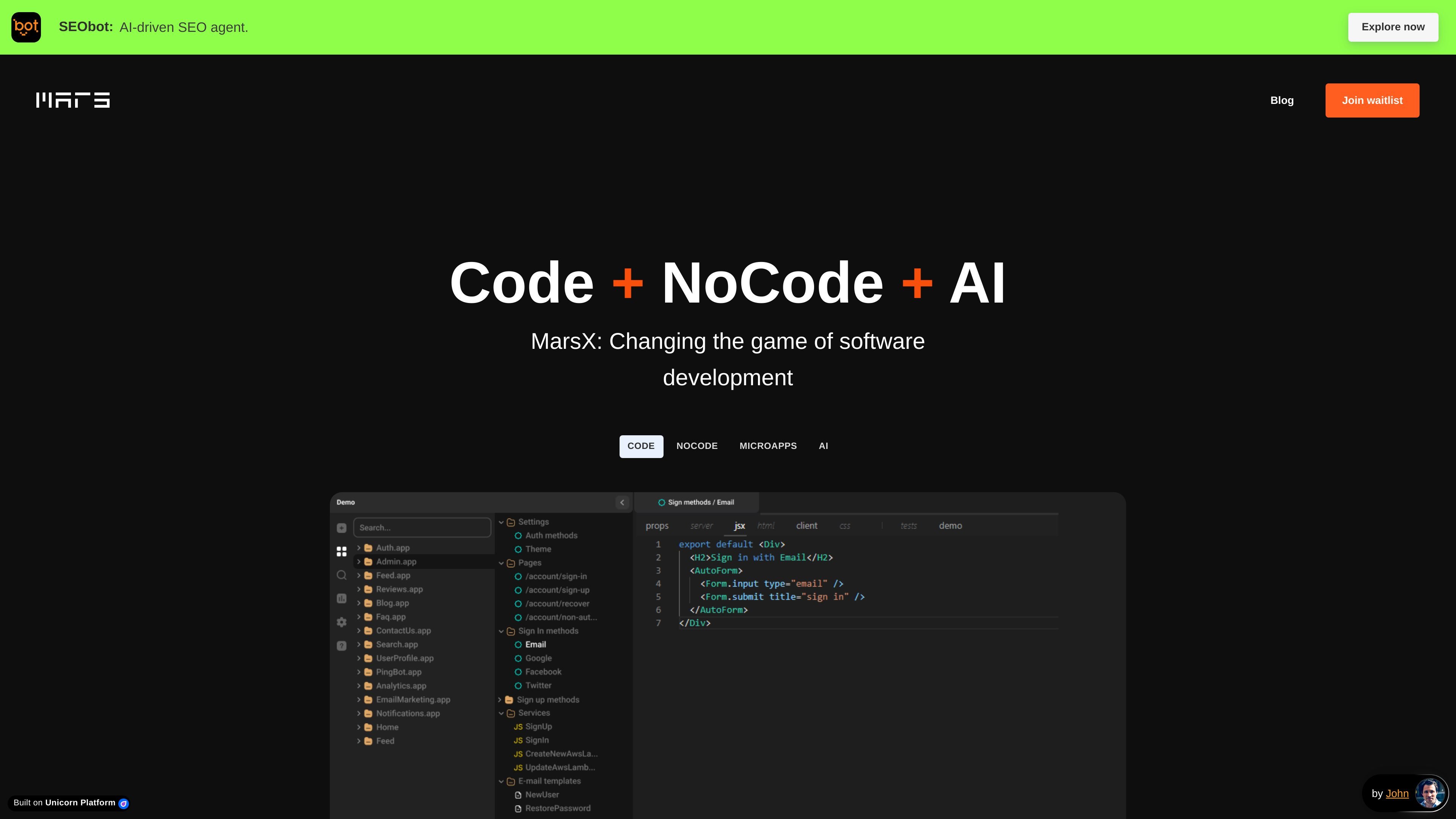
MarsX is a development platform for building SaaS tools and micro-app-based products with a no-code-to-code workflow. It supports self-hosting, an open-source engine, and audience-specific options for startups, dev shops, and accelerators.

MarsX preview

What MarsX is

MarsX is a development platform that combines AI, no-code, code, and micro-apps for building SaaS products and other software faster. The home page positions it as a dev tool for creating applications from reusable micro-apps, with examples such as marketplaces, social networks, streaming portals, and app builders.

The platform is designed to let teams start with no-code for supported app modules and switch to code when they need custom behavior. Its pricing and audience pages also describe Mars as a cross-platform development server with open-source components, self-hosting options, and support services for startups, dev shops, and accelerators.

Key capabilities

No-code to code workflow

Build with no-code for supported micro-apps, then move into the full code IDE when a project needs custom logic. The source says you can mix no-code and code work in the same project without discarding what you already built.

Full-stack project foundation

The platform is described as combining server, client, and database in one cross-platform development server, with content management, administration, dashboards, email marketing, push notifications, and localization included in the startup package.

Micro-app templates and patterns

The home page lists ready-made micro-app patterns such as NFT marketplaces, Uber-like apps, social networks, no-code builders, collections, peer-to-peer marketplaces, video portals, and photo-sharing apps.

Open-source deployment options

The site states that Mars engine and micro-apps are open source, and that projects can be deployed on your own server or local machine as well as through Mars cloud hosting.

Team workflow and marketplace support

For dev shops, Mars emphasizes using programming only where needed, reducing maintenance because micro-apps are maintained by their creators, and finding extra developers through Mars Marketplace if a team needs help.

Common use cases

  • Startup MVP development

    Use the platform to assemble an MVP from existing micro-apps, then add custom logic in code only where the product needs something unique.

  • SaaS and marketplace apps

    Build marketplaces, social apps, and other repeatable product patterns with reusable modules instead of starting from a blank stack.

  • Hybrid product builds

    Use the no-code path for routine parts of a project and bring in code for advanced requirements without discarding earlier work.

  • Agency delivery workflows

    For agencies and dev shops, delegate supported app parts to micro-apps, keep engineers focused on custom work, and use Mars Marketplace when extra help is needed.

  • Accelerator programs

    Accelerators can use the documented perk program to give portfolio startups platform access, hosting, credits, and access to Mars Academy resources.

Pros and Cons

Pros

  • Combines no-code and code in one workflow, which helps teams extend projects without starting over.
  • Includes many reusable micro-app patterns for common SaaS and marketplace use cases.
  • Supports self-hosting on your own server, local machine, or closed network.
  • States that the core engine is open source under Apache 2.0.
  • Offers audience-specific support paths for startups, dev shops, and accelerators.
Cons

  • The no-code layer is limited to the scope of existing micro-apps, so fully custom builds still require code.
  • The source mentions third-party micro-apps and marketplace services, so the exact scope of included tools can vary by project.

FAQ

Is Mars no-code or code?

Mars is positioned as a dev tool rather than a pure no-code builder. It supports no-code building for existing micro-apps, and users can switch to a code interface when they need custom logic or changes to the platform itself.

Is Mars open source and self-hostable?

The source says the Mars engine is open-sourced under the Apache 2.0 license. It also says you can run Mars on your own servers, on a local machine, or in a closed network, which reduces vendor lock-in.

What pricing options are documented?

The pricing page shows a free Startup package for startups at MVP and full-scale complexity stages, plus an Enterprise option with custom pricing and dedicated support.

Can teams get outside help through Mars?

Yes. The dev-shops page says Mars Marketplace can help teams find dedicated developers, designers, and other startup experts when they need additional help.

Does Mars offer accelerator perks?

Yes. The startup-accelerators page says Mars includes perks such as free platform usage for 12 months, free hosting for development and MVP projects, micro-app credits, dev-market credits, and access to Mars Academy courses.

Quick Facts

Category
Developer Tool
Platform
Web-based development platform
Primary use
Build SaaS tools and micro-app-based applications
Deployment
Self-hosted, local, or Mars cloud
Open source
Yes, for the Mars engine
Pricing
Free startup tier; enterprise quote available