
Long-context Kimi K3 model
Kimi K3 provides a 1M-token context window and native visual understanding for large codebases, extensive documents, and complex reasoning workflows.

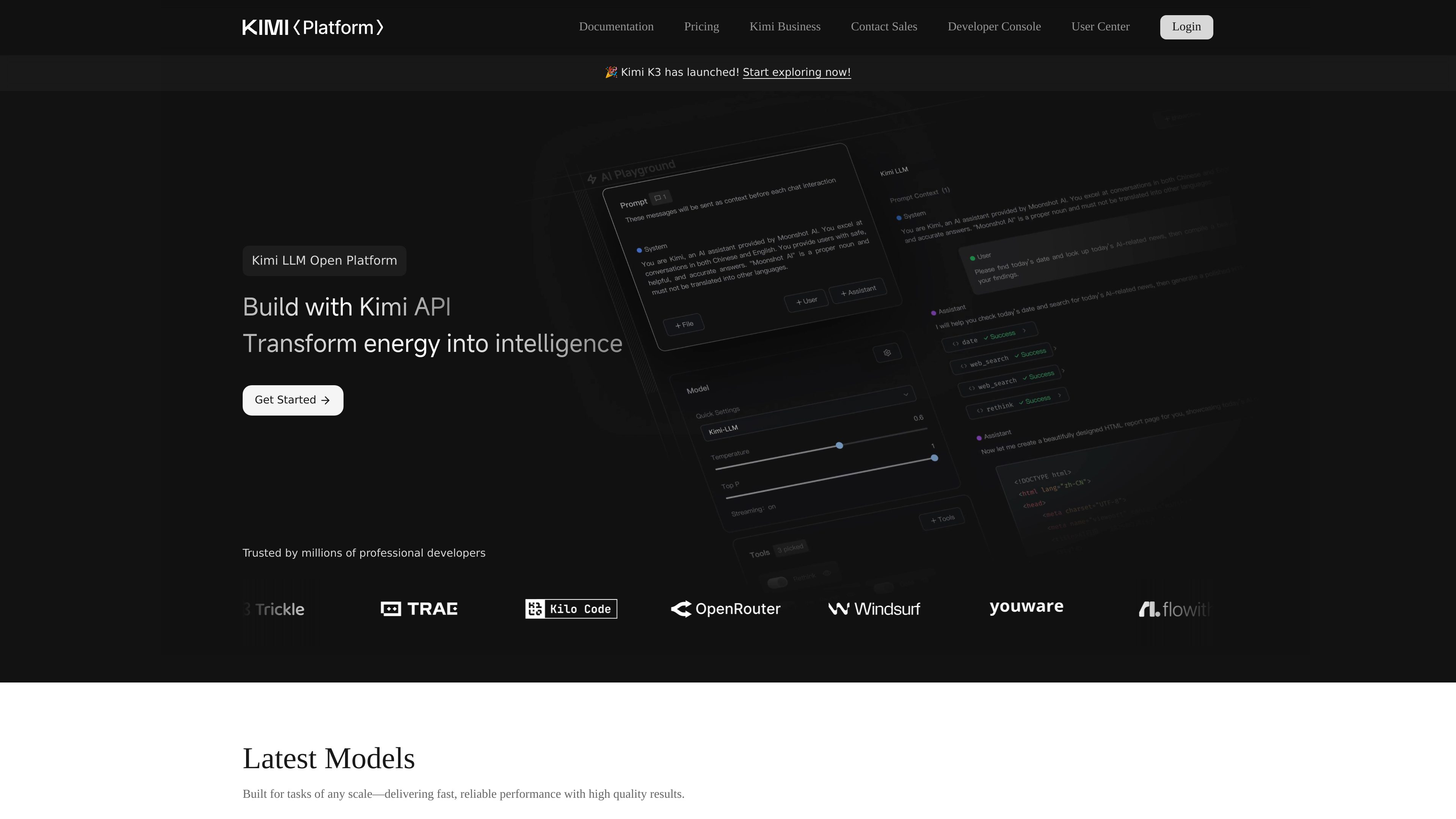
Kimi API Platform gives developers API access to Kimi language models for software engineering, dialogue, visual understanding, reasoning, and tool-using applications. It includes models with context windows up to 1M tokens and usage-based token billing.
Kimi API Platform is a developer API platform for integrating Kimi language models into AI applications. The available models support software engineering, long-context reasoning, dialogue, visual understanding, and agent-oriented workflows.
Kimi K3 is the flagship model, with 2.8 trillion parameters, native visual understanding, and a 1M-token context window. The platform also provides Kimi K2.7 Code and its High-Speed variant for coding, plus Kimi K2.6 for visual and text input, dialogue, and agent tasks. Developers can select a model based on the context length, modality, and workflow required.
Kimi K3 provides a 1M-token context window and native visual understanding for large codebases, extensive documents, and complex reasoning workflows.
Kimi K2.7 Code is designed for coding tasks and long-context instruction following. The K2.7 Code High-Speed variant is listed with output speed of approximately 180 tokens per second, reaching up to 260 tokens per second in short-context scenarios.
Kimi K2.6 supports both visual and text input, along with thinking and non-thinking modes for dialogue and agent tasks.
The platform lists tools for web search, persistent memory, Excel and CSV analysis, Python execution, JavaScript execution through QuickJS, URL extraction, date and time processing, unit conversion, and Base64 encoding and decoding.
Inference is billed by tokens, with separate input and output charges. K3 also has separate cache-write pricing by TTL and a cached-input price for repeated request prefixes.
Use Kimi K3 or Kimi K2.7 Code for code generation, debugging, refactoring, automated testing, and multi-step development workflows across large codebases.
Combine long-context reasoning with tools such as web search and multi-step tool calling for strategic research, competitive or pricing analysis, and financial research workflows.
Process contracts, patents, and other high-stakes documents where terminology, detailed reading, structured analysis, and drafting are important.
Analyze unstructured conversation data for tasks such as customer-intent detection, key-information extraction, public-opinion monitoring, and quality assessment.
Use visual and text understanding to extract information from charts, formulas, research literature, and other technical materials.
The model list includes kimi-k3, kimi-k2.7-code, kimi-k2.7-code-highspeed, and kimi-k2.6. The documentation also identifies several older models as deprecated.
Kimi K3 has a 1,048,576-token context window. Kimi K2.7 Code, Kimi K2.7 Code High-Speed, and Kimi K2.6 are listed with 262,144-token context windows where specified by the pricing or model documentation.
Input and output tokens are billed separately. K3 additionally charges for cache writes according to a 5-minute or 1-hour TTL, while repeated prefixes that hit the cache use the cached-input price without another cache-write charge. Prices are stated per 1 million tokens and exclude applicable taxes.
Yes. The platform lists official tools including web search, memory, Excel analysis, Python and JavaScript execution, URL fetching and extraction, date processing, unit conversion, and Base64 encoding and decoding.
Kimi K3 is positioned for frontier intelligence tasks such as software engineering, knowledge work, and deep reasoning. Kimi K2.7 Code is dedicated to coding, while Kimi K2.6 supports visual and text input, dialogue, and agent tasks.

platform.deepseek.com
DeepSeek Platform provides access to DeepSeek AI models, API documentation, and developer resources through an online API platform. It is intended for users who want to sign up or log in to use DeepSeek’s platform services.

aistudio.google.com
Google AI Studio is a browser-based development environment for experimenting with Google’s generative models and moving prompts into applications through the Gemini API. It supports developers building text, image, video, audio, and agent experiences.
aimlapi.com
AIMLAPI provides one API and billing key for accessing a catalog of AI models for chat, reasoning, image, video, audio, voice, search, embeddings, code, and related tasks. It is intended for developers and teams that want to compare and use models from multiple providers through a common platform.

cloud.sambanova.ai
SambaNova Cloud is an AI inference platform that provides API access to open-source language and vision models. Developers can use its OpenAI-compatible API, playground, and model catalog to build and test AI-powered applications.

www.ibm.com
IBM watsonx.ai is an enterprise AI development studio for building predictive, prescriptive, and generative AI solutions. It supports AI builders, data scientists, and developers across model development, customization, retrieval-augmented generation, deployment, and lifecycle management.

platform.openai.com
OpenAI Platform is a developer platform for building applications with the OpenAI API. It provides API access, model and pricing information, technical documentation, starter apps, and cookbooks for implementation guidance.