
Pre-built bioprocess integrations
Connect bioreactors, historians, ELNs, LIMS, analytical instruments, MES, and enterprise data stores into one harmonized layer so scientists can query data from the systems they already use.

Invert is a bioprocess infrastructure and intelligence platform for development and manufacturing teams. It connects equipment and data sources for live monitoring, summaries, lineage analysis, and reporting.
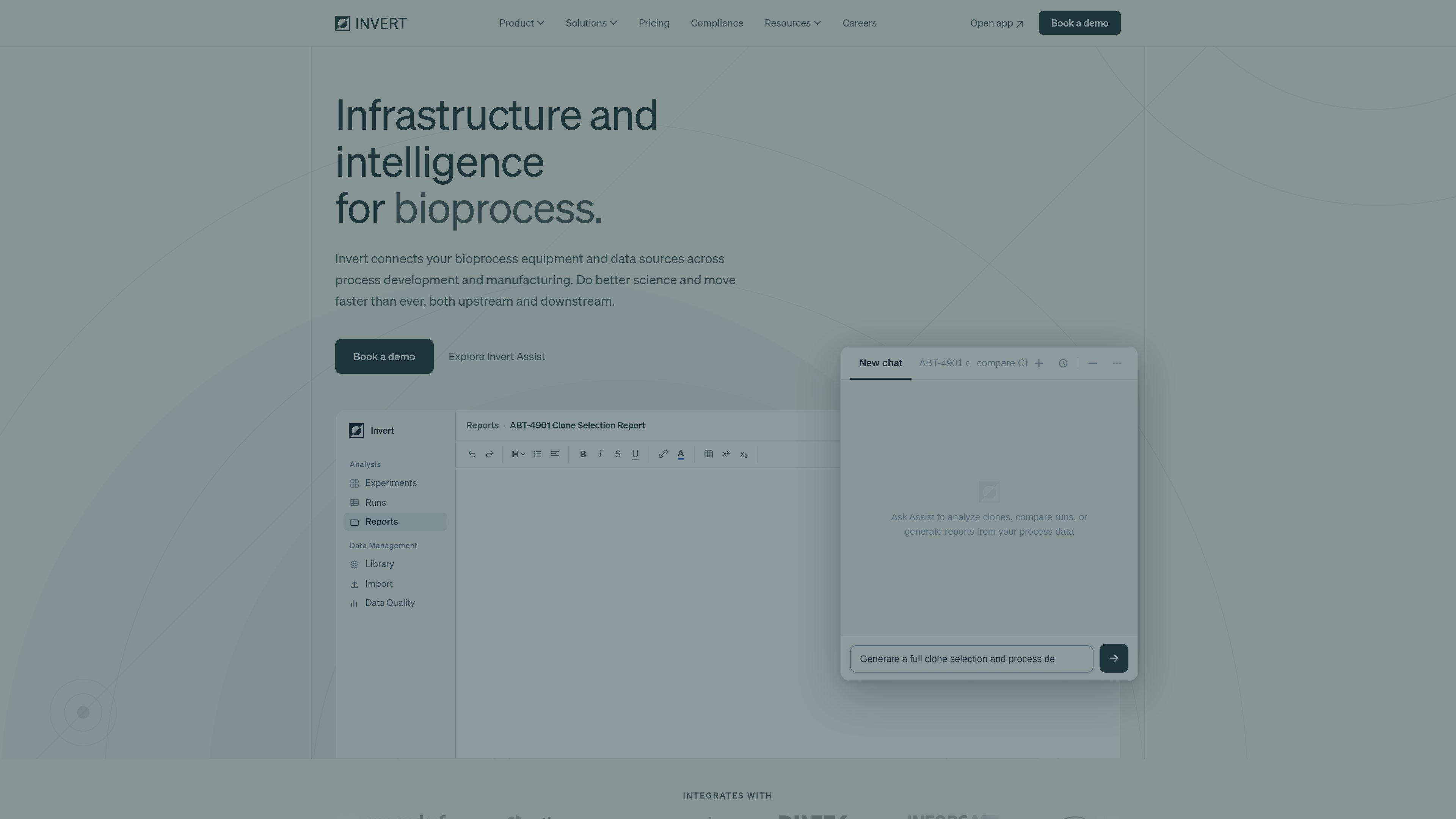
Invert is an infrastructure and intelligence platform for bioprocess development and manufacturing. It connects bioprocess equipment and data sources, then organizes the resulting data into a run-centric layer that teams can use for monitoring, analysis, lineage tracking, and reporting.
The site presents the product as a fit for biopharma, synthetic biology, and CDMO teams that work across upstream and downstream operations. Its main purpose is to reduce manual data handling, preserve run context, and help teams see deviations, process behavior, and historical learnings in one place.
Connect bioreactors, historians, ELNs, LIMS, analytical instruments, MES, and enterprise data stores into one harmonized layer so scientists can query data from the systems they already use.
Attach time-series and offline data to the correct run automatically, preserving timestamps and run context so users do not have to rebuild context from spreadsheets or folders.
Monitor live runs against historical baselines with model-based alerts for drift, missing samples, and unusual behavior while a batch is still in progress.
Summarize each run with intent, outcome, key parameters, and flagged deviations, making it easier to review experiments without re-reading protocols or chasing the original operator.
Visualize product and material streams through splits, pools, and unit operations, then calculate step yields using bioprocess-native formulas.
Create living reports that combine raw data, calculated metrics, and interactive analysis blocks, with options to lock and share the report with colleagues or external stakeholders.
Track live bioreactor or downstream runs against historical baselines so operators can spot drift, missing samples, or other deviations before the batch ends.
Review completed experiments with intent, outcome, key parameters, and flagged deviations in a single summary instead of piecing together notes from multiple systems.
Search a six-month-old run by molecule, scale, condition, operator, or date, then pull the full context without digging through drives or asking around.
Compare upstream and downstream unit operations with process and material lineage views to see where product was lost and how yields changed across steps.
Build shareable reports that combine raw data, charts, and interactive analyses for internal review, CDMOs, or regulated reporting workflows.
Invert uses a run-centric data model to attach online time-series data and offline samples to the correct run, then makes that context available for monitoring, summaries, and reporting. The source pages describe it as an analytical and reporting layer rather than a batch-record execution system.
The product pages show live run monitoring, run summaries, a searchable run directory, process lineage views, step-yield calculations, and interactive reports with Python-mediated analysis. These capabilities are presented across the Enablement and Intelligence pages.
The pricing flow asks teams to choose development lab, pilot plant, or manufacturing facility, along with the systems and modalities they plan to connect. The home and product pages position the platform for development and manufacturing teams in biopharma, synthetic biology, and CDMOs.
The integrations page says many pre-built connections go live in hours, with most pre-built connections live within 1–2 hours. It also notes support for OPC-UA, OPC-DA, SFTP, REST APIs, JDBC, and file upload.
The integrations page says Invert ingests and analyzes data, but does not execute batch records or control processes. It also notes that this limits validation scope compared with systems that control operations.