
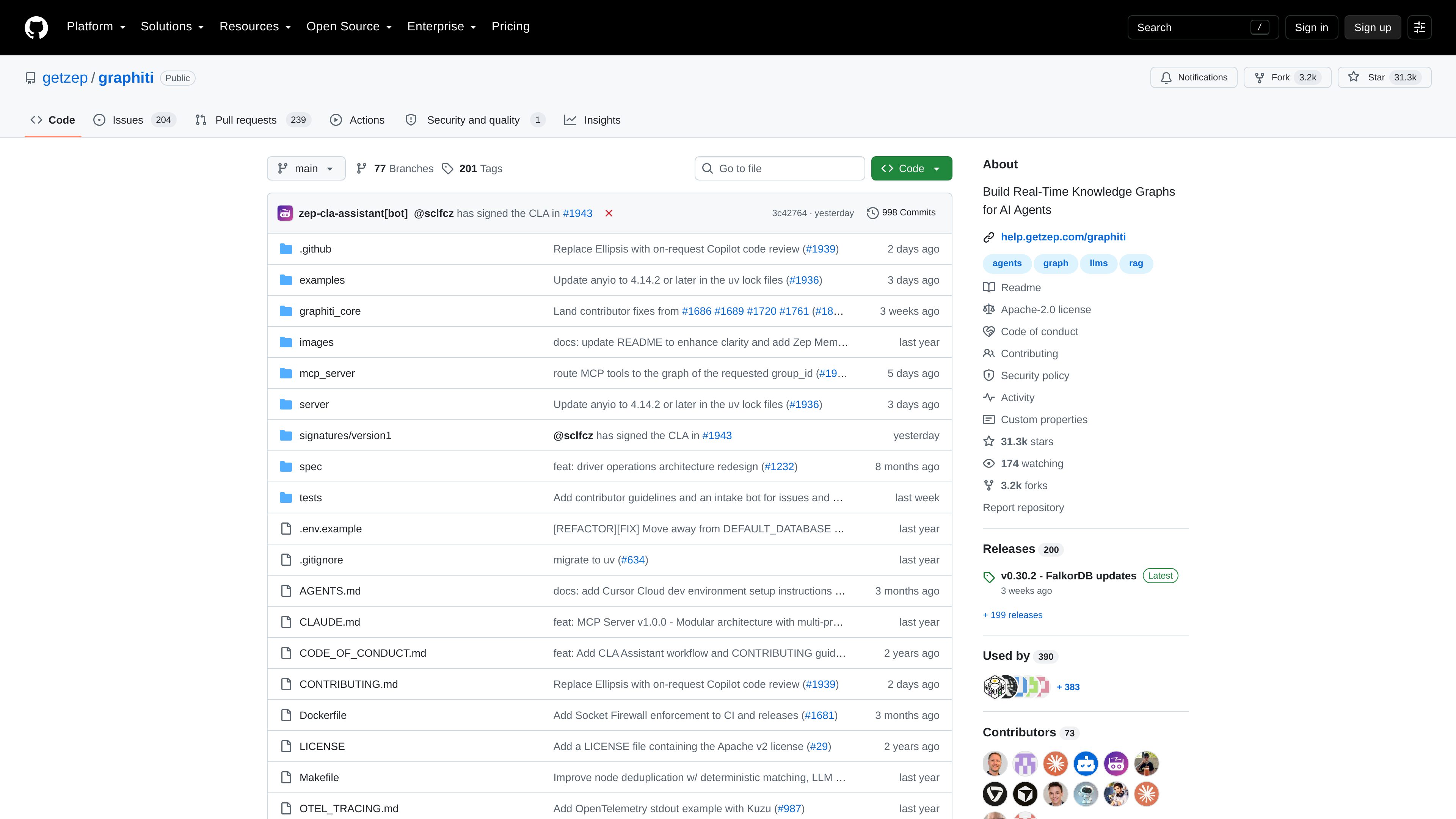
Real-time knowledge graph focus
The project is explicitly designed around knowledge graphs for AI agents, providing a codebase for developers investigating graph-based agent context.

Graphiti is an open-source GitHub project for building real-time knowledge graphs for AI agents. It provides a codebase that developers can inspect, extend, and contribute to through the repository’s development workflow.
Graphiti is an open-source GitHub project from getzep focused on building real-time knowledge graphs for AI agents. It is presented as developer infrastructure rather than a hosted application: users work with the repository, inspect its implementation, and adapt or contribute to the code. The visible project structure includes graphiti_core, examples, server, and mcp_server directories, but the supplied evidence does not establish the full set of supported integrations, deployment models, or runtime requirements.
The project is explicitly designed around knowledge graphs for AI agents, providing a codebase for developers investigating graph-based agent context.
Graphiti is publicly hosted on GitHub, where developers can inspect the source, repository history, branches, and project files.
The repository visibly includes `graphiti_core`, `examples`, `server`, and `mcp_server` directories, separating core code from examples and server-related components.
GitHub provides issue and pull request tracking for the project, supporting discussion, bug reports, review, and collaborative changes.
The repository shows ongoing commits and contributor activity, giving evaluators a current development history to review before adopting the project.
AI engineers can inspect the public repository to determine whether Graphiti’s approach fits an agent system that needs knowledge-graph-oriented context.
Developers can use the repository’s visible examples and implementation areas as a starting point for technical experiments, subject to confirming the current setup documentation.
Engineering teams can review source changes, discuss issues, and propose modifications through GitHub pull requests and repository collaboration tools.
Technical evaluators can examine commits, branches, issues, and pull requests to understand project activity and identify questions about compatibility, operations, and support.
Graphiti is a public GitHub project from getzep focused on building real-time knowledge graphs for AI agents.
The available evidence presents Graphiti as a code repository rather than documenting a hosted end-user service. Deployment and hosting details should be confirmed in the current project documentation.
Developers can inspect the public repository, use GitHub issues for discussion or reports, and submit changes through pull requests.
The supplied evidence does not provide a verified list of integrations. Review the current repository documentation and configuration before selecting it for a particular stack.
No Graphiti-specific pricing is established in the available source. The referenced GitHub pricing page describes GitHub plans, not Graphiti.

www.pipecat.ai
Pipecat is an open-source Python framework and ecosystem for building real-time voice and multimodal AI agents. It helps developers compose pipelines that coordinate speech, language, vision, video, text, tools, and telephony transports.

dspy.ai
DSPy is an open-source framework for programming language-model applications instead of manually prompting them. Its public repository provides the project code, documentation, tests, issue tracking, and contribution workflow.

getbb.app
bb is a local-first, open-source IDE for running coding agents in parallel, organizing their work in threads, and extending the workspace with plugins. It is designed for developers and teams that want to coordinate provider-based agents and customize their software workflow.

opentrade.io
OpenTrade is an open-source trading harness for Claude Code and Codex agents. It provides a repository-based app, agent templates, and scheduling-oriented run management for automated trading workflows.

veecle.ai
Chiplab is an MCP platform that lets AI coding agents run firmware against virtual instances of target chips instead of waiting for physical hardware. It provides chip-aware execution and searchable embedded-development knowledge through a single endpoint.

steel.dev
Steel is open-source browser infrastructure for AI agents and web automation. It provides cloud browser sessions through an API, with support for common browser automation tools and workflows such as scraping, research, RPA, and agent-driven web tasks.