
Unified schema composition
Compose services, databases, and APIs into a single federated graph so teams can manage multiple backends through one API layer.

GraphQL API management for federated graphs, governance, observability, and self-hosted deployment.
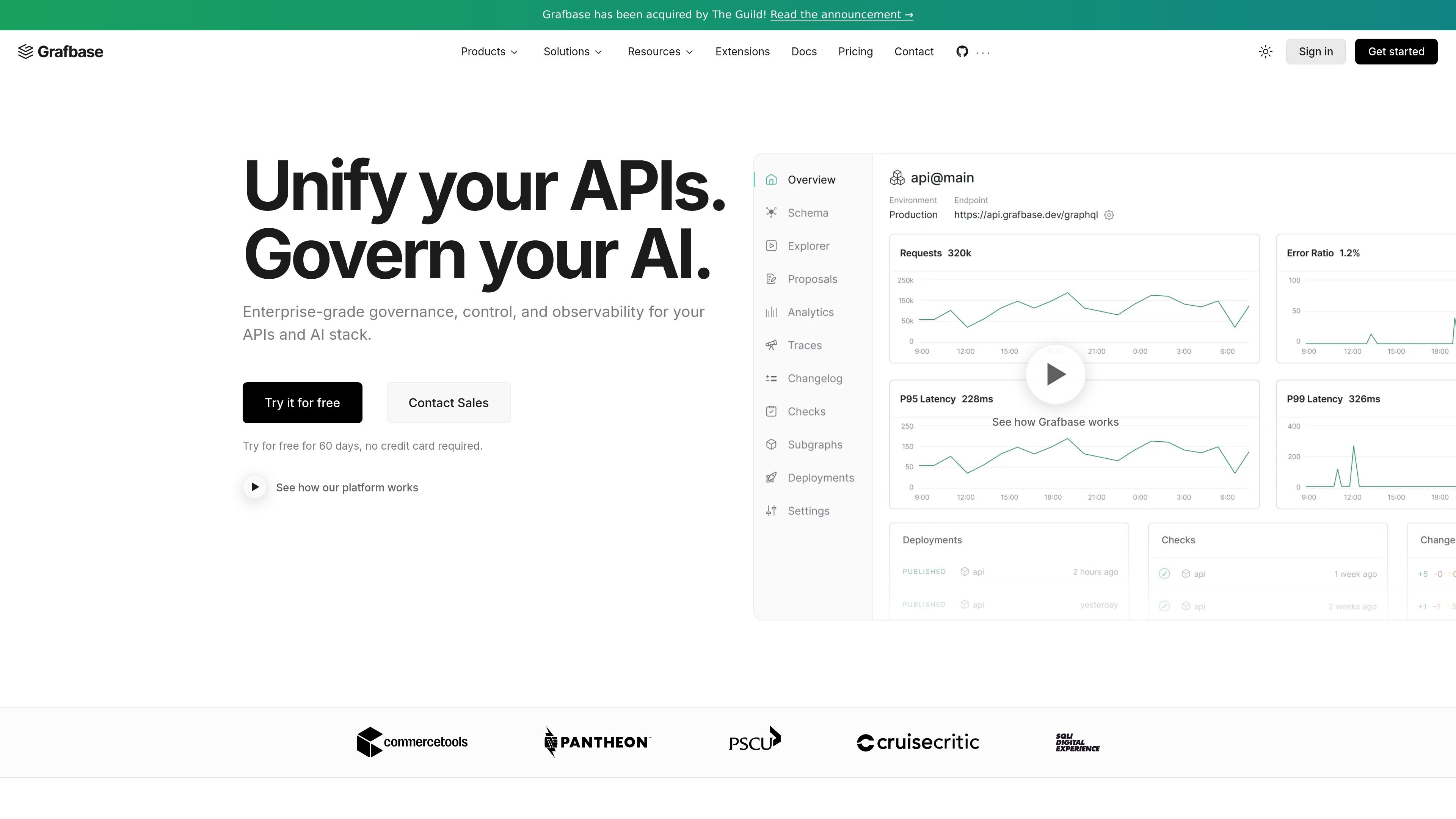
Grafbase is a GraphQL API management platform for building and operating federated graphs across multiple data sources. The product is positioned around governance, control, observability, and performance for enterprise API and AI workloads.
The platform combines a federated GraphQL gateway, schema management, security features, observability tooling, and deployment flexibility. It supports self-hosted enterprise deployment, and the public docs describe Helm-chart-based installation on Kubernetes with supporting services such as Postgres, ClickHouse, Kafka, Zitadel, and S3-compatible storage.
Compose services, databases, and APIs into a single federated graph so teams can manage multiple backends through one API layer.
Use schema proposals, approval workflows, and schema checks to coordinate changes and reduce breaking updates across teams.
Apply rate limiting, trusted documents, SAML SSO, fine-grained access control, authentication, authorization, and access logging to protect the gateway.
Use logs, metrics, traces, telemetry, and custom access log messages to monitor and debug federated graphs.
Customize gateway behavior with Rust-based WebAssembly extensions for authentication, authorization, resolvers, and integrations with external services.
Deploy in cloud, hybrid, fully air-gapped on-prem, or self-hosted Kubernetes environments depending on operating requirements.
Unify services, databases, and APIs into a federated graph when a team needs a single GraphQL layer over multiple data sources.
Coordinate schema changes across multiple teams using schema proposals, approvals, and checks to catch breaking changes before they reach production.
Host the platform inside your own infrastructure when regulatory or internal security requirements call for self-hosted control.
Extend gateway behavior with custom authentication, authorization, or resolver logic when default gateway behavior is not enough.
Add observability and access controls for production federated graphs that need logging, metrics, traces, and document-based access policies.
The source says the Grafbase Enterprise Platform is self-hosted, runs in your infrastructure, and is distributed via Helm charts that can be installed on Kubernetes clusters. The public docs also mention a Grafbase CLI for building and deploying extensions.
The pricing page says the platform offers a 60-day free trial with no credit card required. After the trial, users are invited to contact sales to discuss the right plan.
Yes. The pricing page says customers can switch between self-hosted and cloud control planes at any time.
The self-hosting docs list Postgres, ClickHouse, Zitadel, Kafka, OpenTelemetry Collector, and an S3-compatible object store such as MinIO as part of the enterprise platform architecture. MinIO is described as optional because any S3-compatible storage can be used.
The docs say Grafbase extensions are written in Rust and compiled into WebAssembly modules. The gateway loads them automatically at startup through configuration, and extensions can be used for custom authentication, authorization, and resolver logic.
Traffic data is for reference only.

baserow.io
Baserow is an open-source no-code database platform for building databases, apps, dashboards, and automations with cloud or self-hosted deployment.

relaticle.com
Relaticle is an open-source CRM for teams that combines shared records, pipeline and task management with built-in AI chat and a 39-tool MCP server. Teams can use the hosted workspace or self-host the AGPL-3.0 application and connect external AI agents through MCP and REST API access.

deplo.build
Deplo is a self-hosted deployment platform that builds, deploys, and serves applications on servers you own. It provides repository-based deployments, HTTPS, managed data services, access controls, and optional AI-assisted infrastructure operations.