
Natural-language workflow definitions
Describe repository behavior in plain language instead of writing bespoke GitHub API scripts. The workflow definition is treated as the source of truth for the agentic job.

GitHub Next is GitHub’s research site for prototyping future software development tools and workflows, including Agentic Workflows for natural-language automation on GitHub Actions.
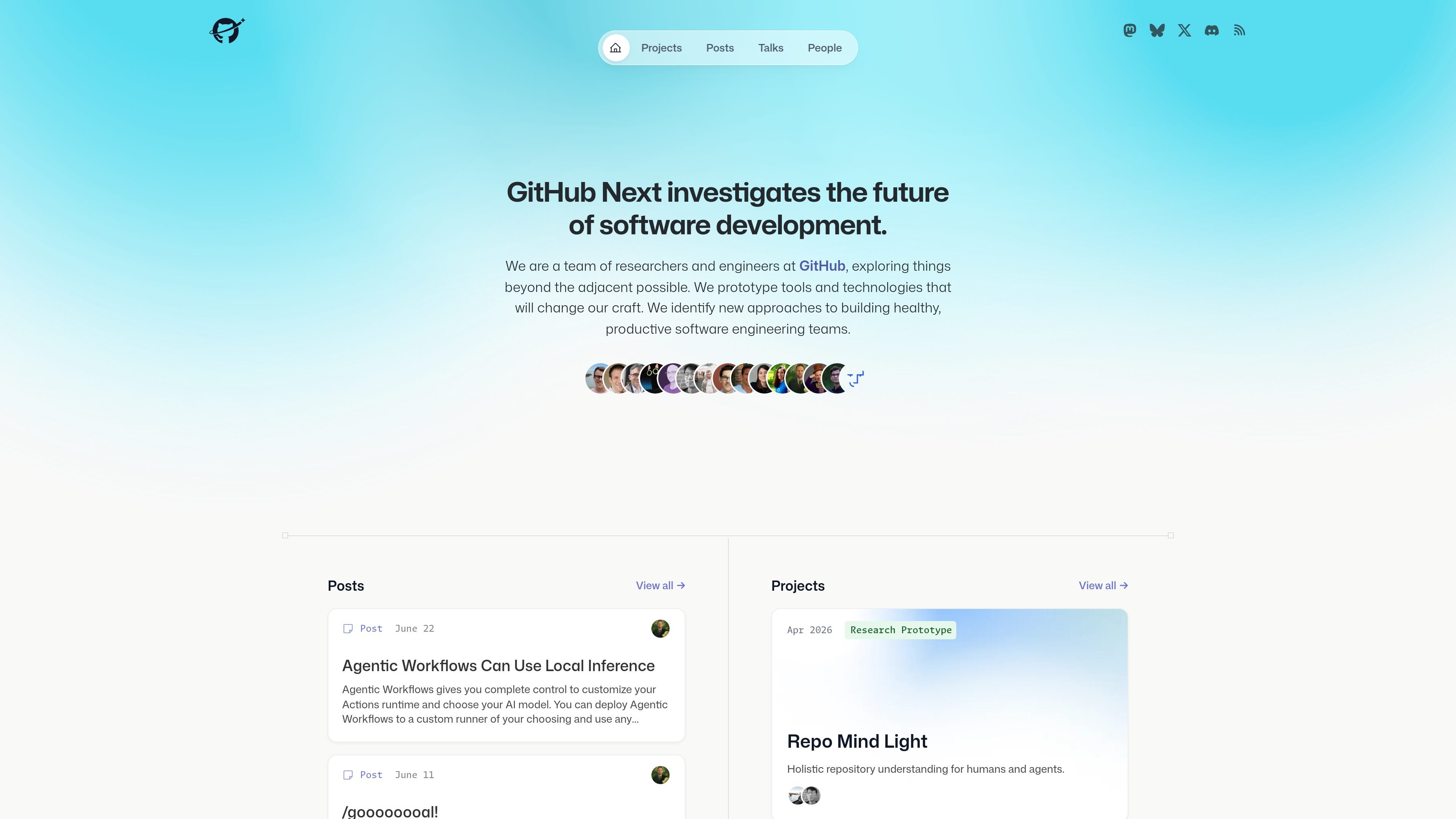
GitHub Next is a research site from GitHub where researchers and engineers prototype the tools, workflows, and ideas that may shape software development. The site functions as an umbrella for multiple explorations and published posts rather than a conventional product page with a single commercial offering.
One of the clearest projects on the site is Agentic Workflows, a research demonstrator for expressing repository-level behavior in natural language and running it on GitHub Actions. It is explicitly described as not a product and not even a technical preview, but as a way to learn what works in day-to-day repositories.
Agentic Workflows translates markdown-based instructions into executable GitHub Actions workflows using an agentic engine such as Claude Code or OpenAI Codex. The design keeps familiar Actions concepts like triggers, permissions, logs, secrets, environments, and reviewable YAML, while adding a more declarative layer for automation tasks.
The site’s examples focus on collaborative repository work: issue triage, documentation updates, quality checks, accessibility review, and test improvement. The broader GitHub Next project list also shows other research prototypes and completed experiments, reinforcing that the site is a living research portfolio rather than a packaged software product.
Describe repository behavior in plain language instead of writing bespoke GitHub API scripts. The workflow definition is treated as the source of truth for the agentic job.
Compile the markdown workflow into standard GitHub Actions YAML, so the result stays within GitHub Actions’ existing model and tooling.
Use a GitHub Action with familiar controls such as triggers, permissions, secrets, environments, logs, and job semantics. The design explicitly keeps execution repo-centric and auditable.
Choose from compatible agent engines, including Claude Code and OpenAI Codex. The workflow language is separated from the engine, which makes swapping engines possible without rewriting the workflow.
Use GitHub-specific controls such as safe outputs, partial sandboxing, and security guardrails to keep agentic steps constrained and reviewable.
Support practical repository work such as documentation upkeep, issue handling, quality checks, and selective test improvements, rather than requiring a single fixed task type.
Use Agentic Workflows when you want to automate recurring repository chores such as labeling issues, summarizing discussions, routing work, or suggesting the next action in a queue.
Use it for documentation upkeep when code changes outpace docs, so an agent can review the diff, identify gaps, and propose updates in a reviewable pull request.
Use it for quality work such as targeted test creation, selective checks, and other reviewable improvements that help maintain robustness over time.
Use it for repository hygiene tasks that benefit from judgment but still need clear guardrails, such as accessibility review or checking untrusted content before the agent acts on it.
Use the broader GitHub Next site as a place to follow early prototypes, posts, and research writeups if you want to track how GitHub is exploring agentic software development.
No. The page explicitly says Agentic Workflows is not a product and not even a technical preview; it is a research demonstrator for learning and exploration.
It is a GitHub Action–based demonstrator that compiles a markdown definition into an executable GitHub Actions workflow. The source describes a short manual compile step using the `gh aw` CLI extension.
The source says workflows are engine-neutral and can use multiple coding agents, including Claude Code and OpenAI Codex.
The source highlights repository-level tasks such as issue triage and labeling, continuous QA, accessibility review, continuous documentation, and continuous test improvement.
The source does not show pricing for GitHub Next or Agentic Workflows. The pricing URL returns a 404 page not found.