
Git-native agent state
Store identity, memory, rules, tools, and skills as plain files in a git repository so the agent can be branched, diffed, reviewed, and rolled back like code.

GitAgentProtocol (GAP) is a git-native AI agent harness for managing identity, memory, rules and skills as version-controlled files via CLI, Node.js SDK or browser UI.
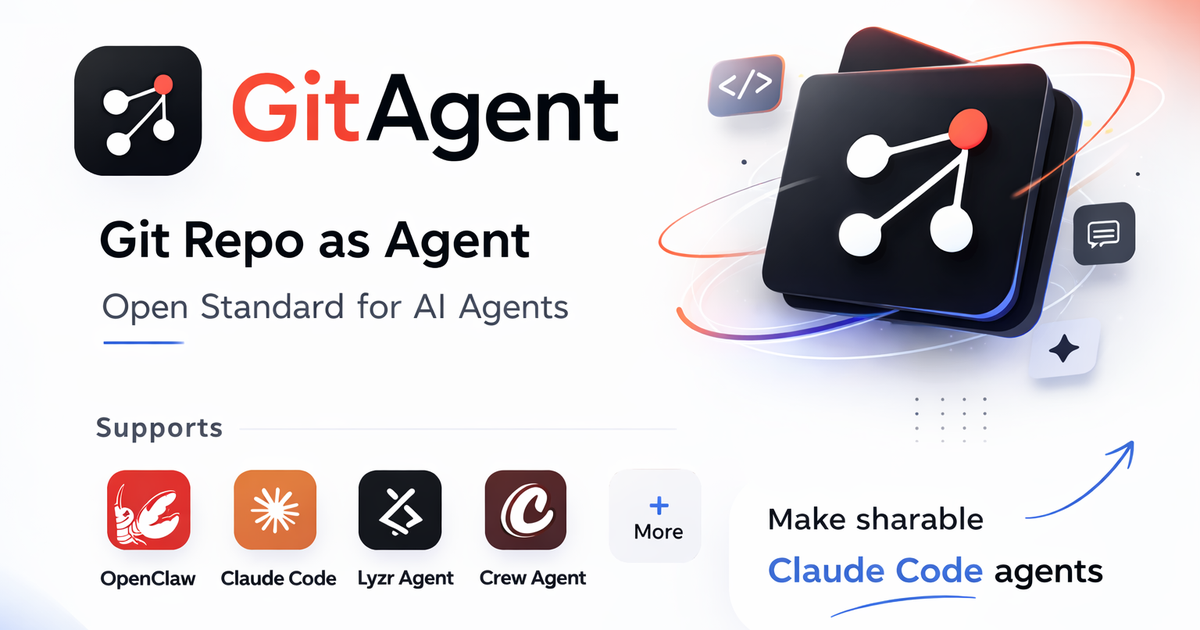
GitAgentProtocol (GAP) is a git-native AI agent harness built in TypeScript. Its core idea is that an agent’s identity, memory, rules, tools, and skills live as plain files inside a repository, so the whole agent can be read, versioned, branched, diffed, and rolled back with standard git workflows.
The product is designed for developers who want to run and manage agents through code, a terminal REPL, an SDK, or a browser interface. The site emphasizes auditability, human-in-the-loop review, and reversible changes, and it positions GitAgent as a focused system for autonomous coding and project work rather than a general life assistant.
Store identity, memory, rules, tools, and skills as plain files in a git repository so the agent can be branched, diffed, reviewed, and rolled back like code.
Run the primary terminal interface as an interactive REPL, with options for single prompts, remote repositories, sandboxed execution, and launching the web UI from the CLI.
Embed GitAgent in a Node.js app through the SDK and call `query()` from code to automate prompts and workflows programmatically.
Serve a browser UI on port 3333 with chat, voice, skills, integrations, communication channels, a scheduler, and a visual skill-flow builder.
Use git branches, commits, logs, diffs, tags, and revert operations to inspect agent history and recover earlier states.
Define deterministic workflows in YAML and support hooks, skills, and lifecycle files such as `bootstrap.md` and `teardown.md` for agent behavior.
Run an agent from the terminal when you want a fast interactive session, a single prompt, or a local workflow that stays close to your repository.
Embed GitAgent in a Node.js application to automate prompts and integrate agent behavior directly into product code.
Use the browser interface for chat, voice, scheduler-driven runs, skills, and integrations when a graphical workflow is easier than the terminal.
Manage agent changes like software changes by branching, diffing, committing, and reverting agent files during review or experimentation.
Connect messaging channels or third-party services when you need the agent to respond outside the repository through Telegram, WhatsApp, phone, or Composio-backed integrations.
GitAgent runs as a git-native agent harness. The docs describe the CLI, SDK, and browser UI as different ways to interact with the same agent repository.
The source describes GitAgent as framework-agnostic and says it works with providers including Claude, OpenAI, CrewAI, and Lyzr. The docs also mention OpenAI Realtime and Gemini Live for voice mode.
The CLI starts an interactive terminal REPL by default. It also supports a single-prompt mode, remote repo work, sandboxed runs, and a flag to start the web UI with voice.
The web UI runs on port 3333. It provides chat, skills, integrations, communication channels, a visual skill flow builder, scheduler, settings, and voice mode.
The site positions GitAgent as a developer-focused agent system built around version control, branching, diffs, and rollback. The homepage also says it is not a general-purpose life assistant.