
Multimodal deepfake detection
Analyzes video, voice, and image files as well as real-time streams to identify manipulated media, synthetic content, and suspicious identities.
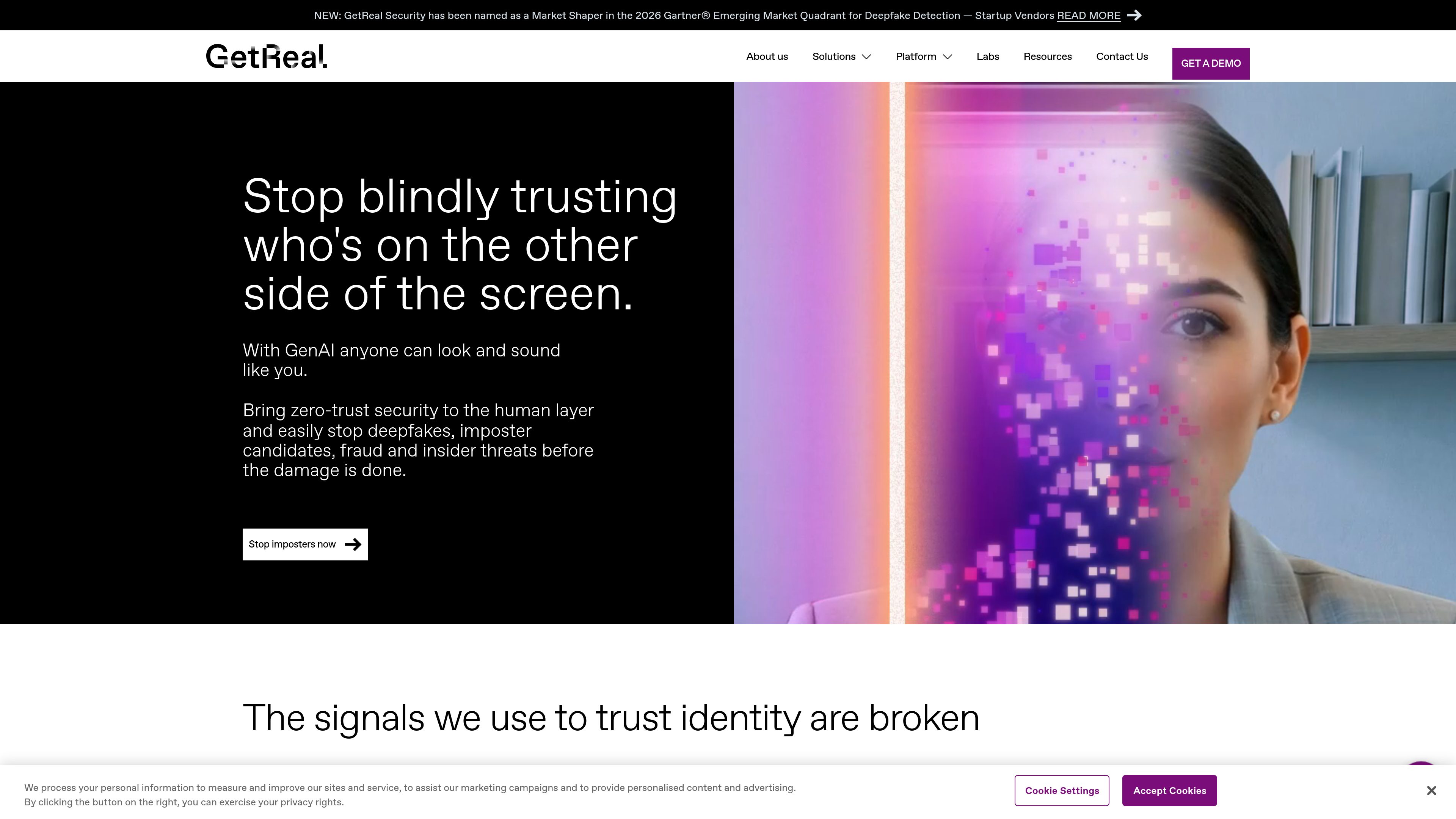
GetReal Security is an enterprise deepfake detection and human-identity defense platform for verifying people and media in real-time interactions and files. It helps security, hiring, fraud, and support teams identify impersonation and synthetic-media risks across video, voice, image, and hiring workflows.
GetReal Security provides the GetReal Trust & Authenticity Platform (GTAP), an enterprise platform for detecting deepfakes, manipulated media, and suspicious identities. It is designed to extend zero-trust controls to the human layer, where organizations rely on video calls, voice interactions, digital content, and remote hiring.
The platform combines multimodal media analysis with continuous identity authentication and adaptive security policy enforcement. It analyzes video, voice, image files, and real-time streams using content, biometric, behavioral, environmental, and contextual signals. The stated goal is to identify impersonation and AI-generated deception before it leads to fraud, unauthorized access, or insider risk.
Analyzes video, voice, and image files as well as real-time streams to identify manipulated media, synthetic content, and suspicious identities.
Correlates biometric, behavioral, and contextual signals during live video and voice interactions to help expose impersonation as an interaction unfolds.
Supports action on identity threats as they appear by applying security policies during an interaction, while the site positions the approach as low friction for legitimate participants.
Examines content credentials, watermarks, C2PA information, pixel artifacts, physical surroundings, provenance, semantics, human signals, biometrics, behavior, and environmental context.
Maps identity relationships, flags repeat attackers, and correlates signals across detections and interactions so security teams can view related identity attacks as patterns.
The platform includes GetReal Protect for real-time digital communications and GetReal Inspect for automated forensic content verification.
Hiring teams can assess interviews, synthetic voices, fabricated identities, and stand-ins before a fraudulent candidate progresses into the workforce or becomes an insider threat.
Security and finance teams can scrutinize high-risk video or voice interactions in which a cloned executive identity is used to influence employees, approve payments, grant access, or bypass controls.
Service desk and support teams can use identity verification during credential resets, MFA enrollment, and account-recovery conversations where an attacker may attempt to appear legitimate.
Contact center teams can assess callers and cloned voices during customer interactions, with the site specifically positioning the use case around verifying callers without adding friction.
Enterprise security teams can apply continuous workforce verification across calls, meetings, and other digital interactions instead of relying only on credentials or device authentication.
The site says the platform analyzes video, voice, and image files, as well as real-time streams. Its stated analysis includes content credentials, pixels, provenance, physical context, semantics, human signals, biometrics, behavior, and environmental context.
Yes. GetReal describes continuous authentication during live video and voice calls by correlating biometric, behavioral, and contextual signals. It also describes applying security policies as interactions unfold.
The published use cases include hiring and onboarding, executive impersonation, account recovery, IT service desks, customer contact centers, and broader workforce-integrity workflows. The site also identifies security, IAM, fraud, customer support, talent acquisition, and executive stakeholders.
The supplied materials do not provide pricing, plan limits, trial terms, integrations, deployment requirements, or supported technical platforms. The site directs prospective customers toward a demo.
GetReal says it can identify suspicious identities and synthetic or manipulated media, correlate signals across interactions, and support adaptive policy enforcement when identity threats appear. The supplied materials do not specify the exact alert, score, or case-management formats.

wedetect.ai
WeDetect is a free, no-sign-up AI image detector that estimates whether an uploaded photo or screenshot was generated by AI. It helps shoppers, fact-checkers, and other users triage suspicious images while making clear that results are probabilities, not proof.
sensity.ai
Sensity AI is a deepfake and synthetic-media detection platform for analyzing videos, images, and audio. It combines pixel, file, metadata, and voice analysis with explainable forensic reporting and supports cloud, API, web-app, and on-premise deployments.

www.scam.ai
Halo is a Windows desktop app for real-time, on-device deepfake detection during video calls. It helps finance, HR, and other sensitive teams flag synthetic faces and face swaps before they lead to fraud or a bad hire.

truthscan.com
TruthScan is an enterprise AI detection platform that analyzes submitted images, PDFs, text, voice, and video for AI generation or manipulation. It helps fraud, trust and safety, compliance, education, media, and government teams review content with forensic evidence and workflow-ready results.

isthisai.com
IsThisAI is a web-based detector for AI-generated and AI-manipulated images, video, and audio. It helps people assess suspicious media using model analysis, source detection, and visual heatmaps.
www.duckduckgoose.ai
DuckDuckGoose AI provides forensic deepfake detection for images and video. It is designed for fraud prevention, identity security, compliance workflows, and legal or forensic investigations.