
Repository-based API discovery
Scan repositories to identify APIs and endpoints, build a catalog, and generate OpenAPI 3.1 specifications from code without requiring an existing OpenAPI file.

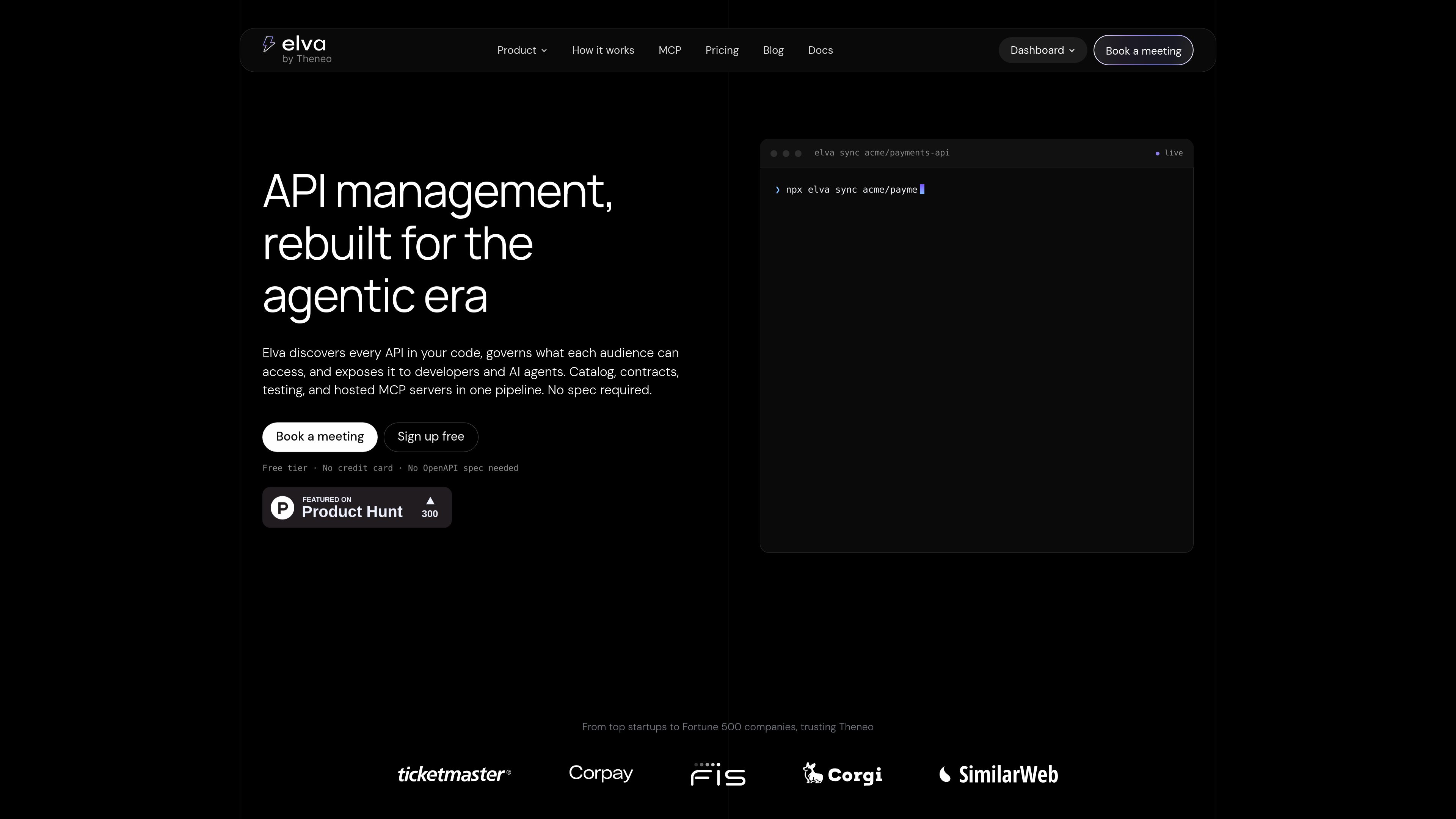
Elva is an API management platform that discovers APIs from source repositories, evaluates their design and AI readiness, and governs how they are published to developers and AI agents. It generates contracts, documentation, MCP servers, and related delivery artifacts without requiring an existing OpenAPI specification.
Elva is an API management platform for teams that need to discover, assess, govern, test, and publish APIs for different audiences. It scans connected repositories to build an API catalog and can generate OpenAPI specifications from code, so teams can begin without maintaining a separate specification first.
The platform scores APIs and endpoints across areas such as design, developer experience, AI readiness, security, and performance. It can identify issues including missing descriptions, untyped response fields, and undocumented authentication, then provide AI-assisted fixes where available. API testing includes manual testing, with automated scheduled and CI testing and chaos suites on higher plans.
Elva uses audience-specific API contracts to define which endpoints and fields are exposed and where the resulting interface is published. A contract can produce specifications, documentation, MCP servers, Postman collections, and TypeScript SDKs depending on the plan and deployment configuration. Elva also compares source changes against contracts and supports breaking-change policies, notifications, governance rules, and approval workflows on higher tiers.
For AI-agent access, Elva generates hosted or self-hosted MCP servers from governed contracts. Its MCP gateway checks identity and tool scope, applies rate and quota controls, can redact fields according to the contract, and records calls. Teams can test servers in the MCP Playground and use agent feedback and operational insights to improve the catalog and exposed tools.
Scan repositories to identify APIs and endpoints, build a catalog, and generate OpenAPI 3.1 specifications from code without requiring an existing OpenAPI file.
Evaluate endpoints and collections across design, developer experience, AI readiness, security, and performance; identify documentation, schema, and authentication gaps and apply supported AI fixes.
Select audiences, endpoints, and fields for internal, partner, public, or AI-agent access. Contracts can define visibility, approval requirements, and field exclusions such as PII or internal data.
Compare commits against contract promises, surface schema and authentication changes, and support breaking-change policies, stakeholder notifications, rulesets, webhooks, and contract deployment targets on applicable plans.
Generate curated MCP tools from API contracts rather than exposing an entire API. Elva’s gateway supports identity checks, per-tool scopes, rate and quota controls, field redaction, and call logging.
Use the MCP Playground for interactive testing, collect agent feedback, and inspect server status and call activity. Business and Enterprise plans add automated API testing, chaos suites, and expanded MCP insights.
An API team can connect a repository, discover endpoints, generate a baseline specification, and review scores and gaps before investing in a manually maintained catalog.
A team can define a partner contract that selects approved endpoints and fields, excludes internal or sensitive data, requires approval, and publishes the resulting specification and documentation.
A platform or security team can generate an MCP server from a contract, expose only suitable tools, assign per-agent or per-key scopes, and inspect calls through the gateway logs.
API owners can compare source changes with published contracts, review schema or authentication diffs, notify stakeholders, and use governance policies to block or warn on changes that affect consumers.
Developers can exercise an MCP server in the Playground, inspect the calls made by an agent, and use feedback about unclear descriptions, timeouts, or parameter complexity to improve the catalog.
No. The site states that Elva can read repositories, discover APIs from code, and generate an OpenAPI specification. An existing OpenAPI spec is not required to start.
A contract can specify the audience, selected endpoints, exposed fields, and publishing destinations. The documented audiences include internal services, partners, public APIs, and AI agents using MCP. Contracts can also support approval, breaking-change, notification, and governance policies depending on the plan.
Elva places MCP tool calls behind an authorization gateway. The documented checks include identity, tool-level scope, field redaction, rate and quota controls, and an audit record containing call details such as the agent, tool, latency, and outcome. Hosted and self-hosted deployment options are described, with self-hosted deployment available on Enterprise.
Yes. The MCP Playground lets teams interact with their server through an agent and inspect the tool calls and responses. The site states that Playground calls do not count against the MCP gateway quota.
Yes. The pricing page lists a Free plan and paid Startup, Business, and Enterprise plans. It also states that plans have unlimited members and no per-seat pricing; exact repository, server, call, governance, and testing limits vary by plan.
Traffic data is for reference only.

www.cadenya.com
Cadenya is an agent runtime for developers building, testing, and improving AI agents on existing APIs. Connect tools, models, objectives, webhooks, feedback, and embeddable widgets in one platform.

relaticle.com
Relaticle is an open-source CRM for teams that combines shared records, pipeline and task management with built-in AI chat and a 39-tool MCP server. Teams can use the hosted workspace or self-host the AGPL-3.0 application and connect external AI agents through MCP and REST API access.

openship.io
Openship is an open-source deployment platform for building and running applications from Git repositories, local folders, or templates. Teams can use its dashboard, CLI, desktop app, or MCP interface to deploy on Openship Cloud, connected servers, or their own infrastructure.

webdecoy.dev
WebDecoy monitors automated traffic reaching a Vercel site or app, identifying crawlers, AI bots, tools, and requests without a user agent. It verifies published IP ranges or signed requests, flags forged well-known user agents, and reports activity without changing application code on supported Vercel plans.