
Unified access to many models
Access OpenAI, Mistral, Gemini, Claude, and specialized providers through one API instead of maintaining separate vendor connections.

Eden AI is an AI API gateway and model catalog for unified access to hundreds of AI models, with comparison, routing by price or region, and fallbacks.
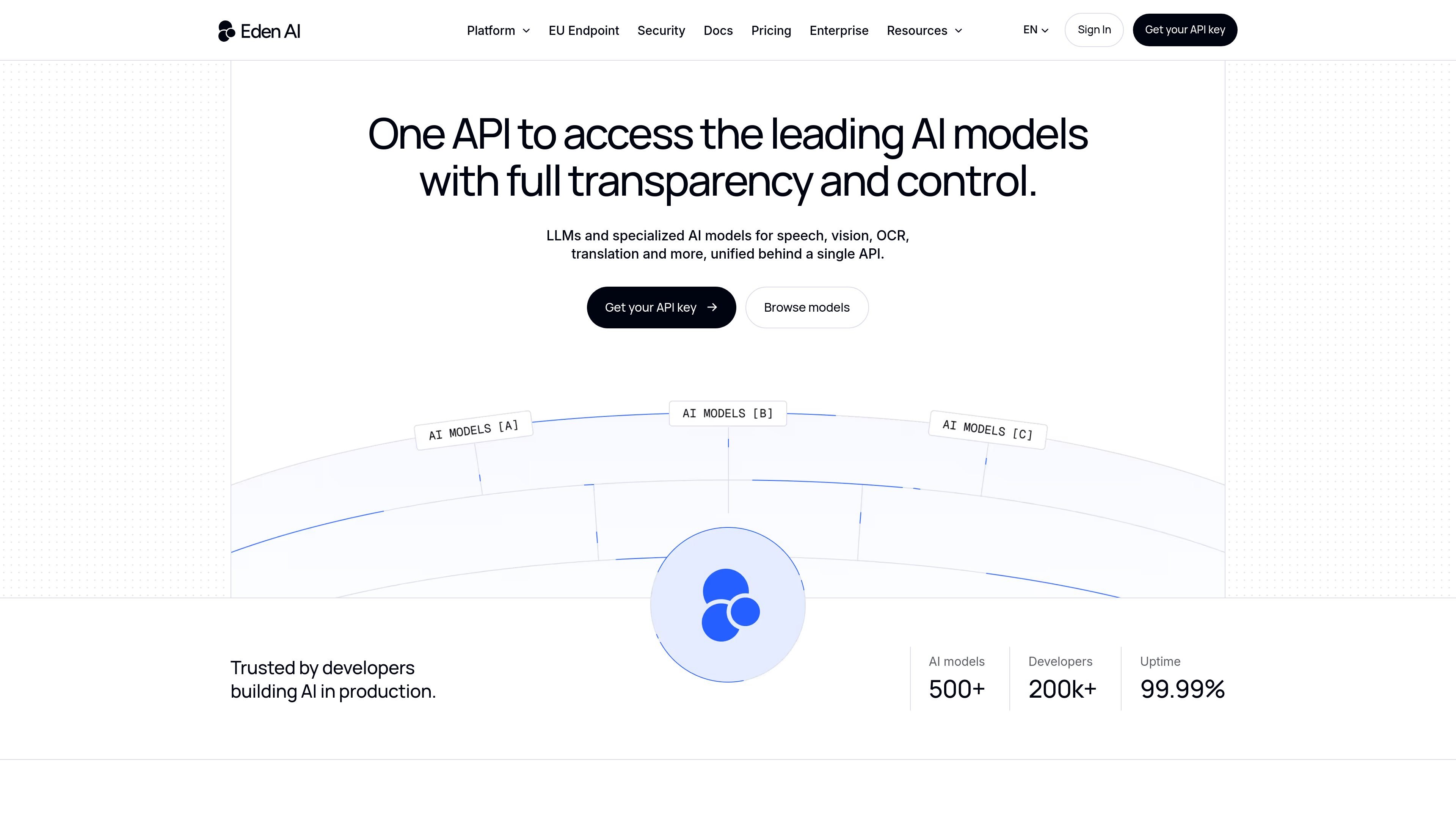
Eden AI is an AI API gateway and model catalog that lets teams access hundreds of models through one unified API. The product is positioned around routing requests by cost, performance, and region, with built-in fallbacks when a provider fails or reaches its limits.
The site describes coverage across large language models and specialized AI models for OCR, speech, vision, translation, document processing, and more. Its main purpose is to reduce integration work by standardizing provider access, while giving teams more control over model selection and routing.
Access OpenAI, Mistral, Gemini, Claude, and specialized providers through one API instead of maintaining separate vendor connections.
Standardize requests, responses, authentication, billing, and monitoring so different providers behave through a consistent interface.
Compare providers by price, performance, and processing region before choosing which model to send a request to.
Switch to a fallback model automatically when a provider fails or reaches its limits to keep production workflows running.
Use the catalog for specialized capabilities such as OCR, speech, vision, translation, document processing, generative AI, and video processing.
Create multiple API keys, monitor cost and performance, and use unlimited seats on the self-serve plan.
Build one integration that can reach many AI providers, so product teams do not have to maintain separate code paths for each vendor.
Choose between providers by price, performance, and region when the same task can be served by different models.
Keep an application running by switching to fallback models when a provider fails or reaches its limits.
Use specialized APIs for OCR, speech, vision, translation, document processing, or video tasks instead of forcing a general LLM to do every job.
Set up separate API keys and monitor cost and performance across projects, especially when several teams share the same account.
Eden AI provides a single API and model catalog so teams can browse and use AI models without wiring separate integrations for each vendor. The source also shows both self-serve and Advanced paths, with a note that teams can move from self-serve to Advanced later without changing the integration.
The source highlights a unified API, standardized requests and responses, provider comparison by price, performance, and region, and fallback routing when a provider fails or reaches its limits. It also points to docs and a model browser for getting started.
Pricing is usage-based: users pay vendor rates plus a 5.5% Eden AI platform fee, with no monthly commitment or hidden costs stated on the pricing page. The Advanced plan is custom-priced for higher limits, bulk discounts, private deployments, or specific compliance needs.
The source lists AI models, a model catalog, docs, and support for multiple API keys and unlimited seats on the self-serve plan. That suggests it can be used by teams, but the pages shown do not give detailed role-based permissions or workspace controls.
The product pages describe a unified API, model browsing, routing controls, and fallback mechanisms, but they do not provide a full list of supported SDKs, cloud connectors, or external integrations in the collected text.