
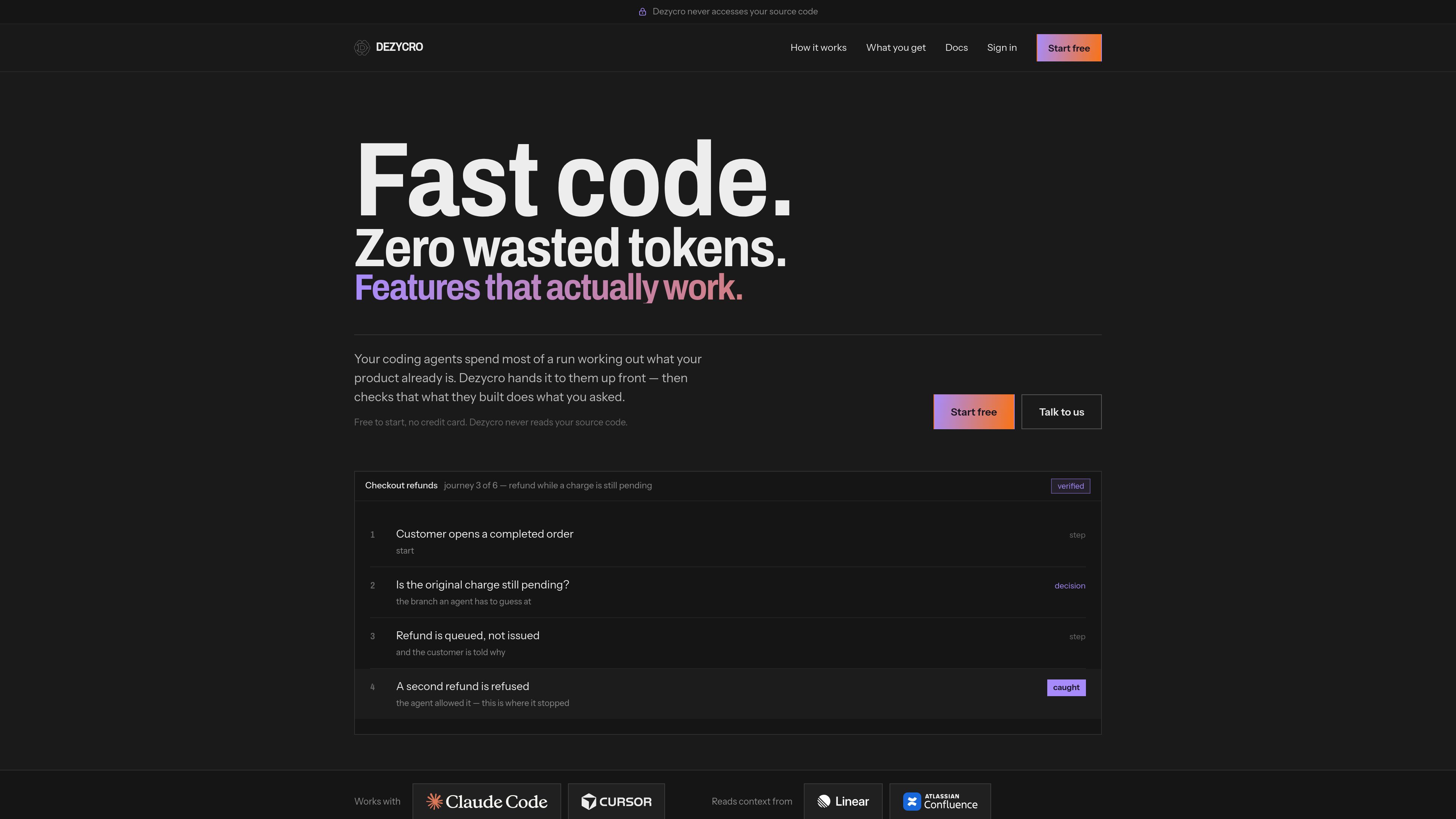
Provisioned agent context
Give agents product and technical specifications, flow maps, notebooks, OpenAPI information, tasks, decisions, and reference documents before they begin work.

Dezycro is an operations layer for AI coding agents that provides product context, steers work, verifies behavior against requirements, and records decisions. It is designed for developers, product teams, and organizations that want to use agents without giving Dezycro access to source code.
Dezycro is an operations layer for AI coding agents. It does not write the application code itself; instead, it supplies agents with product context, accepts steering instructions while work is in progress, verifies the resulting behavior against requirements, and records the decisions and evidence for later work.
The product is built for workflows using agents such as Claude Code and Cursor. Teams can organize PRDs, technical specifications, flow maps, OpenAPI information, tasks, decisions, and reference documents into a shared context. Dezycro then generates checks from the intended behavior and runs them against the product’s running API, helping identify missing endpoints, skipped flow steps, and requirements that drifted during implementation.
Dezycro says it does not access repository source code: repositories are not cloned, uploaded, or indexed. Its verifier runs in the user’s environment, while specifications, journeys, results, and project history are kept in a workbook that can be exported.
Give agents product and technical specifications, flow maps, notebooks, OpenAPI information, tasks, decisions, and reference documents before they begin work.
Use a per-feature command inbox to send new instructions or invalidate stale work while an agent is running, without having to manage every terminal step.
Generate checks from PRDs and API specifications independently of the coding agent, then run them against the product’s running API to expose differences between intended and observed behavior.
Represent user journeys as steps and decision points, including alternate or abandoned paths, and flag conflicts when a new requirement contradicts an existing one.
Keep decisions, assumptions, tasks, blockers, specifications, and verification evidence in one workspace, with version history for PRDs and technical requirements.
Use the CLI, Claude Code plugin, MCP server, or API, and bring in context from Linear, Atlassian Confluence, and document ingestion.
A product or engineering team can assemble the feature’s PRD, technical requirements, journeys, decisions, and existing documentation before handing the task to an AI coding agent.
Teams can generate independent checks from the requirements and run them against a running API to find missing routes, skipped stages, or incorrect responses that the agent’s own tests did not identify.
A developer or product owner can issue a correction or invalidate outdated work through the feature command inbox instead of waiting for implementation to reach review.
Teams can retain reusable notebooks, skills, decisions, and verification history in the workbook so subsequent agent sessions start with documented context rather than reconstructing it.
No. Dezycro says that it does not clone, upload, index, or read repository source code. Its verifier runs in the user’s environment against a running API.
No. Claude Code and Cursor write the code; Dezycro provides the surrounding context, in-run direction, verification, and recorded project knowledge.
The site lists Claude Code and Cursor through the Dezycro plugin, CLI, and MCP server. It also lists Linear and Atlassian Confluence connectors for bringing issues and existing documentation into context.
Dezycro generates checks from the API specification and PRD independently of the coding agent. The checks are intended to compare the built product with the specified behavior rather than only confirm tests written by the same agent pass.
The product says teams can keep their existing agent and repository while Dezycro runs alongside them. Generated checks can also plug into a CI/CD pipeline as ongoing sanity tests.

getbb.app
bb is a local-first, open-source IDE for running coding agents in parallel, organizing their work in threads, and extending the workspace with plugins. It is designed for developers and teams that want to coordinate provider-based agents and customize their software workflow.

www.edgee.ai
Edgee is an agent gateway for coding teams that reduces token usage, routes requests across models, and provides usage visibility. Its Compression V2 works as a drop-in CLI layer for Claude Code, Codex, OpenCode, Cursor, and other supported agents.

usefiretower.com
Firetower is an open-source, self-hosted control plane for running coding agents on servers you own. It lets developers start agent sessions from repositories, monitor them from desktop or mobile clients, review changes, and ship branches without keeping the initiating device online.

obot.ai
Obot is an open-source enterprise AI control plane and MCP gateway for deploying, governing, and auditing AI agents, MCP servers, and Skills. It helps organizations centralize access policies, discovery, authentication, and activity records across AI tooling.

relace.ai
Relace is an AI model and infrastructure platform for coding agents, enabling code retrieval, file merging, and source-control workflows with hosted, on-premise, and VPC-isolated deployment.

harproject.dev
HAR HQ is a team governance and observability layer for organizations running coding agents with HAR. It standardizes verification, tracks AI-related work and spend, and helps engineering teams review and improve agent workflows.