
Fast sandbox provisioning
Create sandboxes quickly for AI-generated code, with the homepage and docs both describing sub-90ms creation from code to execution.

Daytona provides secure sandbox infrastructure for AI-generated code, with stateful environments, SDKs, APIs, and CLI access for agent and developer workflows.
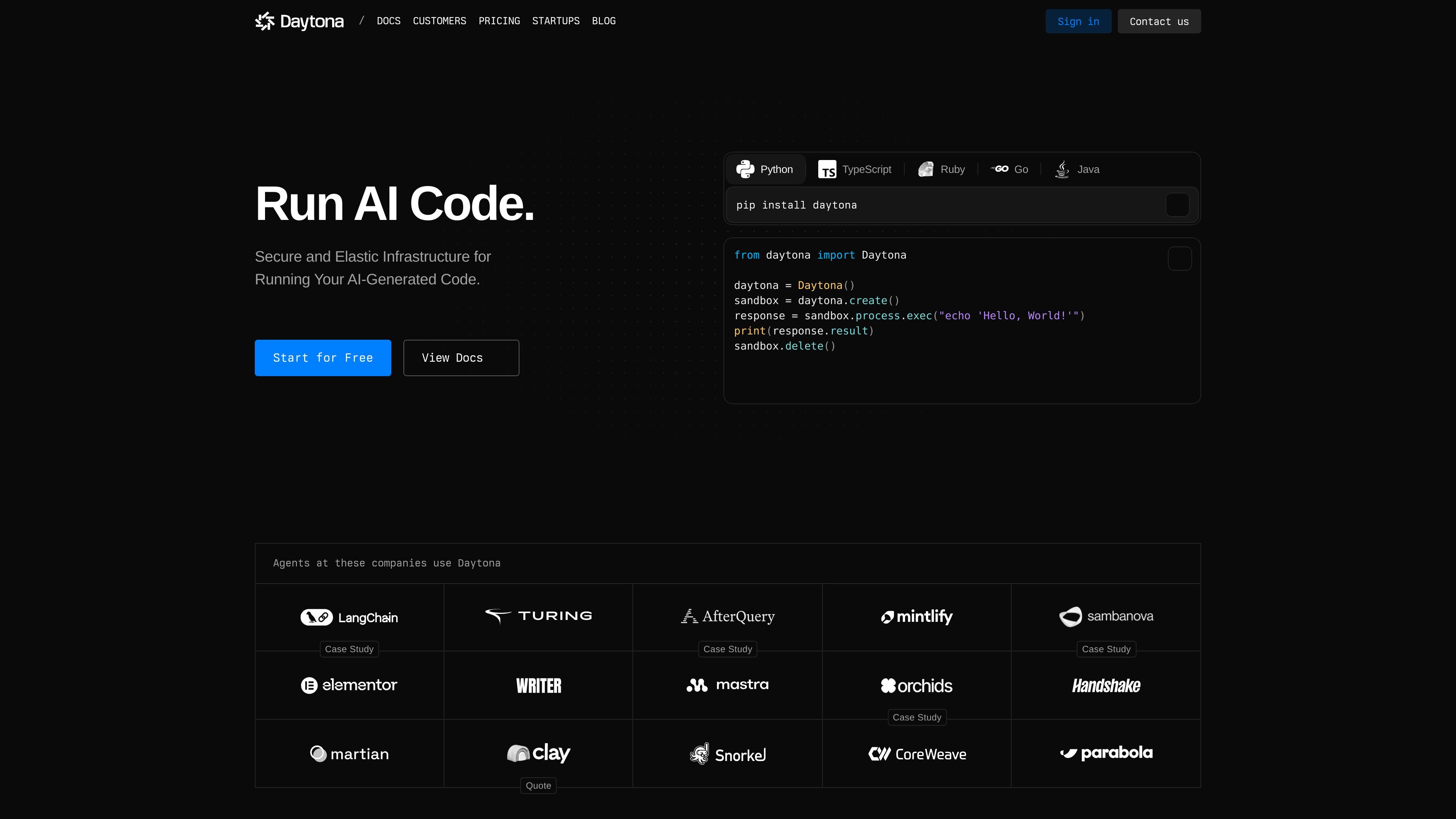
Daytona is a secure infrastructure platform for running AI-generated code in isolated sandboxes. It is positioned for agent and developer workflows that need controlled execution, stateful operations, and repeatable environments instead of local machine access.
The docs describe Daytona sandboxes as full composable computers with a dedicated kernel, filesystem, network stack, and allocated vCPU, RAM, and disk. The platform supports programmatic control through SDKs, a RESTful API, and a CLI, and it is built for persistent agent workflows that can span sessions.
Create sandboxes quickly for AI-generated code, with the homepage and docs both describing sub-90ms creation from code to execution.
Run code and shell commands inside isolated environments with real-time output streaming and process execution controls.
Manage sandbox files with full CRUD operations and granular permission controls, backed by filesystem operations in the SDK and API.
Use native Git operations with secure credential handling when workflows need repositories or source control access.
Access language server features for multi-language completion and real-time analysis through built-in LSP support.
Work programmatically through Python, TypeScript, Ruby, Go, and Java SDKs, plus RESTful API and CLI access.
Use Daytona to run code produced by agents in isolated environments so the developer machine and primary workspace stay separate from execution.
Use parallel sandboxes, snapshots, and persistent state for agent loops that need repeatable outputs across multiple runs or sessions.
Use the SDKs or APIs to automate sandbox creation, process execution, file operations, and cleanup in application code.
Use the platform for evaluation runs, where reproducible snapshot states and parallel environments help compare outcomes across repeated tests.
Use sandboxed runtime access with LSP, Git, and real-time output for coding-assistant workflows that need source control and interactive feedback.
Daytona provides secure infrastructure for running AI-generated code in isolated sandboxes. The docs describe it as a platform for managing sandboxes programmatically through SDKs, an API, and a CLI.
The documentation says Daytona SDKs are available for Python, TypeScript, Ruby, Go, and Java. The docs also mention a CLI for Mac/Linux and Windows, plus RESTful API and Toolbox API access.
Daytona sandboxes are described as spinning up in under 90ms from code to execution, with stateful environment snapshots and persistence across sessions.
The pricing page shows usage-based pricing for compute, GPU, memory, storage, and Windows, with a free trial and $200 in free compute included. It also notes startup credits and enterprise options such as larger limits, SSO, audit logs, or BYOC.
The documentation states that sandboxes provide complete isolation, a dedicated kernel, filesystem, network stack, and allocated vCPU, RAM, and disk. The rendered docs also say Daytona runs any code in Python, TypeScript, and JavaScript, and supports OCI/Docker compatibility.