
Multi-protocol API input
Bring together OpenAPI, AsyncAPI, GraphQL, gRPC, and OpenRPC sources in one project, with contract validation before generation.

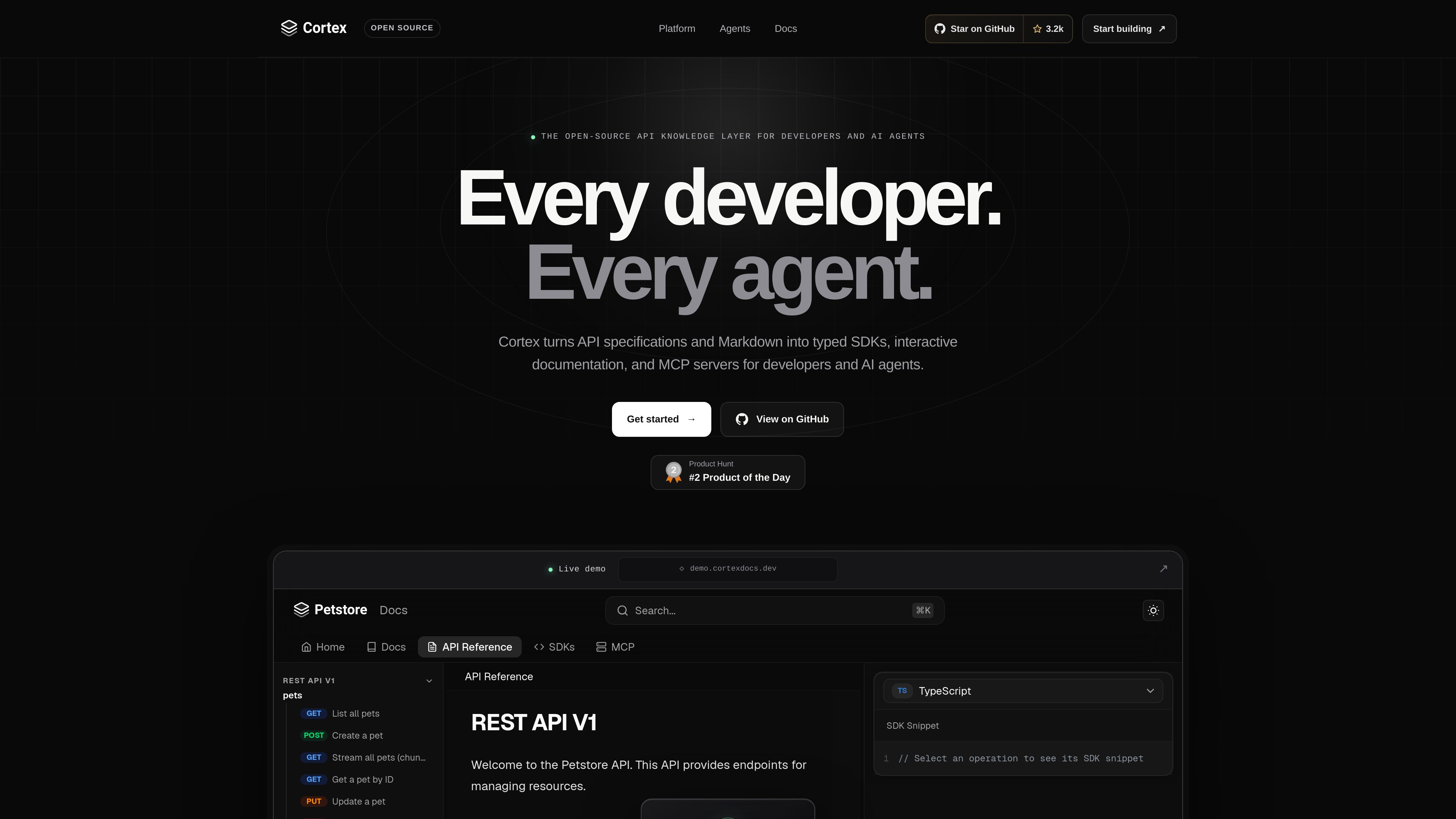
Cortex Docs is an open-source API tooling workflow that turns API specifications and Markdown into interactive documentation, typed SDKs, and MCP servers. It helps developers publish API interfaces for human users, applications, and AI agents from a shared project.
Cortex Docs is an open-source API tooling workflow for generating several interfaces from API definitions and Markdown. A single project can produce interactive documentation for developers, typed SDKs for application integration, and MCP servers that expose API operations to AI agents.
The workflow accepts REST-oriented OpenAPI specifications as well as AsyncAPI, GraphQL, gRPC, and OpenRPC sources. Cortex validates the API contract before generation and supports combining multiple sources in a project configuration. Generation is started with the cortex generate command.
The product's core purpose is to keep API knowledge and generated interfaces aligned across human-facing documentation, application clients, and agent-facing tools.
Bring together OpenAPI, AsyncAPI, GraphQL, gRPC, and OpenRPC sources in one project, with contract validation before generation.
Generate searchable guides, interactive reference pages, copy-ready examples, and a live request builder for developer exploration.
Produce clients in eleven listed languages, with language-appropriate naming, types, authentication, timeouts, streams, retries, and package metadata.
Map API operations to typed MCP tools and package specifications, documentation, SDK references, and project docs for AI-agent access.
Export and override Eta templates, publish generated packages to the registries you choose, and deploy documentation wherever Node runs.
Start with existing API specifications and generate searchable, interactive documentation with examples and a request builder for users evaluating or integrating the API.
Generate typed SDKs for application teams that need native clients across languages such as TypeScript, Python, Go, Java, or Kotlin.
Generate an MCP server whose typed tools and accompanying specifications and guides give AI agents a structured interface to API operations.
Combine sources such as OpenAPI and GraphQL in one project configuration, then validate the contracts and generate the selected outputs through one command.
Use MIT-licensed templates, reviewable generation, and selective template overrides when the team needs control over generated code and documentation output.
It generates interactive API documentation, typed SDKs, and MCP servers from API specifications and Markdown. These outputs address developer exploration, application integration, and AI-agent access respectively.
The site lists OpenAPI, AsyncAPI, GraphQL, gRPC, and OpenRPC as supported source types. Multiple sources can be combined in one project configuration.
A project is configured with a `cortex.config.yml` file containing sources and MCP settings, then generation is started with `cortex generate`.
Yes. Cortex Docs describes its templates and languages as open, with the ability to export and override Eta templates, publish generated packages to chosen registries, and deploy generated documentation wherever Node runs.
The project is described as MIT-licensed and built in the open. The site also links to its public GitHub repository and presents docs-as-code and reviewable generation as part of its workflow.
Traffic data is for reference only.

platform.openai.com
OpenAI Platform is a developer platform for building applications with the OpenAI API. It provides API access, model and pricing information, technical documentation, starter apps, and cookbooks for implementation guidance.

python.useinstructor.com
Instructor is a developer library for extracting structured, validated data from large language models. It uses Pydantic schemas, automatic retries, streaming, and a consistent interface across cloud, local, and routed LLM providers.

learn.microsoft.com
Semantic Kernel is Microsoft’s public GitHub software project for integrating large language model technology into applications. The repository includes implementation and documentation directories for .NET, Python, and Java development.

projectaria.com
Meta’s research platform for AR and AI with wearable glasses, datasets, documentation, and tools
ai-sdk.dev
AI SDK is a TypeScript toolkit for building AI-powered applications and agents across supported model providers and web frameworks. It provides shared APIs for model generation, tool use, streaming, structured output, and AI user interfaces.

refraction.dev
AI code generation for refactoring, tests, docs, bugs, and code conversion