
Role intake and ATS import
Teams can post roles and bring requirements into Contrario’s internal ATS, or work through supported third-party systems such as Ashby and Lever.

Contrario is an AI recruiting platform that pairs AI agents with expert recruiters to help companies hire faster. It supports role intake, candidate matching, interview coordination, and offer support for critical hires.
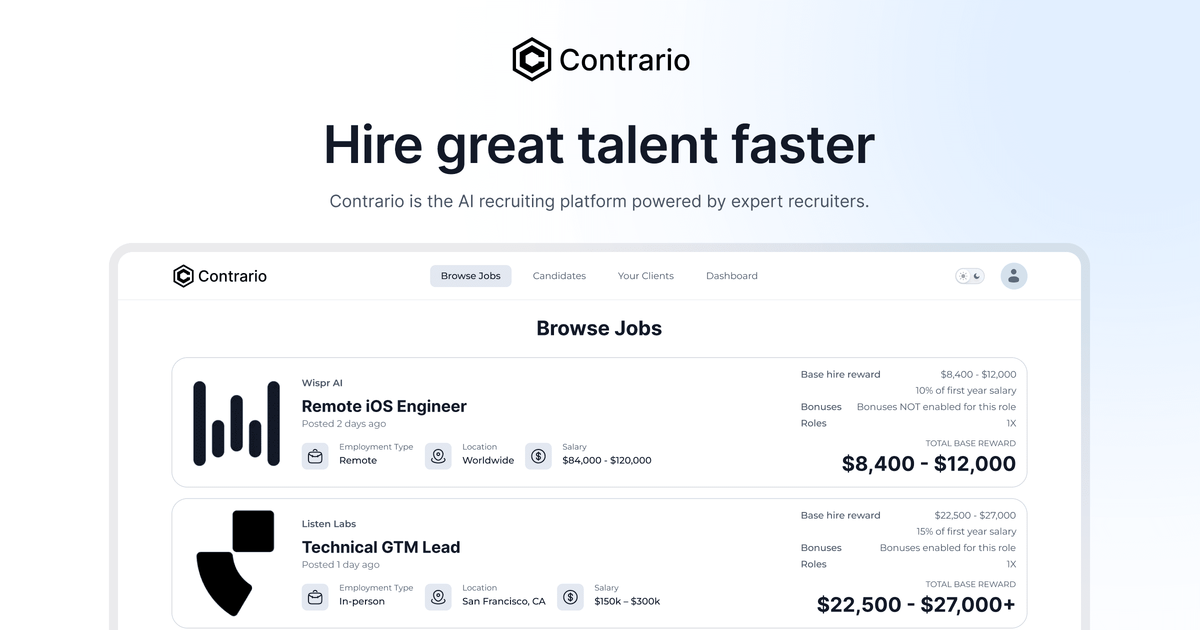
Contrario is an AI recruiting platform that pairs software with expert recruiters to help teams hire faster. The site presents it as a system for getting qualified candidates in front of hiring teams while reducing the manual work involved in sourcing, screening, scheduling, and closing.
The product is aimed at companies with critical hiring needs and is positioned for use across multiple functions, including engineering, go-to-market, product, and design. Public source pages emphasize a managed recruiting workflow rather than a standalone sourcing tool: teams post roles, share requirements, and let Contrario run much of the candidate pipeline.
Contrario also describes itself as fitting into existing hiring stacks. The companies page references imports from internal ATS workflows and third-party tools such as Ashby, Lever, and Calendly, which suggests it is designed to work alongside tools teams already use instead of replacing their entire process.
Teams can post roles and bring requirements into Contrario’s internal ATS, or work through supported third-party systems such as Ashby and Lever.
The site shows automated role generation and detailed intake videos as part of the setup flow, which suggests guided role definition before sourcing begins.
Contrario says it matches candidates to roles and filters noise before candidates reach the hiring team, with examples of high match scores shown on the companies page.
The companies page says Contrario handles sourcing, scheduling, follow-ups, and negotiation support, reducing the amount of manual recruiting work for the team.
The site shows Calendly integration for scheduling links and references working alongside tools such as Ashby Jobs.
Use Contrario when a growing company needs help hiring for roles where speed and candidate quality both matter. The site highlights critical hires and shows examples across engineering, GTM, product, and design.
Use it when you want recruiting support that plugs into an existing ATS or scheduling workflow instead of forcing a full process reset. The companies page mentions imports through internal ATS setups and third-party tools like Ashby, Lever, and Calendly.
Use it when internal teams want to reduce screening and scheduling overhead. Contrario says it handles sourcing, follow-ups, interview coordination, and negotiation support so hiring teams can spend more time on qualified candidates.
Use it when you need stronger signal early in the pipeline. The site repeatedly emphasizes qualified or high-signal candidates and filtering out noise before candidates reach the team.
Use it when you are hiring across several functions and want a recruiter-led workflow that can adapt across role types. Customer examples mention engineering, GTM, and cross-functional hiring.
Contrario positions itself as an AI recruiting platform that connects companies with expert recruiters powered by AI agents. The source also shows a workflow that includes role setup, sourcing, interview coordination, and closing offers.
The companies page says teams can post roles, import requirements into Contrario’s internal ATS, or connect through third-party providers such as Ashby or Lever. It also mentions importing a scheduling link through Calendly and exporting job descriptions from Ashby Jobs.
Contrario appears aimed at fast-growing teams and companies making critical hires, especially for engineering, GTM, product, and design roles. The site highlights that it is used by companies at every stage and by teams that want pre-qualified candidates rather than a traditional full self-serve recruiting stack.
The site emphasizes candidate sourcing, role matching, interview coordination, follow-ups, and negotiation support. It does not provide a public pricing page with plan details; the pricing URL currently returns a 404 page.
The source does not list a public self-serve pricing model or detailed plan structure. Instead, it repeatedly points users to get a demo.