
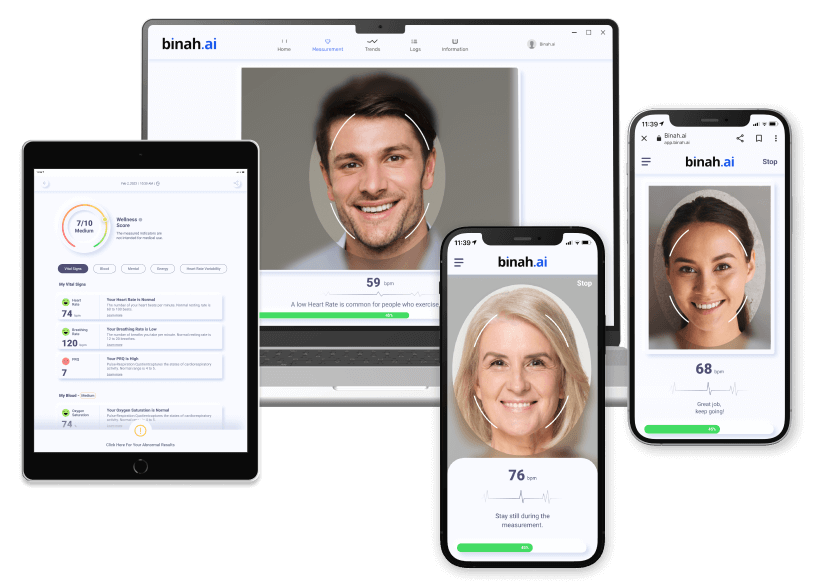
Integrate the SDK into an app or web flow
Integrate the Binah SDK into an existing iOS or Android app, or send a link that opens a mobile web check in Safari or Google Chrome. Supported app integrations include iOS 14+ and Android 10+.

Embed camera-based health and wellness spot checks in an app or mobile web flow; continuous checks use a compatible contact PPG sensor.
Binah.ai provides a health data SDK for businesses building health or wellness services. A team can add video-based spot checks to an iOS, Android, or mobile web app; users can open the mobile web check from a link without installing an app. The camera workflow analyzes a remote photoplethysmography (rPPG) signal from exposed facial skin. For a 35–60 second check, users should be at rest, remain still, avoid talking, and use a well-lit environment.
Camera checks are spot checks. Continuous checks use a PPG sensor and require skin contact; compatible sensors include Polar Verity Sense. The platform reports health and wellness indicators such as heart rate, blood pressure, breathing rate, and mental stress.
Integrate the Binah SDK into an existing iOS or Android app, or send a link that opens a mobile web check in Safari or Google Chrome. Supported app integrations include iOS 14+ and Android 10+.
For spot checks, the SDK analyzes an rPPG signal from light reflected by exposed facial skin. This camera workflow does not require skin contact.
Heart rate is reported in about 10 seconds, followed by blood pressure, respiration rate, and mental stress within 35–60 seconds. For optimal results, users should be resting, still, quiet, and in good lighting.
Continuous checks use a PPG signal from a sensor and require skin contact. Compatible sensors include the Polar Verity Sense heart-rate sensor.
The measurement process runs on the end-user’s device without an internet connection. Each user may opt to keep all data on their device.
A wellness service can integrate a camera spot check into its existing app so users can share selected health and wellness indicators as part of the service.
A business can send users a link to open a spot check in mobile Safari or Google Chrome, without requiring a separate mobile app for that flow.
A service that needs continuous readings can use the sensor-based PPG workflow, with a compatible contact sensor such as Polar Verity Sense.
No. A spot check uses a camera and does not require skin contact. Continuous checks use a PPG sensor in contact with the skin; Polar Verity Sense is one compatible sensor.
The check takes 35–60 seconds. For optimal results, the user should be at rest, remain still, avoid talking, and use a well-lit environment.
Yes. A business can send a link that opens the web check in mobile Safari or Google Chrome. The SDK also supports iOS 14+ and Android 10+ app integrations.
No. The measurement process runs on the end-user device and does not need an internet connection. Each user may opt to keep all data on the device.
No. Binah.ai’s product and its analysis are not intended to diagnose, treat, monitor, cure, or prevent disease and do not replace medical or scientific measurement devices or a physician’s diagnosis. Analysis accuracy and completeness are not guaranteed.
Traffic data is for reference only.