
Runtime action enforcement
Inspect each agent action at the point where it is about to execute. Tool policies can use identity, role, route, typed arguments, target resources, and prior run steps, with decisions that allow, block, or hold an action.

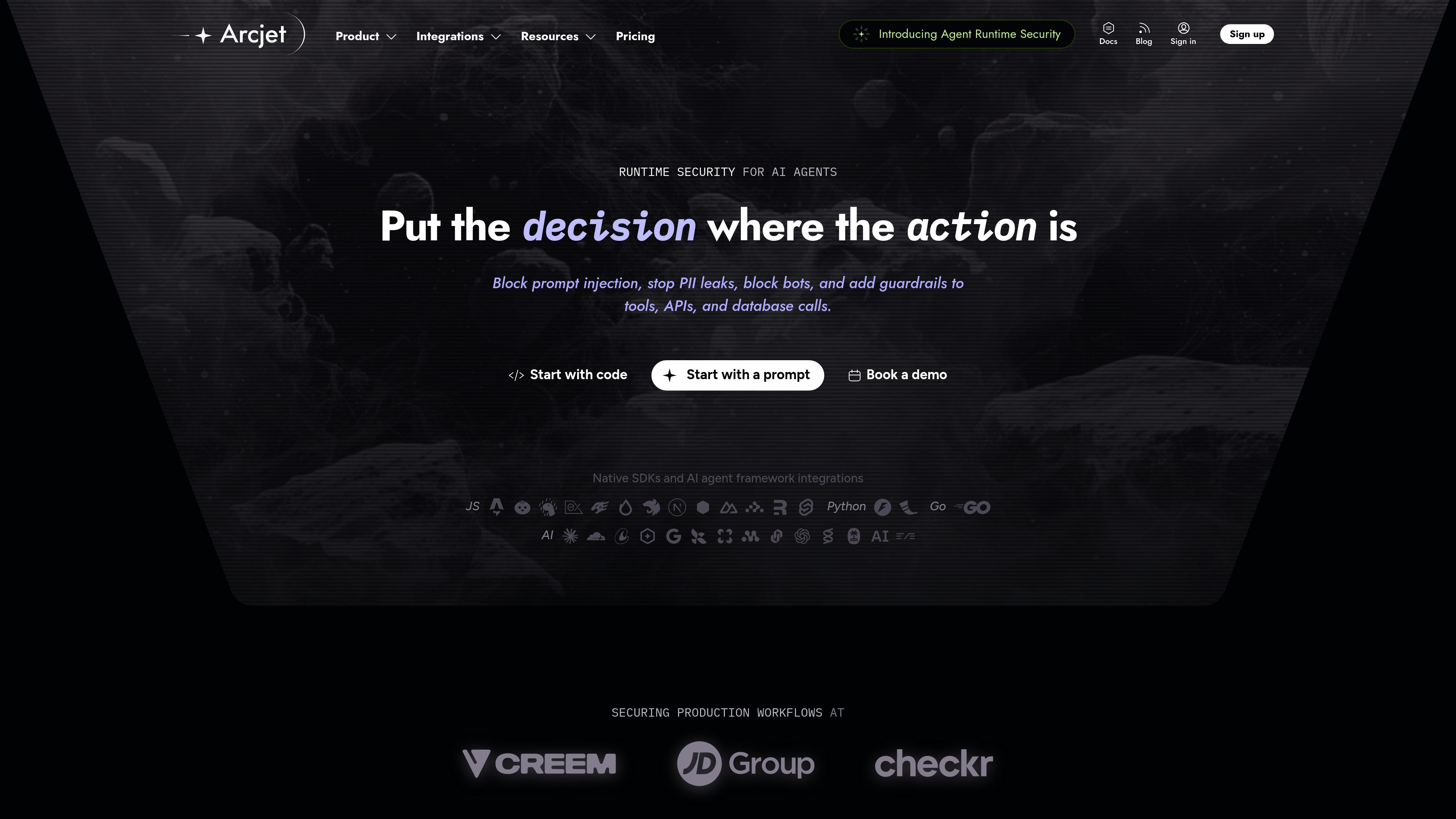
Arcjet is an AI agent runtime security platform for inspecting and enforcing policy on agent actions, prompts, tool calls, and data flows. It also protects web and AI endpoints from bots, prompt injection, sensitive-data leaks, and uncontrolled usage.
Arcjet is an AI agent runtime security platform for applications that need to control what agents do while a workflow is running. It observes actions inside the application, evaluates policy before execution, and records decisions and context so teams can investigate what happened.
Its controls cover prompt injection, agent tool authorization, sensitive information and data loss prevention, token and spend budgets, bot traffic, and web application abuse. Policies can consider the actor, route, identity, typed inputs, target action, and prior steps in a run. Decisions can allow, block, redact, or hold an operation for review.
Arcjet is designed for developers securing production AI agents, AI endpoints, web applications, and custom workflows. It provides SDKs for JavaScript, Python, and Go, plus listed integrations with several web frameworks and AI agent frameworks.
Inspect each agent action at the point where it is about to execute. Tool policies can use identity, role, route, typed arguments, target resources, and prior run steps, with decisions that allow, block, or hold an action.
Screen user messages, retrieved pages, API responses, and tool output for hostile instructions before the content reaches the model or is used in a subsequent step.
Detect and strip names, addresses, national IDs, bank numbers, and card numbers before they enter model context, logs, or third-party tools. The source describes in-process inspection for keeping sensitive data in the application environment.
Apply token or call budgets to a user, organization, agent, or run rather than treating each endpoint as an isolated limit. A request can be denied before a model call when the configured budget is exhausted.
Capture actions with context such as the user, session, route, actor, tool label, typed arguments, and previous steps. Decisions and policy versions are retained as evidence for reviewing agent behavior.
Use bot detection, Shield WAF, email validation, signup protection, and related controls to protect HTTP-facing applications and AI endpoints from automated or abusive traffic.
Screen ticket notes and customer data before they become model context or tool inputs, then restrict actions such as customer lookups and outbound replies to reduce accidental disclosure.
Wrap sensitive operations such as refunds or other state-changing tools with policies based on the authenticated user, role, action, and typed arguments so an unauthorized call is stopped before the tool runs.
Check prompts, fetched pages, domains, shell commands, and other tool inputs for prompt injection or unsafe destinations before an agent downloads, executes, or communicates with external content.
Combine bot detection, access policies, and per-user, per-tenant, or per-route budgets to distinguish trusted users from automated clients and limit abusive AI usage before the provider call.
Use grouped run history, decisions, policy versions, actors, inputs, and prior steps to trace an incident, understand sequence drift, and preserve evidence of downstream actions.
Arcjet evaluates controls inside the application at runtime, before an action or tool call executes. The application receives the decision and acts on it, so the control can change whether the operation proceeds.
The homepage describes four outcomes: allow, block, redact, and hold for review. The application is responsible for handling the returned decision before continuing the workflow.
The source says sensitive checks run in process so the data does not leave the application's environment. It specifically describes local detection for sensitive information; implementation details may vary by control and integration.
Arcjet also provides controls for HTTP-facing applications and AI endpoints, including bot detection, Shield WAF, email validation, signup protection, and usage or token-bucket budgets.
The pricing page lists Individual at $25 per month, Startup at $299 per month, and custom pricing for Enterprise. It also lists usage fees, including separate rates for web requests and agent requests, and a 15-day free trial.

premai.io
Sovereign AI infrastructure and agent tools for organizations handling sensitive data.

harden.run
Agentic Integrity Foundation is a local endpoint-security product for coding agents. It evaluates supported tool calls before execution and can allow, approve, make safe, block, or record actions on a developer’s machine.
www.edgee.ai
Edgee is an agent gateway for coding teams that reduces token usage, routes requests across models, and provides usage visibility. Its Compression V2 works as a drop-in CLI layer for Claude Code, Codex, OpenCode, Cursor, and other supported agents.

anysite.io
Anysite provides live web data to AI assistants and software through MCP, REST API, and CLI interfaces. It helps GTM, marketing, research, and other teams query 900+ sources and 5,000+ endpoints for structured results.

www.usepropane.ai
Propane connects customer, competitor, and tool data in one shared context layer, with flat-fee unlimited users, a 7-day trial, and one-click agent handoff.

www.imessage.store
agent store is a directory of AI agents you can text from iOS, organized by use case. It also maps infrastructure providers and APIs that power iMessage-based agents.