
Claude Code setup guide
The homepage gives step-by-step setup instructions for Claude Code, including the required environment variables and the terminal commands to start using the service.

Any Router routes APIs for CLI coding tools such as Claude Code, OpenAI Codex, and OpenClaw, with token access, setup guides, and pay-as-you-go model pricing.
Any Router is an API access and routing service centered on Claude Code workflows, with documented support for Claude Code, OpenAI Codex, and OpenClaw. The site provides login, registration, pricing, and setup instructions that show how to connect these clients to Any Router’s base URL and token-based authentication.
The homepage positions the service as a way to use AI coding tools from the terminal by setting ANTHROPIC_AUTH_TOKEN and ANTHROPIC_BASE_URL, while the Codex instructions use an Any Router model provider configuration under ~/.codex. The pricing page shows pay-as-you-go model pricing with per-model ratios and token rates across OpenAI and Anthropic models.
The homepage gives step-by-step setup instructions for Claude Code, including the required environment variables and the terminal commands to start using the service.
A separate section shows how to configure OpenAI Codex with an Any Router model provider, base URL, and auth file so the CLI can route requests through the service.
The openclaw page publishes a sample provider configuration with a model entry for Claude Opus 4.6, including context window, token limits, and multimodal input fields.
The pricing page lists available models with model ratios, completion ratios, billing type, and token prices, making the cost formula visible before use.
The homepage FAQ explains that the service forwards official Claude Code traffic and mentions a fallback API endpoint for some network conditions.
A developer using Claude Code can follow the homepage steps to install the CLI, set `ANTHROPIC_AUTH_TOKEN`, point `ANTHROPIC_BASE_URL` at `https://anyrouter.top`, and start working from the terminal.
A user who prefers OpenAI Codex can create the `~/.codex/config.toml` and `~/.codex/auth.json` files shown on the homepage to route Codex requests through Any Router.
Someone configuring OpenClaw can copy the sample provider block from the `/openclaw` page and adapt the base URL and API key fields for their own setup.
A user comparing costs can review the pricing table to see model-specific ratios, completion ratios, and token prices before selecting a model for a task.
A user troubleshooting access can consult the homepage FAQ for guidance on login errors, offline status, or fetch failures.
Any Router provides an API service and documentation for using it with Claude Code, OpenAI Codex, and OpenClaw. The homepage also notes that the site directly forwards official Claude Code traffic rather than arbitrary non-Claude Code API traffic.
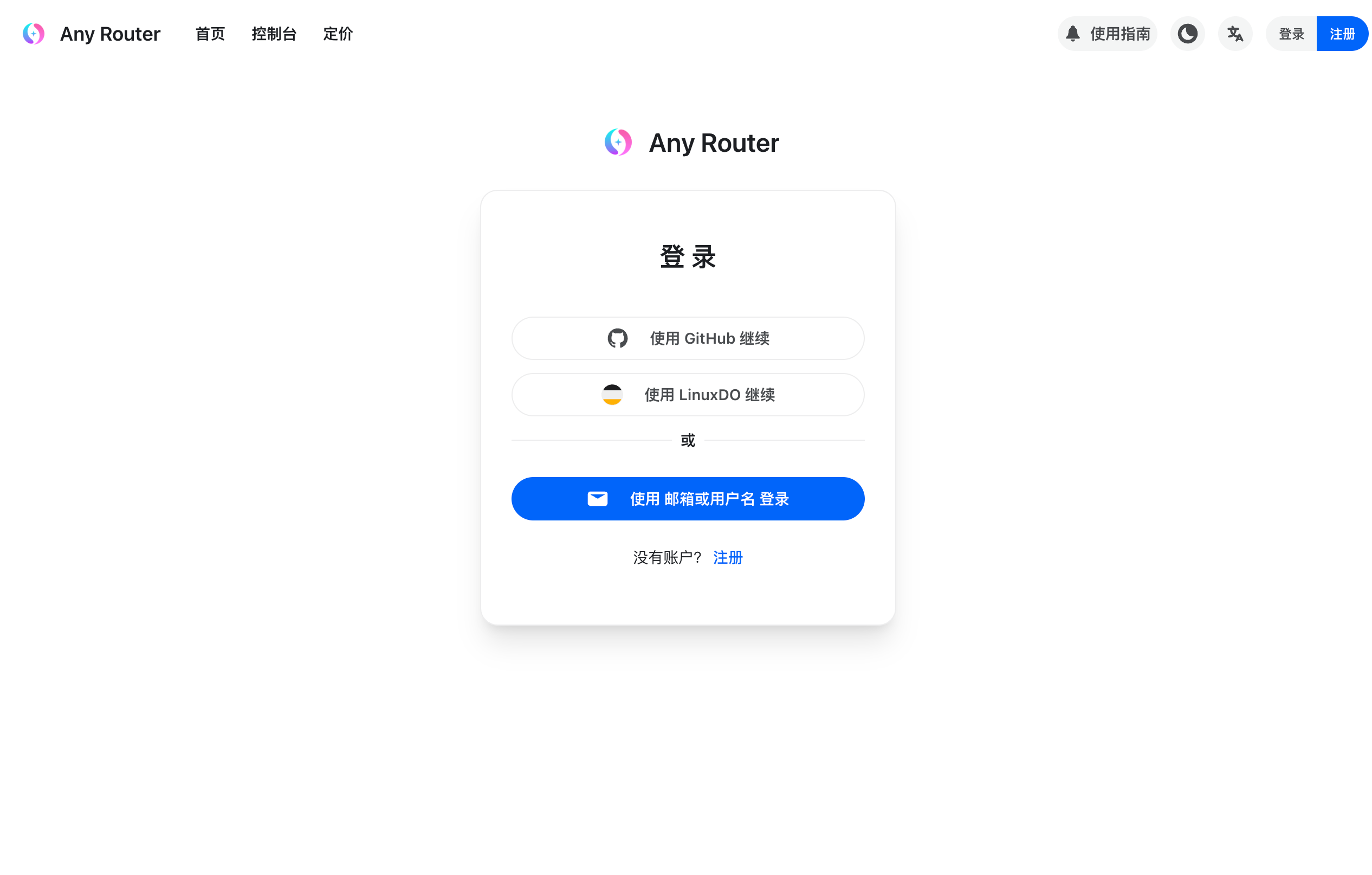
The site supports login with GitHub, LinuxDO, and email or username, and the homepage notes an experimental email registration option restricted to *.edu.cn addresses at the time shown in the source. The register page itself is protected by a verification step.
The pricing page shows pay-as-you-go model pricing with per-model ratios and token rates, including multiple OpenAI and Anthropic models. The site also applies a group ratio, which is shown as 1x when not logged in on the captured page.
The homepage instructions describe setting ANTHROPIC_AUTH_TOKEN and ANTHROPIC_BASE_URL for Claude Code, and a separate config path for Codex under ~/.codex. The openclaw page provides a sample configuration that points to https://anyrouter.top.
The source suggests the service is centered on Claude Code forwarding and related model access. It does not provide a full integrations catalog, so support beyond the documented command-line workflows is unclear from the available pages.
Traffic data is for reference only.
| Apr | 823630 |
|---|---|
| May | 959859 |
| Jun | 1488007 |

eachlabs.ai
each::labs provides a single API for orchestrating more than 600 AI models, with routing, fallback handling, observability, and usage-based pricing. It is designed for teams building and operating production AI applications across video, image, audio, and text workflows.

piapi.ai
PiAPI is a unified platform for generating video, images, audio, 3D assets, and LLM outputs through a model catalog, playground, APIs, CLI, and MCP server. It is designed for developers, AI agents, and automation workflows that need access to multiple generative models.

docs.litellm.ai
LiteLLM lets teams call and manage 100+ LLMs through an OpenAI-compatible SDK or proxy, with request routing, spend tracking, and multi-provider access.

portkey.ai
Production AI platform with gateway, observability, guardrails, and prompt management for Gen AI teams.

gmicloud.ai
AI infrastructure for production inference, training, and fine-tuning on NVIDIA GPUs.
aimlapi.com
AIMLAPI provides one API and billing key for accessing a catalog of AI models for chat, reasoning, image, video, audio, voice, search, embeddings, code, and related tasks. It is intended for developers and teams that want to compare and use models from multiple providers through a common platform.