
Inference-time scaling
Aide frames its work around agents that operate at inference time, emphasizing test-time scaling rather than a fixed, one-shot output from a model.

Aide is an AI-native developer tools lab for software engineering workflows, with agentic coding, debugging, maintenance, and swebench-verified inference-time scaling.
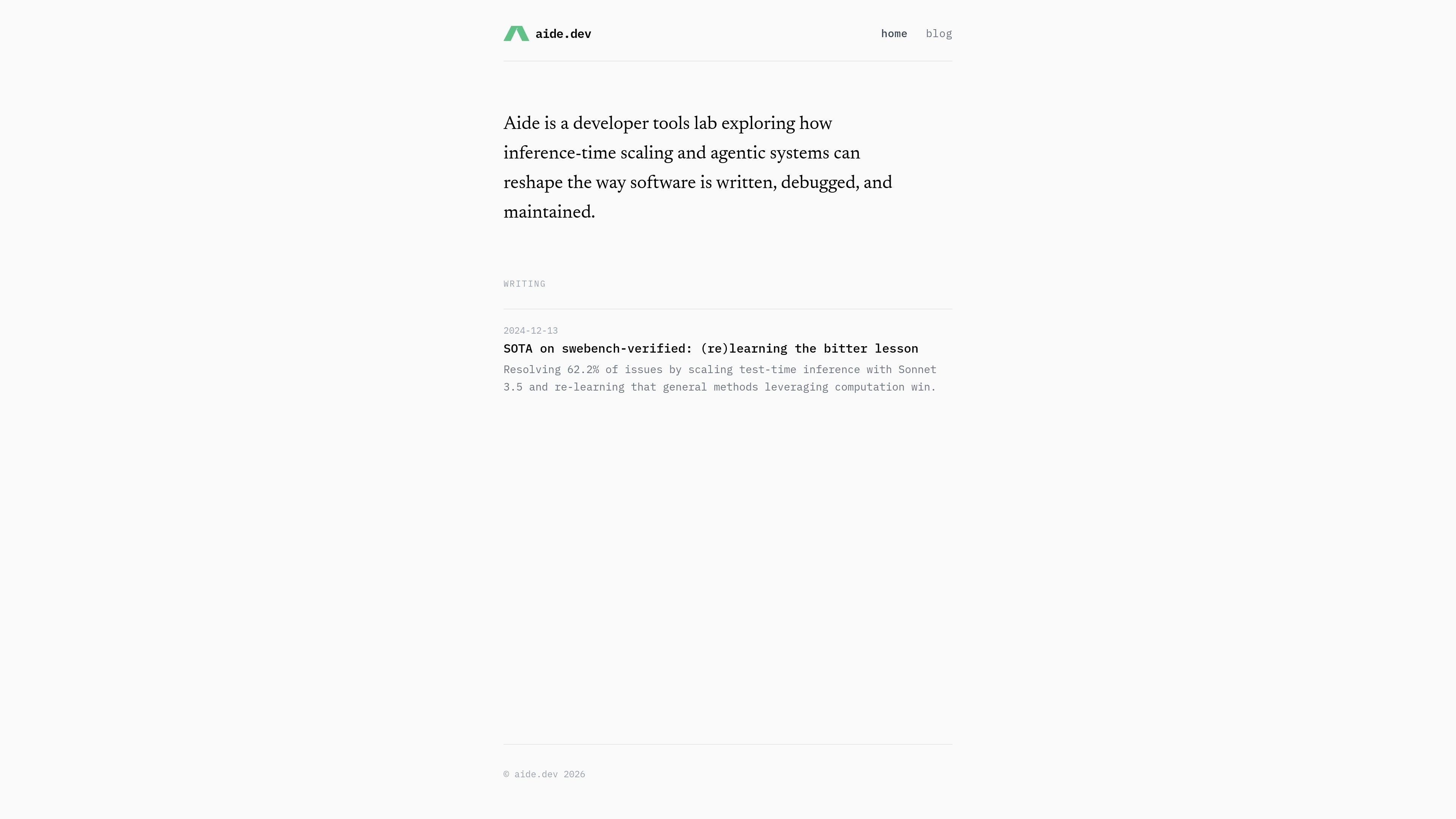
Aide is an AI-native developer tools lab focused on software engineering. Its public site describes the product direction as exploring how inference-time scaling and agentic systems can change how software is written, debugged, and maintained.
The published material centers on agents that work at test time, not just at training time. In a blog post, Aide says it reached 62.2% on swebench-verified by scaling test-time inference with Sonnet 3.5 and simplifying the agent setup to rely on basic developer tools and iterative exploration.
Aide frames its work around agents that operate at inference time, emphasizing test-time scaling rather than a fixed, one-shot output from a model.
The site positions the product around software engineering tasks, including writing, debugging, and maintaining code.
The blog post describes an evaluation setup built around simple tools such as file listing, file opening, search, edit replacement, completion, ripgrep, and terminal access.
Aide describes its approach as agentic, meaning the system explores and iterates through solution paths instead of relying only on a single deterministic pass.
The published research post says the team used Sonnet 3.5 in its benchmark run and improved results through test-time scaling.
Useful for teams exploring agent-based coding assistance that can search, inspect files, edit code, and use the terminal while working through a task.
Useful for debugging or issue resolution workflows where an agent may need to inspect the repository, follow clues, and iterate across multiple steps.
Useful for product or research teams evaluating inference-time scaling approaches on software engineering benchmarks and internal tasks.
Useful for engineering teams interested in a lightweight agent setup built from basic developer tools rather than a large custom toolchain.
Aide is presented as an AI-native developer tools lab focused on software engineering workflows. The site describes it as exploring how inference-time scaling and agentic systems can reshape how software is written, debugged, and maintained.
The published material highlights agentic software-engineering workflows and test-time scaling, but it does not provide a full product walkthrough or setup guide on the pages reviewed.
The site does not list pricing details on the pricing page reviewed. That page currently returns a 404-style not found message.
The blog post describes an agent setup that used file listing, file opening, search, replacement editing, completion, ripgrep search, and terminal access. Beyond that, the site does not publish a broader integrations list in the reviewed sources.