
Grant funding for open source AI
Provides grants ranging from $5,000 to $50,000 for open source AI projects, giving recipients funding at an early or ongoing stage of work.
AI Grant offers $5,000 to $50,000 for open source AI projects, in compute or cash, to support work aligned with its open source focus.
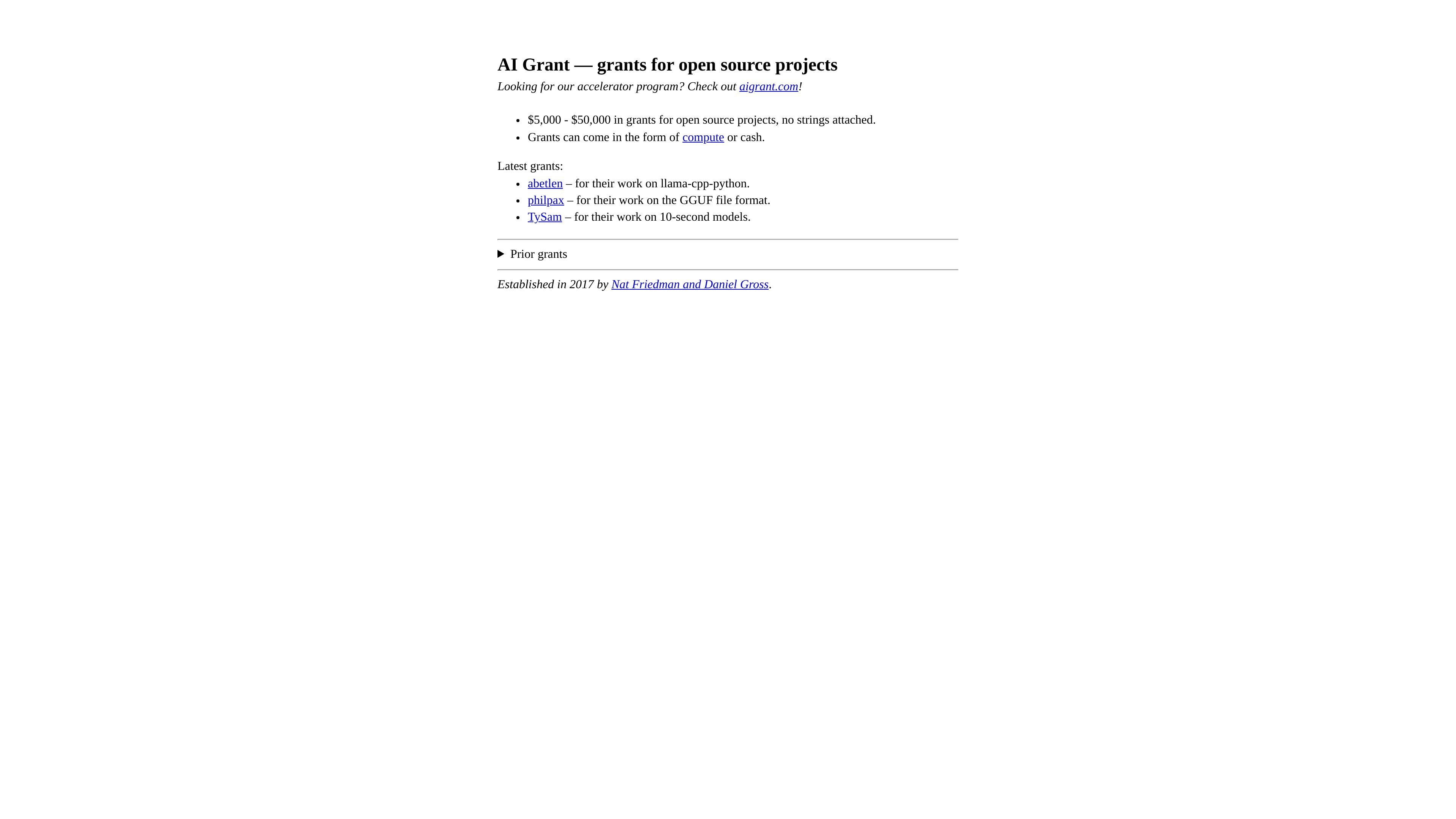
AI Grant is a grant program for open source AI projects. Its homepage says it provides $5,000 to $50,000 in support and that grants can be issued as compute or cash.
The site positions the program around open source work and highlights examples of funded projects, including libraries, file formats, datasets, models, and research tools. It also notes that the grants are 'no strings attached,' but it does not publish a detailed application guide or eligibility page on the pages provided.
Provides grants ranging from $5,000 to $50,000 for open source AI projects, giving recipients funding at an early or ongoing stage of work.
Supports awards in either compute or cash, so funding can be matched to the project’s immediate needs.
Publishes examples of prior and latest grants on the homepage, which gives readers a sense of the kinds of projects the program has supported.
Frames the funding as 'no strings attached,' indicating that the homepage presents the grants as unrestricted support rather than a product purchase or service contract.
Connects to work across research, tooling, datasets, and applied ML projects, showing a broad open-source AI remit.
Open source AI developers can seek funding to continue work on a library, model, or infrastructure component without wrapping it into a paid software subscription model.
Researchers building datasets, experimental methods, or specialized models can use the grant to offset compute or project costs.
Maintainers of widely used tools can look for support when they want to add features or keep a project moving forward with open source licensing.
Teams with immediate infrastructure needs can benefit when grant support is provided as compute instead of cash.
AI Grant provides grants for open source AI projects. The homepage does not describe a separate application portal or eligibility checklist, so the public site only confirms the program is for open source work.
The homepage says grants can come in the form of compute or cash, and that awards range from $5,000 to $50,000.
The site does not publish a pricing page for buyers. The available page is a 404, which suggests this is a grant program rather than a software subscription product.
The site lists prior and latest grants and references work on open source libraries, models, datasets, and research projects. It does not provide a detailed process page describing review steps or timelines.
The homepage points users looking for an accelerator program to aigrant.com, which suggests AI Grant and the accelerator program are separate offerings.