
Open-ended comparison gameplay
The core game asks players to find something that beats the previous answer, extending the rock-paper-scissors idea into an open-ended challenge.

What Beats Rock Game is a browser game where players name things that beat the previous answer, with leaderboards, community variants, and score saving.
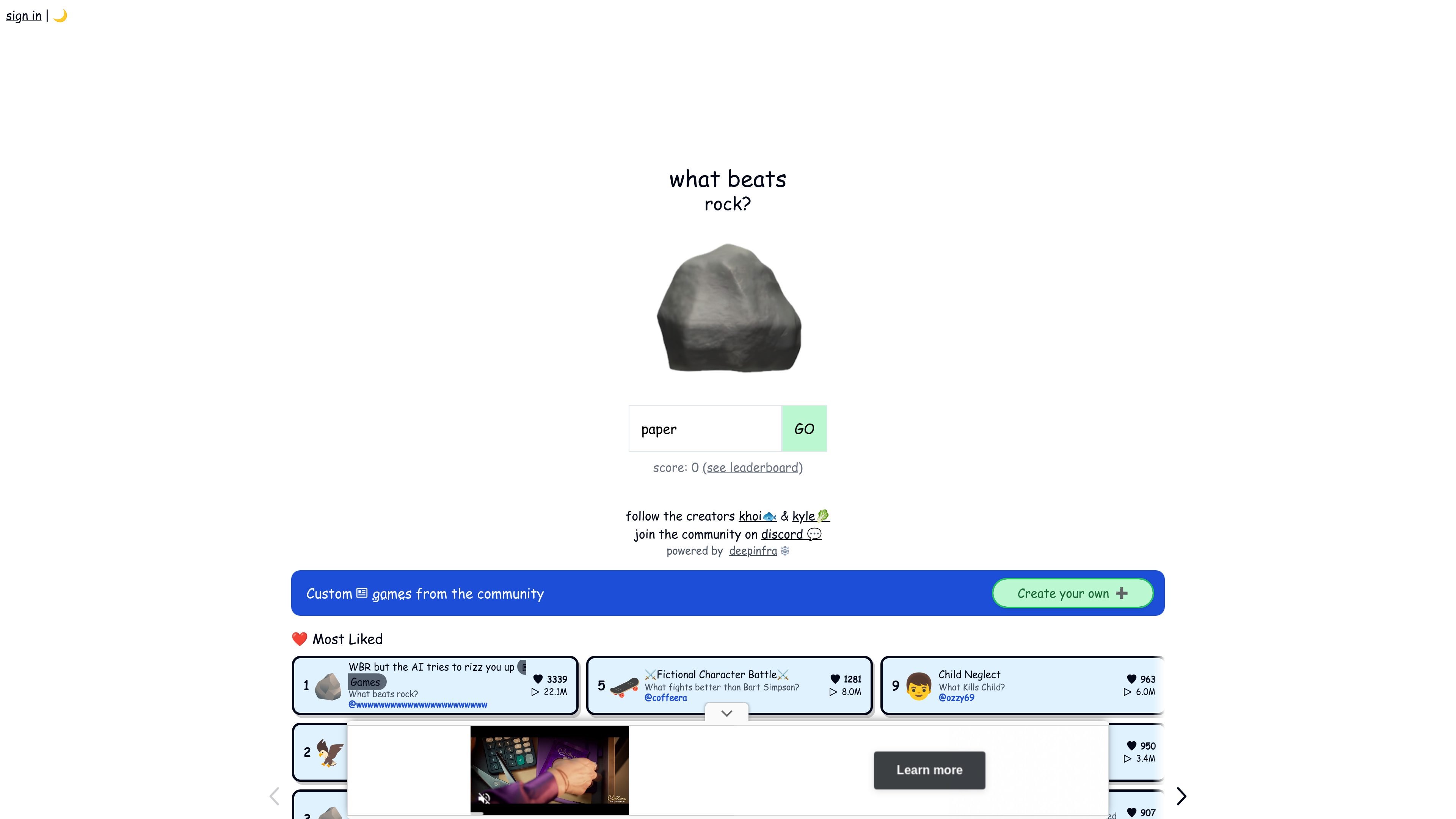
What Beats Rock is a browser game built around a simple prompt: name something that beats the previous item, starting from rock and continuing as far as the player can go. The site presents itself as “Play Rock Paper Scissors but it... keeps going?”, which captures the game’s open-ended format and its focus on quick, creative answers.
The home page centers the main play flow and also surfaces community activity through a leaderboard and a gallery of custom games. That makes the product both a standalone game and a hub for user-made variations, score comparison, and account-based features such as saving progress across devices.
The core game asks players to find something that beats the previous answer, extending the rock-paper-scissors idea into an open-ended challenge.
The homepage shows a running score and a leaderboard link, so players can see progress and compare results.
The leaderboard page separates weekly high scores from all-time scores, giving two ways to browse top performances.
The custom page offers Google and Discord sign-in options for joining the game.
The custom page says players can save scores, collect trophies across devices, and decorate their rock.
The homepage includes a “Create your own” entry point and a list of community-made games, indicating that users can build and share custom variants.
For players who want a fast, low-friction game session, the site offers a single prompt and an immediate play loop that works from the browser.
For users who like competing with others, the leaderboard provides a way to check weekly and all-time rankings against the wider player base.
For people who want a more personalized experience, the custom page points to sign-in, saved scores, trophies, and cosmetic decoration for the rock.
For creators who want to experiment with the format, the home page’s custom game gallery and “Create your own” entry point support making and browsing variants.
You can start from the home page at whatbeatsrock.com and sign in from the top navigation. The site also offers a custom flow that says “Join What Beats Rock” and lets you continue with Google or Discord.
The homepage shows a score counter and a link to the leaderboard, while the leaderboard page includes weekly high scores and all-time scores.
Yes. The custom page says you can save your scores, collect trophies across devices, and decorate your rock.
The site says it is powered by DeepInfra and includes community links such as Discord, but the provided pages do not show formal third-party integrations beyond those references.
The pricing page at /pricing currently returns a 404, so the site does not present a verifiable pricing structure in the provided source pages.