
API and CSV payout workflows
Trigger payouts programmatically through a developer-friendly REST API, or process bulk payment files through CSV upload when you need a more manual workflow.

Routable is a payments, vendor management, and AP platform for businesses that need to send payouts, onboard vendors, and automate AP workflows at scale.
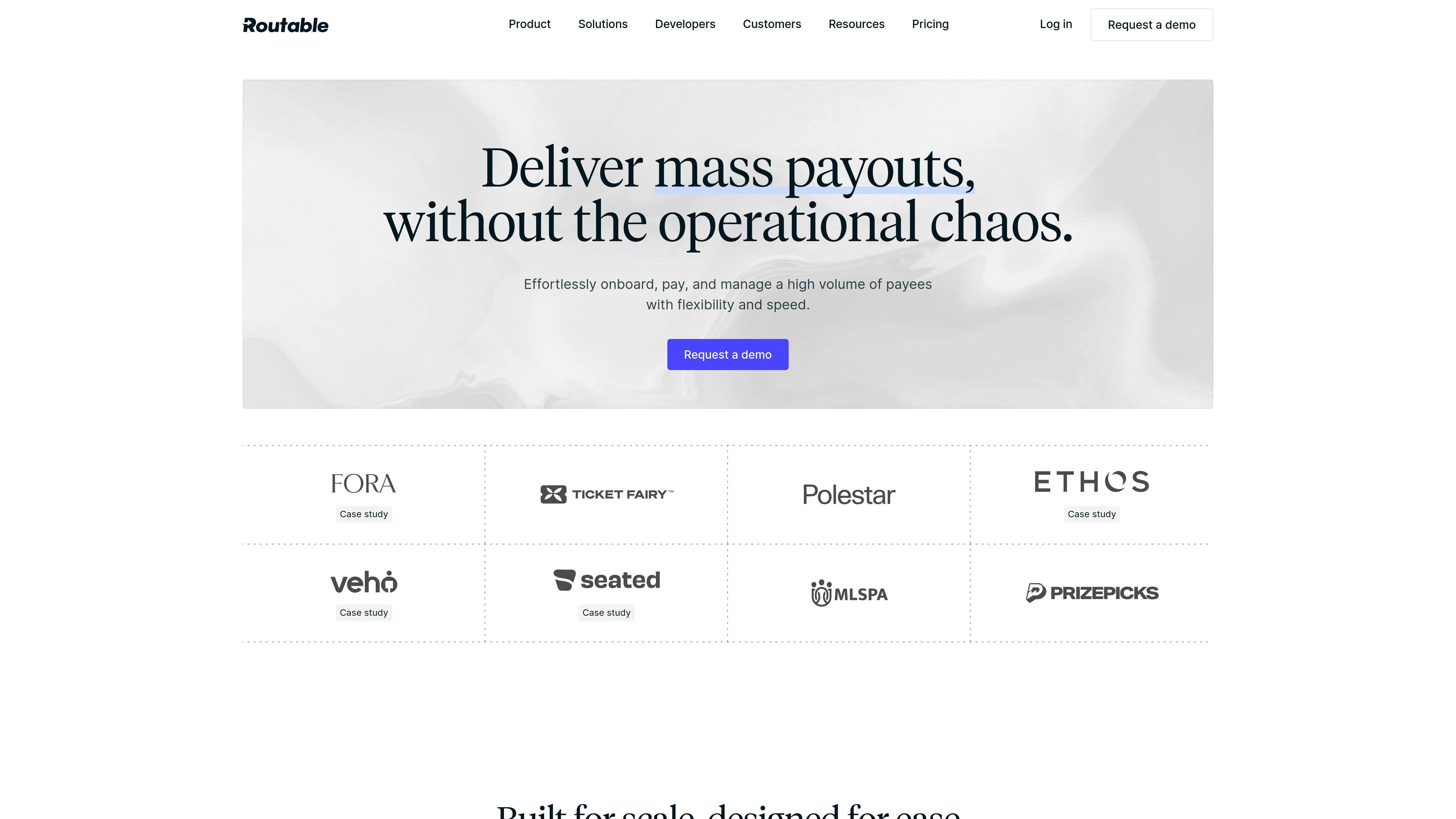
Routable is a payments, vendor management, and accounts payable platform for businesses that need to move money at scale while keeping control over onboarding, approvals, compliance, and reconciliation. The site presents it as a single system for mass payouts, vendor workflows, and AP automation rather than a point solution for one payment method.
From the homepage and pricing pages, Routable supports API-driven payments, CSV uploads, international transfers, onboarding flows, and approval controls. It also includes paid plans for growing teams and larger organizations, with published growth, scale, and enterprise tiers and an annual billing option that saves 20%.
The product is positioned for finance and operations teams that manage many payees, vendors, or bills and want to reduce manual processing. Source material also highlights integrations with accounting and ERP systems, including NetSuite and Sage Intacct, and mentions two-way sync with high accuracy.
Trigger payouts programmatically through a developer-friendly REST API, or process bulk payment files through CSV upload when you need a more manual workflow.
Send payments domestically and internationally, with support for 220+ countries and territories and 140+ currencies. The source also notes instant, same-day, and next-day ACH options in some contexts.
Collect tax forms and payment details during onboarding, use branded invitations and notifications, and keep vendor data synchronized with accounting software.
Apply built-in controls such as approval workflows, budget checks, transaction limits, and compliance checks before payment runs are released.
Support AP tasks such as invoice OCR, bill coding, PO matching, and reconciliation to reduce manual data entry and close-out work.
Finance teams can run high-volume payouts through the API or a CSV file when they need to pay vendors, contractors, partners, or customers without building a custom payment stack from scratch.
Operations teams can onboard vendors in a branded workflow that collects tax forms, bank details, and payment methods before the first payment is issued.
Accounting teams can use invoice capture, bill coding, approvals, and reconciliation tools to reduce manual AP work and keep records aligned with the company’s accounting system.
Compliance teams can validate vendors before payment, apply tax form collection, and retain audit trails for review and controls.
Engineering teams can integrate payout workflows into existing systems through the REST API and developer resources instead of managing payments manually in separate tools.
Routable is designed to let teams send payouts either through the API or by CSV upload, depending on how they want to operationalize payment runs.
The source shows that Routable supports invite-based vendor onboarding, but it does not indicate that vendors must create a full account to receive payouts.
The pricing page shows three paid plans: Growth, Scale, and Enterprise. It also lists a monthly billed option and an annual option with 20% savings, but the exact feature limits and usage thresholds are not fully detailed in the source.
Routable supports workflow elements such as approval rules, vendor management, tax form collection, and compliance checks, but the exact setup process and team configuration details are not fully specified in the source.
The source identifies accounting and ERP integrations, and specifically mentions two-way sync with NetSuite and Sage Intacct, but it does not provide a complete integration catalog here.