
Topic and brand search
Search any topic, trend, or brand and have the platform surface what people are actually saying in online conversations, rather than requiring manual review of raw data.

OneCliq is an on-demand qualitative research platform that helps strategists, creatives, researchers, and marketing teams turn online conversations into sentiment, narrative, and action-oriented insights. The site also highlights video sentiment extraction, strategic recommendations, and enterprise onboarding support.
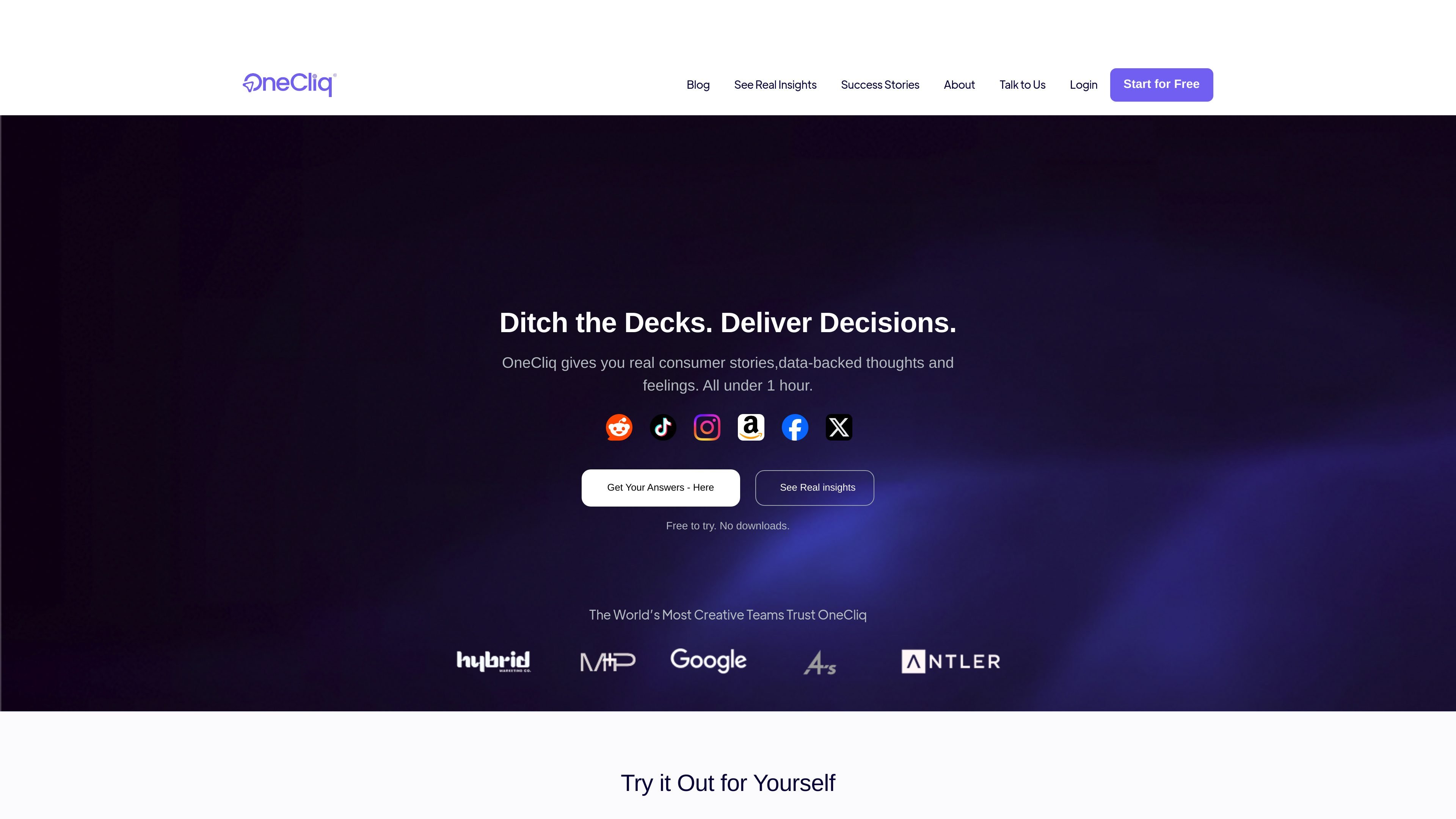
OneCliq is an on-demand qualitative research platform that turns online conversations into structured insights for strategists, creatives, researchers, and marketing teams. The product page describes it as a way to get qualitative answers at the speed of a search, with a focus on sentiment analysis, narrative analysis, and actionable asset creation.
The workflow shown on the site is simple: search a topic, trend, or brand; let the system analyze real conversations for emotions, themes, and what people care about; then receive ready-to-use ideas and decision support. The product is also positioned as a replacement for slower social listening workflows that can leave teams with generic data and unanswered questions about the “why” behind audience behavior.
OneCliq says the platform can extract sentiment from video even without audio, and it emphasizes emotional context over flat dashboards. The site also notes that OneCliq has been acquired by Dig Insights, with current customers retaining access and pricing while gaining support from Dig’s broader insights organization.
Search any topic, trend, or brand and have the platform surface what people are actually saying in online conversations, rather than requiring manual review of raw data.
Analyze emotional tone, sentiment, and narrative patterns to move beyond simple positive-or-negative summaries.
The site highlights proprietary emotional analysis and “emotion-first” strategic recommendations designed to turn findings into next-step ideas.
A video sentiment extraction model is described as reading emotion and sentiment even when videos have no audio.
Dynamic classification is presented as a way to capture the full emotional spectrum and preserve more context than a narrow dashboard view.
Enterprise customers get live onboarding, training, and workshops, along with support designed to help teams use the platform effectively.
Teams can use OneCliq to understand how people feel about a brand, product, or topic without manually sorting through large volumes of comments and posts.
Researchers and strategists can use the platform to surface the emotional drivers and narratives behind audience behavior, not just sentiment scores.
Creative and content teams can turn the platform’s outputs into campaign, messaging, or asset ideas based on what people are actually discussing.
Marketing teams can use the platform to shorten the gap between research and execution when they need insight quickly for planning or iteration.
Teams working with video content can apply the video sentiment extraction model to read reaction and sentiment even when clips do not include audio.
OneCliq is positioned as an on-demand consumer research and qualitative insights platform. The site describes a workflow where you search a topic, trend, or brand, and the system turns real conversations into sentiment, narrative, and action-oriented outputs.
The site is written for strategists, creatives, researchers, and marketing teams that need faster qualitative understanding of audience feelings, opinions, and themes.
The source says the platform supports search-driven analysis of real conversations, including emotional analysis, sentiment analysis, narrative analysis, and ready-to-use strategic ideas.
The pricing page currently returns a not found page, while the acquisition page says current OneCliq pricing is honored for existing customers after the Dig Insights acquisition.
The site emphasizes fast insight generation, automated workflows, and live onboarding and training for enterprise clients, but it does not provide a detailed public integration list or technical setup guide in the captured pages.