
Observability and tracing
Trace agent behavior into a structured timeline of steps so teams can understand what happened, in what order, and why.

LangSmith is LangChain’s engineering platform for observing, evaluating, and deploying AI agents. It helps developers and teams trace agent behavior, run evaluations, and ship production agents with managed infrastructure.
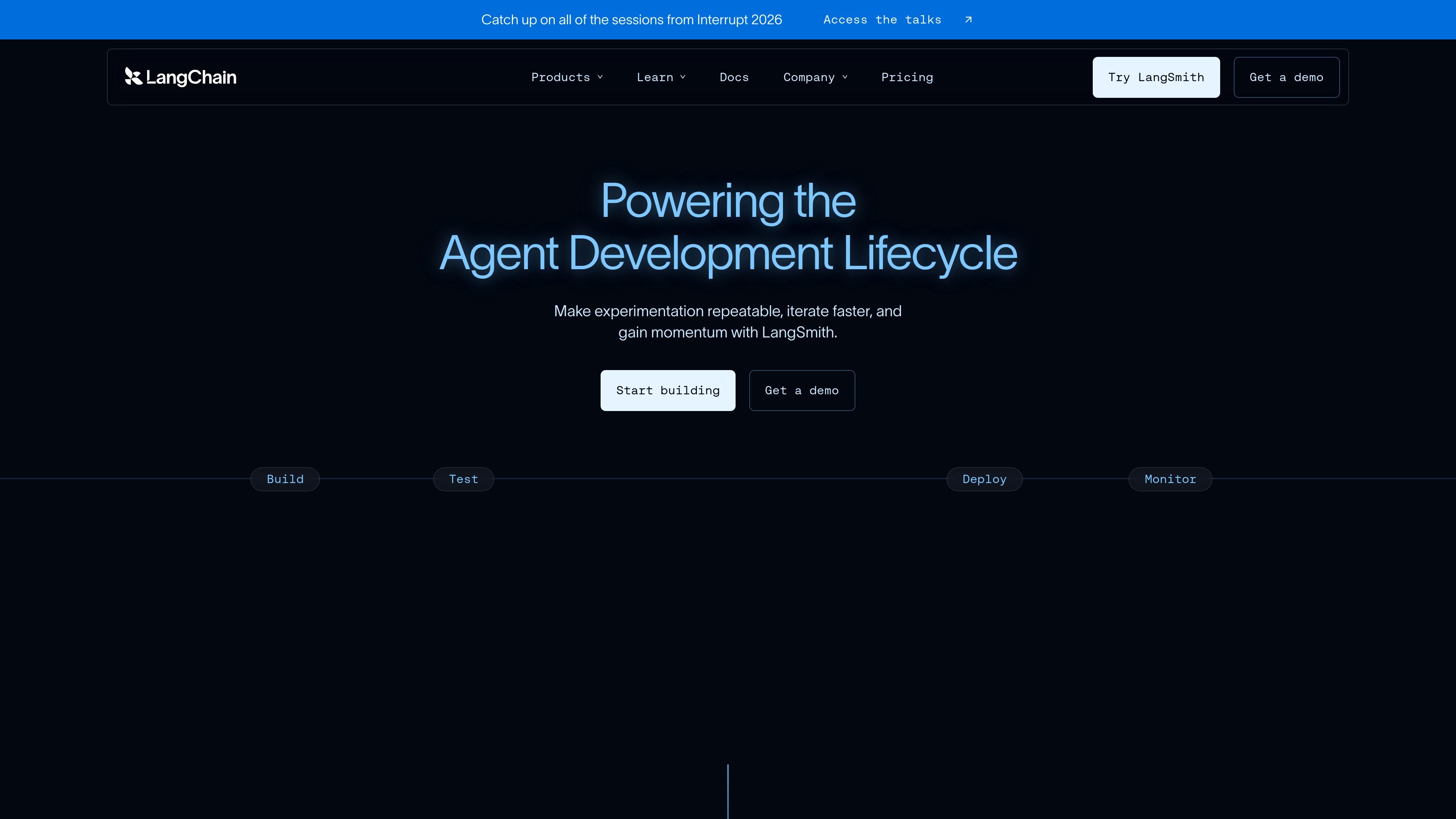
LangChain provides LangSmith, an engineering platform for observing, evaluating, and deploying AI agents, alongside open source frameworks for building them. The platform is aimed at developers and teams that need to make agent experimentation repeatable, improve quality with test and review workflows, and ship production systems with more control.
The product spans the agent development lifecycle: tracing and analytics for understanding behavior, evaluation tools for scoring agents with human and automated feedback, deployment infrastructure for long-running and collaborative agents, and Fleet for turning routine tasks into recurring agents. LangSmith is presented as framework-agnostic and supports Python, TypeScript, Go, and Java SDKs.
Trace agent behavior into a structured timeline of steps so teams can understand what happened, in what order, and why.
Run offline and online evaluations, compare prompt or model versions, and use human feedback to calibrate automated scoring.
Deploy agents with memory, conversational threads, durable checkpointing, and support for human-in-the-loop interactions.
Build agents on LangSmith Engine, which clusters production failures, identifies root causes in traces and code, and proposes fixes for review.
Create recurring agents for everyday tasks in Fleet, with templates, tool connections, API triggering, and shared feedback loops.
Use Python, TypeScript, Go, or Java SDKs and connect to agent stacks through framework-agnostic tracing.
Inspect traces, thread history, and analytics to pinpoint where a long or branching agent flow went wrong.
Run curated datasets and production traffic through online and offline evals to compare versions and catch regressions before release.
Use deployment infrastructure to ship long-running agents that need memory, conversational state, checkpointing, and human-in-the-loop steps.
Convert recurring work such as research, follow-ups, or status checks into agents that can be triggered through everyday language or API calls.
Use annotation queues and shared scoring criteria to gather expert feedback and calibrate judge-based evaluation.
Yes. The source says LangSmith is framework-agnostic, and you can use it with LangGraph, custom Python, or other frameworks through the SDK or API.
LangSmith supports human evaluation through annotation queues, heuristic checks, LLM-as-judge evaluators, pairwise comparisons, and custom evaluators in Python or TypeScript.
Yes. The source says LangSmith integrates with pytest, Vitest, and GitHub workflows so teams can run evals on every PR or nightly build.
The pricing page shows a Developer plan, a Plus plan, and an Enterprise plan. Developer is self-serve for solo users, Plus is for teams, and Enterprise covers advanced hosting, security, support, and deployment needs.
No. The source says LangSmith does not train on customer data, and traces, prompts, and outputs remain private to the organization.