
Text network visualization
Turn pasted text, documents, spreadsheets, or web sources into a visual network of concepts and co-occurrences so you can see how ideas connect.

InfraNodus is an AI text analysis and knowledge graph tool that helps users inspect topics, clusters, and gaps in text. It supports research, ideation, SEO, qualitative analysis, and LLM-assisted workflows.
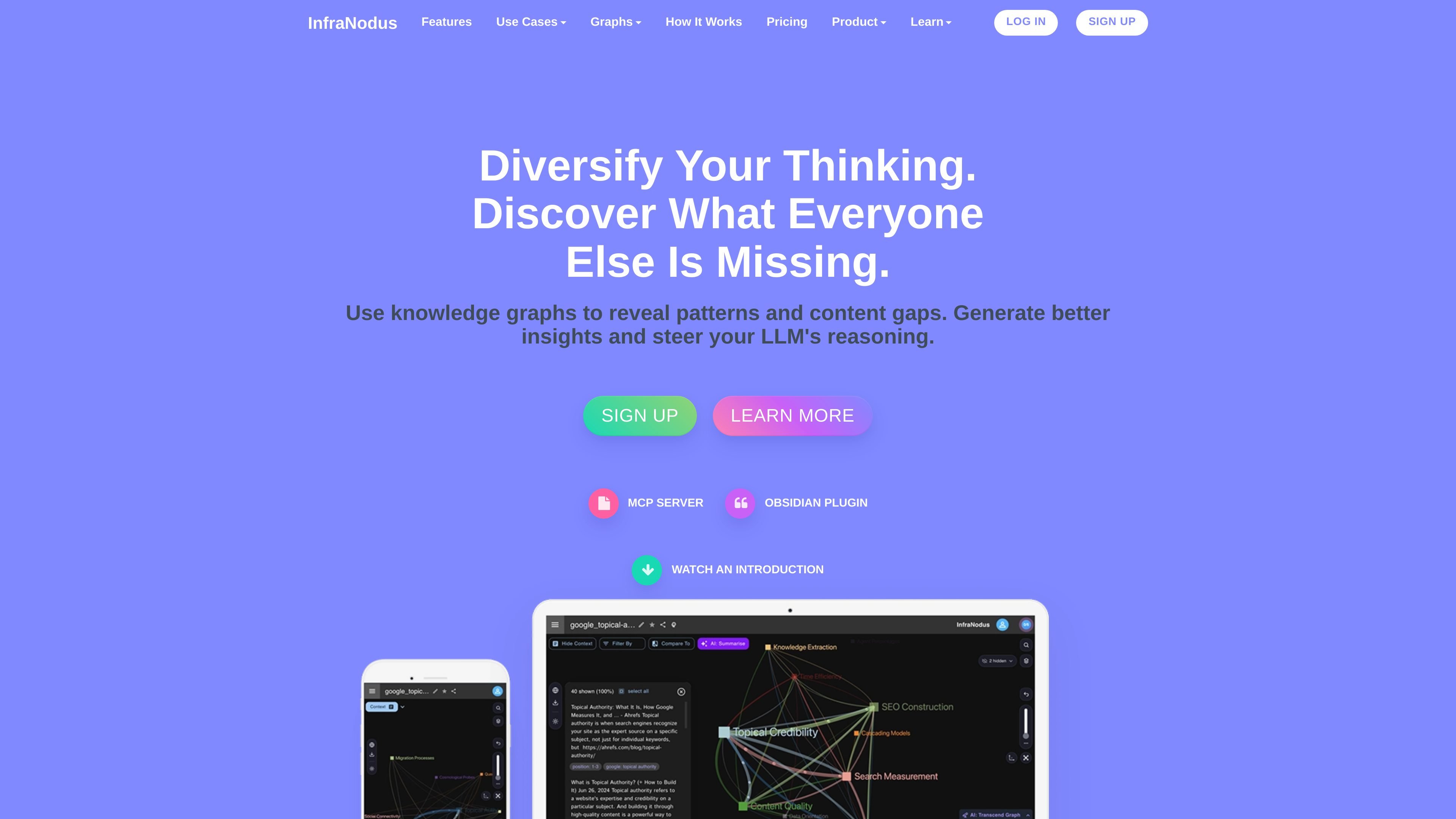
InfraNodus is an AI text analysis and knowledge graph tool for research, ideation, and exploration. It turns text into a visual network of concepts and co-occurrences so you can inspect topics, patterns, and missing links in a discourse.
The product combines text mining, network analysis, data visualization, NLP, and AI. According to the site, this approach helps users generate summaries, discover content gaps, and use the graph structure to guide deeper analysis in a more interactive way.
Turn pasted text, documents, spreadsheets, or web sources into a visual network of concepts and co-occurrences so you can see how ideas connect.
Identify topical clusters, structural gaps, and repeated patterns in a discourse to understand what is emphasized and what is missing.
Use the built-in AI models or MCP-connected LLMs to summarize, expand, and generate research questions from the graph structure.
Import from multiple sources, including PDFs, Markdown, CSVs, Google search results, YouTube content, websites, RSS feeds, and more.
Work through an interactive graph, live editor, and step-by-step workflow that moves from import to overview, drilling into details and then finding gaps.
Share graphs online, embed them, export high-resolution images, and use the browser extension or API for web-based analysis.
Analyze papers, notes, survey responses, or other research material to identify main topics, overlaps, and structural gaps before writing or presenting findings.
Study search results, competitor pages, customer reviews, or product pages to see which themes dominate and where content opportunities may be missing.
Map interviews, discussion transcripts, or open-ended responses as a knowledge graph to surface recurring themes and gaps in qualitative data.
Use the MCP server inside Claude, ChatGPT, Cursor, or another compatible client to query a graph and generate insights from natural-language prompts.
Import websites, RSS feeds, YouTube content, or search results to monitor how a topic is evolving and compare related sources side by side.
InfraNodus accepts text pasted into its editor, uploaded files, and imported data from sources such as PDFs, Markdown files, CSVs, spreadsheets, Google search results, YouTube content, websites, RSS feeds, and some external research sources. Its MCP server also lets compatible LLM clients query InfraNodus graphs through natural language.
The source pages describe three main ways to use InfraNodus: work in the built-in text editor, import files or web data, or connect through the MCP server from an LLM client such as Claude, ChatGPT, Cursor, or local CLI tools.
InfraNodus does not present itself as a simple keyword counter. It turns text into a network of concepts and co-occurrences, then highlights clusters, gaps, and related excerpts so you can explore the structure of the material.
The source shows that InfraNodus can be used individually and through shareable graphs, embeds, exports, API access, and the MCP server. It does not provide team plan details or collaboration limits on the pages reviewed.
The pricing page was not available in the collected sources, so pricing, plan names, and trial details could not be confirmed from the evidence provided.