
Task-centered workspace
Manage tasks, agent sessions, artifacts, and worktrees in a single workspace so engineers and teammates can follow the work together.

HumanLayer is an AI IDE and collaboration platform for engineers in complex codebases, with agent sessions, artifacts, and review workflows.
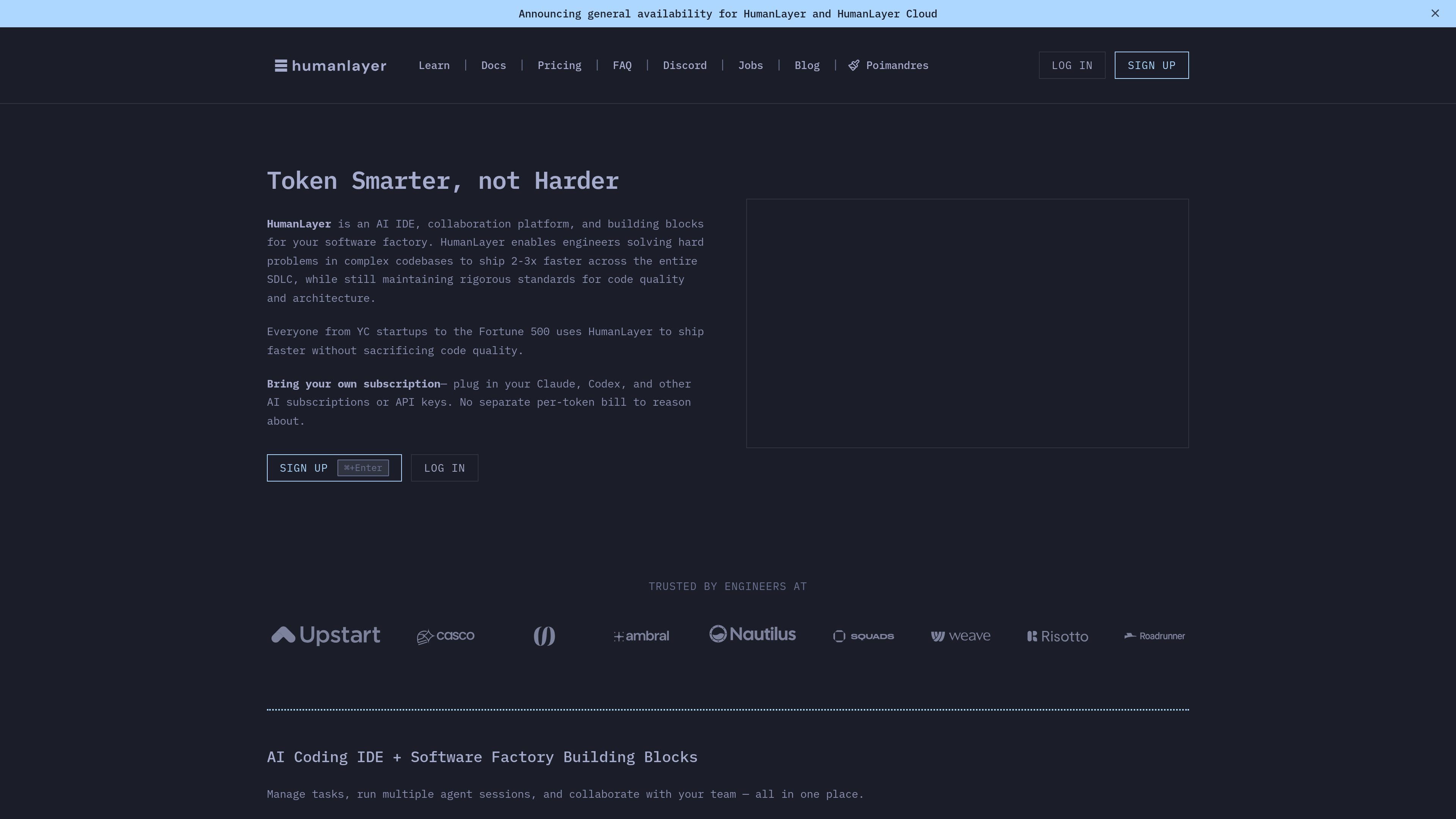
HumanLayer is an AI IDE, collaboration platform, and set of building blocks for a software factory. It is positioned for engineers working in complex codebases who need to coordinate agentic coding work without losing control of code quality or architecture.
The product combines task management, agent sessions, artifacts, and collaborative review in one workspace. The source says it is used by teams ranging from YC startups to the Fortune 500, and it supports bringing your own Claude, Codex, and other AI subscriptions or API keys rather than introducing a separate per-token bill.
Manage tasks, agent sessions, artifacts, and worktrees in a single workspace so engineers and teammates can follow the work together.
Group research, design docs, plans, mockups, and other outputs as versioned artifacts tied to a task.
Use a staged workflow that moves from questions and research through design, structure, planning, and implementation with checkpoints along the way.
Review design documents with inline comments and feed decisions back into the agent workflow before implementation begins.
Inspect thinking messages, subagent tool calls, and code changes to keep visibility into what agents are doing.
Run agent sessions in parallel on a laptop daemon or use cloud daemons for longer-running work, with sync through the HumanLayer API.
Coordinate a multi-step coding task across research, design, planning, and implementation while keeping the team aligned on each checkpoint.
Collaborate on a design doc with inline comments, then route decisions back into the agent workflow before writing code.
Track multiple agent sessions, artifacts, and worktrees for a single task so the team can see what is in progress and what is done.
Run parallel sessions on a laptop daemon for active development, or move long-running work to cloud daemons when needed.
Use your existing Claude, Codex, or API-key-based AI setup instead of adopting a separate token billing arrangement.
HumanLayer presents itself as an AI IDE, collaboration platform, and set of building blocks for a software factory. The site says it helps engineers working in complex codebases manage tasks, run multiple agent sessions, and collaborate with teammates in one place.
The homepage describes a workflow with six phases: Questions, Research, Design, Structure, Plan, and Implement. HumanLayer says these stages create checkpoints before code is written and help teams review design decisions in real time.
The site says teams can bring their own Claude, Codex, and other AI subscriptions or API keys, so there is no separate per-token bill to manage.
The source mentions a local daemon for many agent sessions on a laptop and cloud daemons for long-running work. It also says everything syncs through the HumanLayer API and the same UI is available on web, desktop, or phone.
The pricing page included in the source shows the product’s pricing area, but the collected text does not expose plan names, prices, or limits. Based on the available evidence, pricing details are not visible in the extracted page text.