
AI-guided candidate generation
Generate protein candidates and iterate on them using your organization’s experimental data, so model output is informed by results from your own program.

Cradle is a protein engineering AI platform for scientists. It helps biopharma and industrial bio teams generate protein candidates, optimize multiple properties, and learn from their own experimental data.
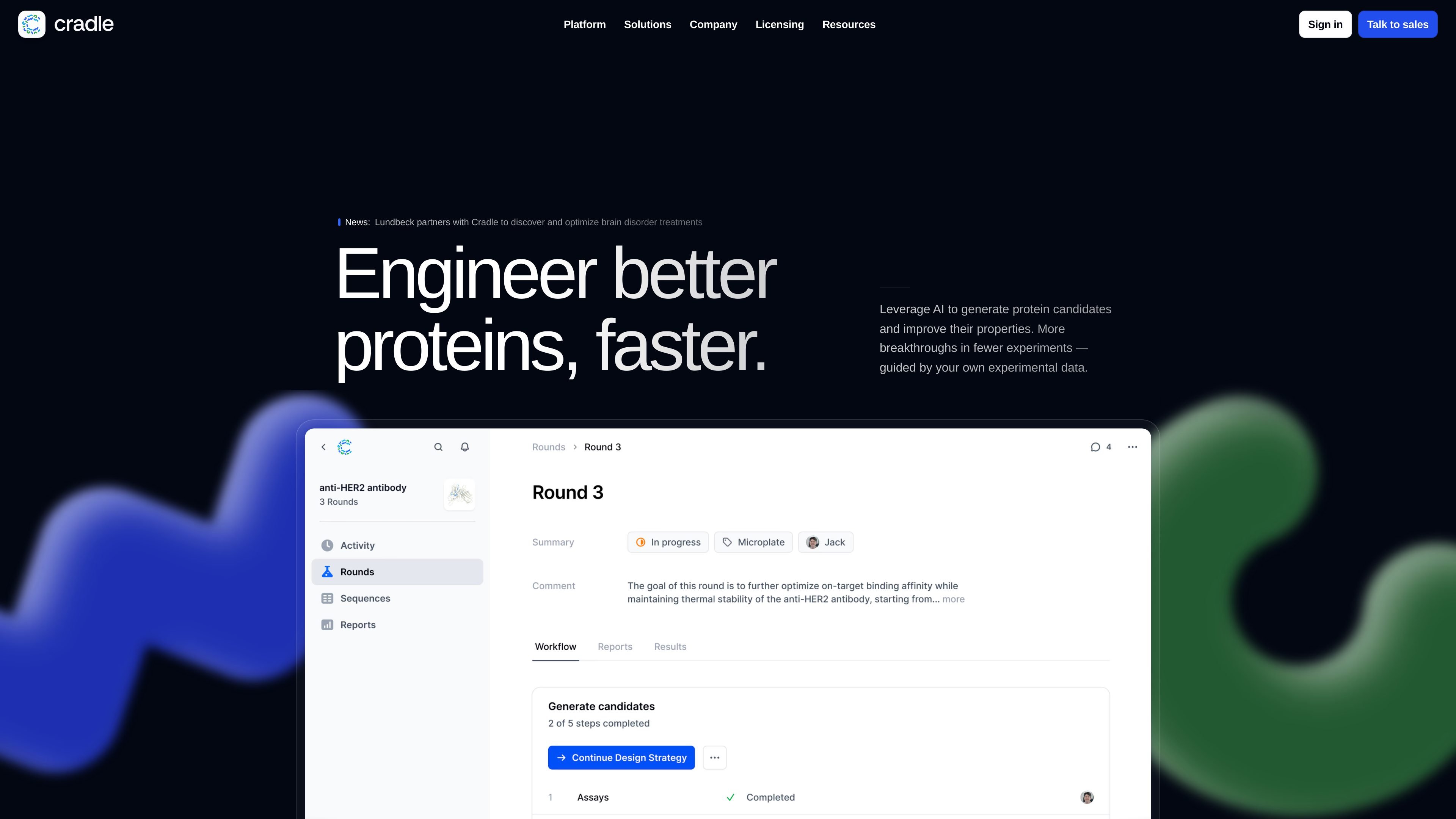
Cradle is a protein engineering AI platform for scientists. It is designed to help teams generate protein candidates and improve their properties using data from their own experiments.
The site positions Cradle as a workflow for round-based protein design and optimization rather than a one-off generator. Teams can use it to manage candidate generation, upload experimental results, and train models on data from multiple rounds to guide the next design cycle.
The platform is shown for biopharma and industrial bio programs, with examples spanning antibodies, enzymes, peptides, and vaccines. The company also emphasizes private workspaces, owned sequence IP, and annual software licensing instead of royalty or milestone-based deals.
Generate protein candidates and iterate on them using your organization’s experimental data, so model output is informed by results from your own program.
Track round status from candidate generation through uploading experimental results, with reports and data management in the workflow.
Set objectives across multiple properties such as affinity, specificity, activity, stability, and expression to optimize trade-offs together.
Use the platform for therapeutics, agricultural solutions, food ingredients, and other protein programs where measurable properties can be optimized.
Run Cradle through the user interface or the API, with simple defaults for some teams and more advanced control for users with in-house expertise.
Use private workspaces, full ownership of sequence IP, and integrated support for organization-level deployment.
Use Cradle to design and optimize antibody sequences, including affinity maturation, developability, and liability reduction across CDRs or framework regions.
Apply the platform to enzyme, peptide, or vaccine programs where you need to improve measurable properties such as stability, efficacy, or expression.
Feed assay results, screening data, and other experimental outputs into the platform to guide another design round and improve the next set of candidates.
Run programs that need multiple objectives optimized together, such as binding, specificity, activity, and stability, instead of trading them off manually.
Use the UI for guided workflows or the API for more controlled program execution across teams with varying computational experience.
Cradle is a protein engineering AI platform built for scientists. It is used to generate protein candidates and improve properties such as binding, specificity, activity, stability, and expression using experimental data from the user’s own program.
The source materials show Cradle positioned for biopharma and industrial bio teams, with examples across antibodies, enzymes, peptides, and vaccines.
Cradle’s site says workflows can run through its user interface or via API, and that teams can start with simple defaults or more advanced design requirements.
The licensing page says Cradle offers annual software licenses rather than royalty or milestone-based deals. It lists Standard, Enterprise, and Academic licensing options.
The source does not list public pricing on the pricing page; it shows a page-not-found message and directs visitors back to the home page or sales contact flows.