
AI-generated test cases
Point ContextQA at a flow and it generates a production-grade suite that covers happy paths, edge cases, and failure states without manual scripting.

ContextQA is an AI test automation platform for enterprise apps and AI agents. Generate tests, heal selectors, and validate AI behavior across web, mobile, API, and backend workflows.
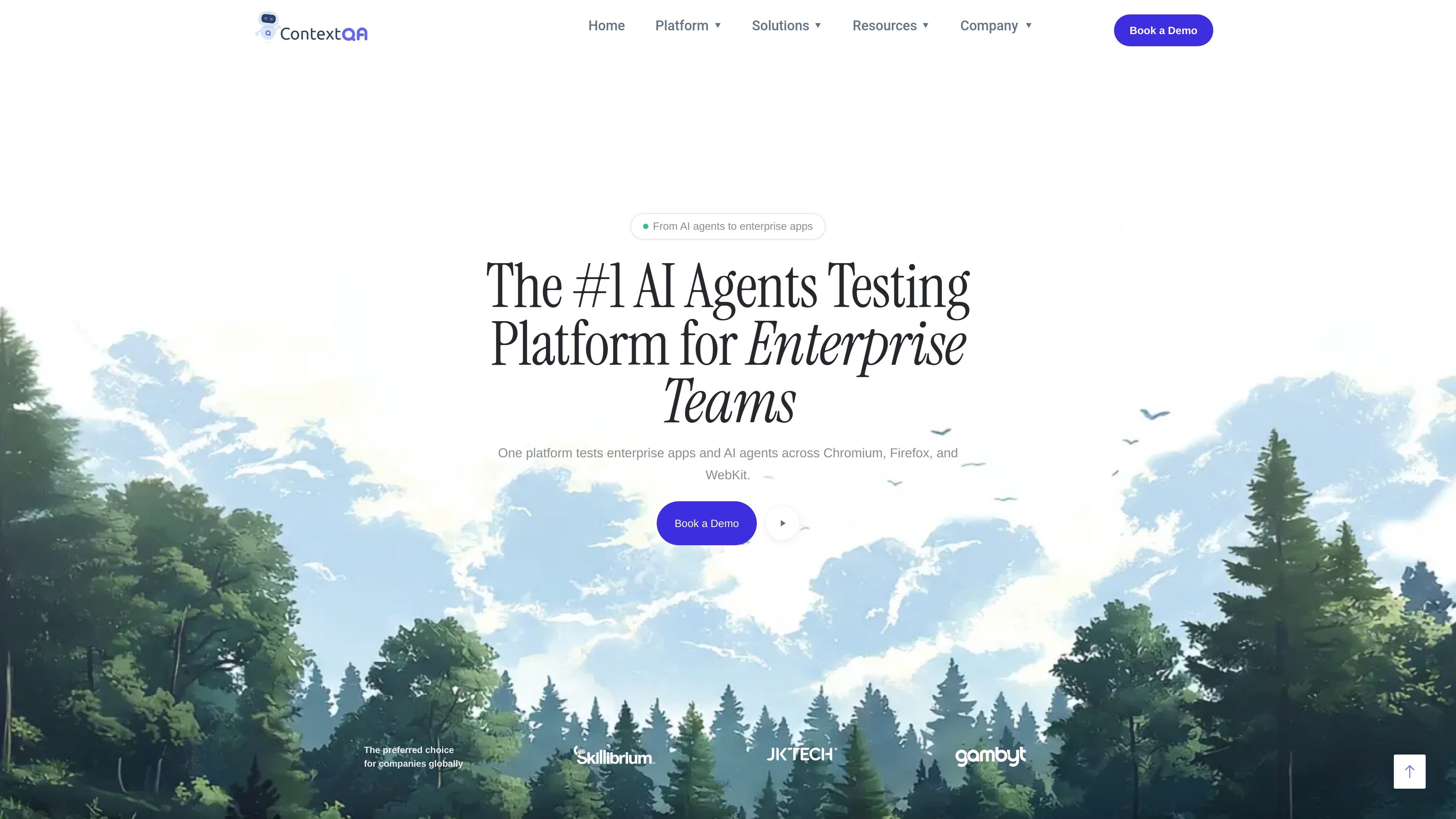
ContextQA is an AI test automation platform for enterprise software and AI agents. It combines test generation, self-healing execution, agent validation, and MCP-based workflows in one product so teams can cover web apps, mobile apps, APIs, backend systems, and AI systems from the same platform.
The home page positions the product for enterprise teams that need coverage across changing interfaces and non-deterministic AI behavior. It emphasizes automated suite generation, broken-selector repair, cross-browser and cross-device execution, and black-box testing of AI agents before they reach users.
Point ContextQA at a flow and it generates a production-grade suite that covers happy paths, edge cases, and failure states without manual scripting.
When selectors break because the DOM changes, ContextQA patches locators during the run to keep tests moving.
ContextQA connects to Claude, ChatGPT, or Cursor through MCP so teams can run tests from plain-English prompts and avoid switching tools.
It tests AI agents from the outside on systems such as Agentforce, Bedrock, Azure AI, and Snowflake Cortex, with support for adversarial scenarios and hallucination checks.
The platform runs across Chromium, Firefox, WebKit, iOS, and Android and plugs into CI/CD pipelines for parallel execution.
The site says ContextQA supports exporting tests as Playwright, Selenium, or WebDriverIO and can run on-prem or in a VPC for enterprise deployments.
Generate a test suite for a checkout or other user flow, then run it across browsers and devices as part of CI/CD.
Validate Agentforce, Bedrock, Azure AI, Snowflake Cortex, or similar agents with adversarial prompts, guardrail checks, and regression suites.
Let manual testers, automation engineers, and SDETs work from the same platform while exporting tests into tools such as Playwright or Selenium.
Run tests from Cursor, Claude Code, or Codex through MCP when developers want to inspect failures or trigger suites without leaving their IDE.
Use the platform for enterprise workflows such as SAP, Salesforce, mobile, API, and backend coverage when releases change quickly and test maintenance is costly.
ContextQA is an AI-powered QA automation platform that can generate tests, auto-heal broken selectors, and support root cause analysis for testing workflows.
The site shows ContextQA being used for enterprise app testing, AI agent testing, mobile and API testing, and MCP-based test execution from tools like Cursor and Claude Code.
The pricing page says demos are tailored to the customer’s stack and that tests can be exported as Playwright, Selenium, or WebDriverIO.
The pricing page indicates a free demo, not a self-serve price list. It also states that onboarding is customized around the user’s stack.