
Searchable video archive
Browse 3,033 specimens by terms and filters including category, aspect ratio, tool, and whether a film is AI-made. Films play from their original X or YouTube post.

A measured video reference library that helps Claude and compatible coding agents plan and build from proven film structures.
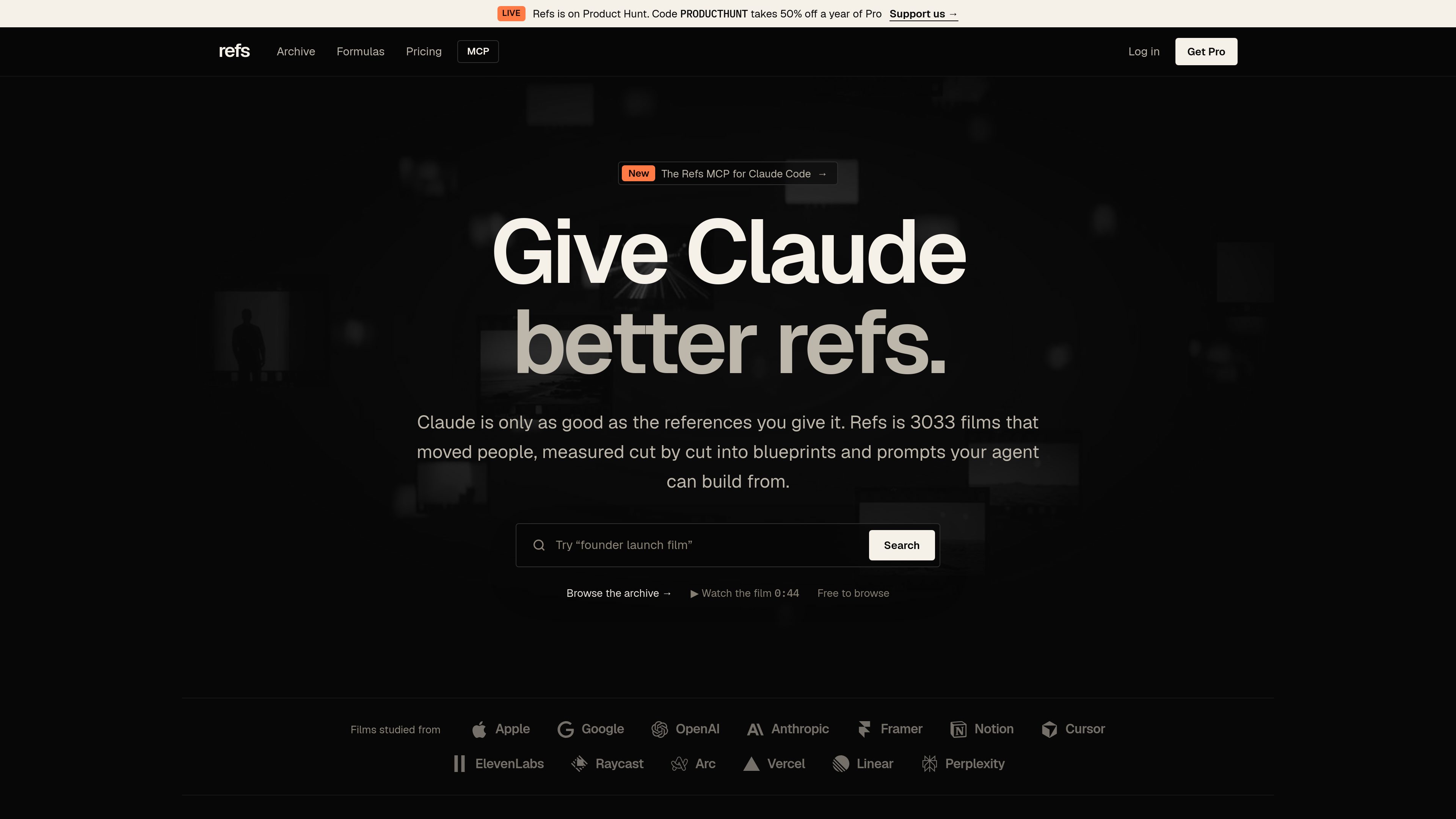
Refs is a video reference library for agents. It catalogs 3,033 launch films, motion pieces, product demos, explainers, and other specimens, each linked to its original post on X or YouTube rather than rehosted. The library is designed to help Claude work from concrete visual references instead of broad mood-board descriptions.
Each specimen includes a measured cut map with shot boundaries, timestamps, shot count, cuts per minute, and average shot duration where available. Pro dossiers extend this analysis into a 15-plate blueprint covering elements such as the hook, beats, shots, type, colour, sound, and script, along with a copy-ready recipe for adapting the method to a new product or brief.
Refs also groups recurring structures into formulas distilled from multiple measured specimens. These formulas describe timed beats, shared constants, notable differences, and a template recipe across formats such as product demos, explainers, film-and-music spots, and short service ads. Users can browse the archive directly or connect the Refs MCP to Claude Code, Codex, or Cursor.
Through the MCP, an agent can search the archive, retrieve a specimen blueprint, list or retrieve formulas, and plan a video from a brief plus one to five references. Searching is free; Pro access is required for MCP tools and includes 3,000 monthly credits. The service offers free browsing and paid monthly or yearly Pro plans, with videos remaining hosted by their original makers.
Browse 3,033 specimens by terms and filters including category, aspect ratio, tool, and whether a film is AI-made. Films play from their original X or YouTube post.
Review shot boundaries, timestamps, cut counts, cuts per minute, and average shot duration. Hover-scrubbing and shot-level navigation make the edit structure inspectable.
Pro dossiers organize a film's method into plates covering the hook, beats, shots, type, colour, sound, and script, rather than providing only a visual reference.
Formulas compare several measured specimens in a shared format and distill their timed structure, constants, differences, and a reusable template recipe.
Copy recipe prompts for adaptation, or use the MCP to search references, retrieve blueprints and formulas, and plan a video from a brief and one to five references.
Search for launch films with a relevant duration, format, or visual approach, then give an agent selected references so it can produce a beat sheet, shot list, and build prompt.
Compare formulas such as silent prompt-to-result demos or narrated design-to-publish films to understand their pacing, sequence, and recurring proof points before writing a new concept.
Use a specimen's cut map and blueprint to turn an admired edit into concrete timing, shot, type, colour, sound, and script guidance without reusing the original footage.
Connect the Refs MCP to Claude Code, Codex, or Cursor so an agent can search the archive and retrieve analysis while planning a video workflow.
No. Each specimen plays from its original post on X or YouTube and remains with its maker. Refs provides measurements, analysis, blueprints, formulas, and recipes.
Free access includes archive browsing, playback from source, measurements and cut maps, search, and the first plates of each blueprint. Full blueprints, recipes, formulas, and MCP access are Pro features.
The site documents MCP connections for Claude Code, Codex, and Cursor. Connection uses the Refs MCP server, a bearer token, and a Pro account.
Its documented tools include searching videos, retrieving a specimen blueprint, listing formulas, retrieving a formula, and planning a video from a brief plus one to five references.
トラフィックデータは参考情報としてご利用ください。

luci.memories.ai
LUCI is a local desktop memory tool for Mac and Windows that captures computer activity and meetings, then makes that context available to search, chat, and connected AI coding agents. It is designed for people and teams that need persistent context across calls, screens, notes, and everyday workflows.