
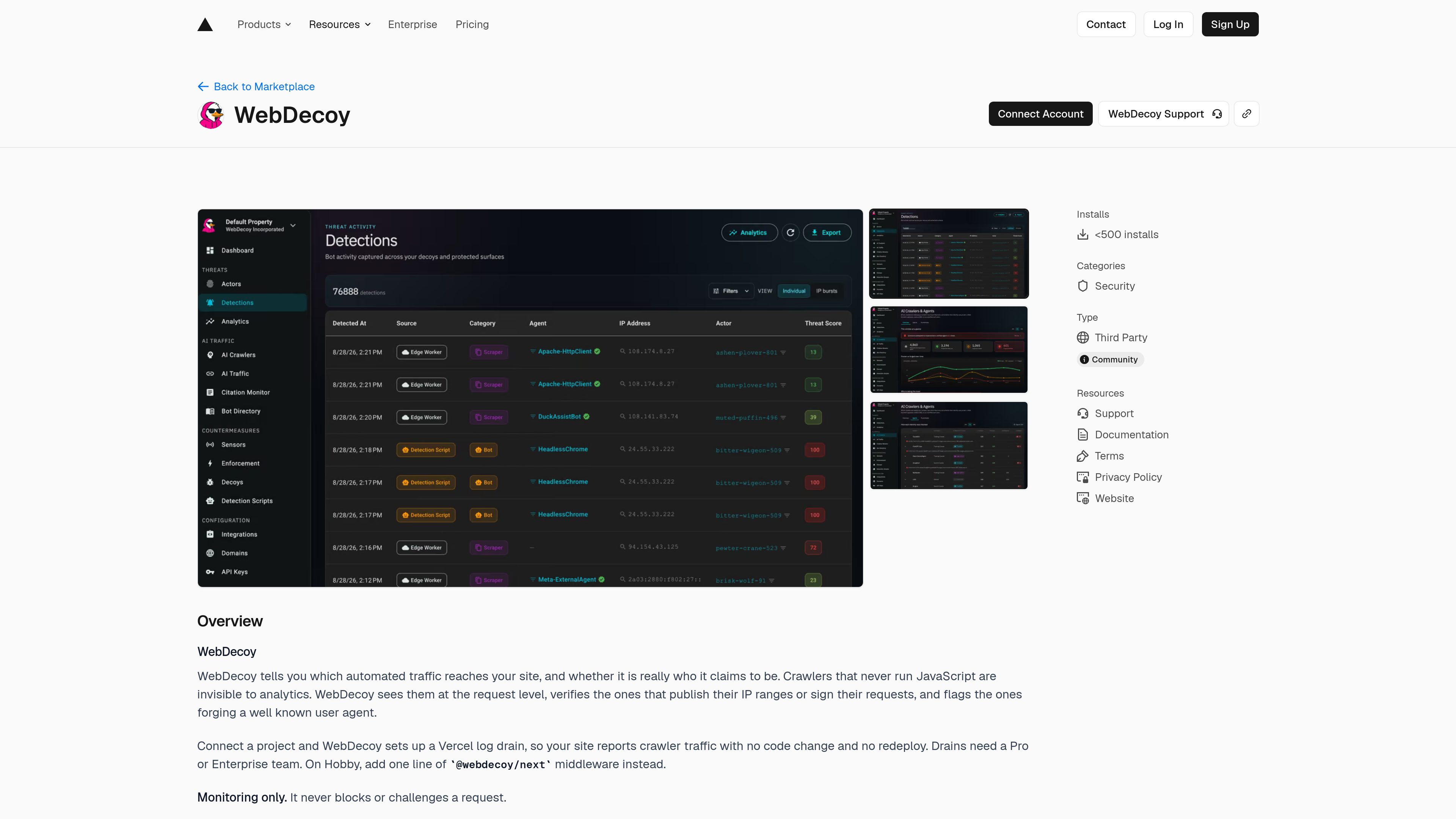
Request-level crawler visibility
Reports crawlers, tools, and requests with no user agent based on traffic received by the site, including automated visitors that browser-based analytics may not capture.

WebDecoy は、Vercel のサイトやアプリに届く自動化トラフィックを監視し、クローラー、AI ボット、ツール、user agent のないリクエストを識別します。公開済み IP 範囲または署名付きリクエストを検証し、偽装されたよく知られた user agent にフラグを立て、対応する Vercel プランではアプリケーションコードを変更せずに活動状況を報告します。
WebDecoy is a monitoring tool for identifying automated traffic that reaches a Vercel site or application. It observes requests that conventional analytics may miss, including crawlers that do not execute JavaScript, and distinguishes reported crawler identities from requests that may be spoofing a known user agent.
For Vercel projects, connecting WebDecoy creates a log drain so the service can analyze request-level data without a code change or redeploy. On Vercel Hobby teams, the alternative is a line of @webdecoy/next middleware. WebDecoy is monitoring-only: it does not block or challenge requests.
Reports crawlers, tools, and requests with no user agent based on traffic received by the site, including automated visitors that browser-based analytics may not capture.
Verifies crawlers that publish IP ranges or sign their requests, helping distinguish claimed identities from observed request characteristics.
Flags requests that appear to forge a well-known user agent rather than treating every matching user-agent string as verified.
Connecting a project creates a Vercel log drain and sends request data such as user agent, path, status, client IP, and TLS fingerprint to WebDecoy.
The Vercel connection does not require an application code change or redeploy. It also creates three environment variables used by the optional Next.js middleware.
Disconnecting a project removes its WebDecoy log drain and the three variables created by the integration; disconnecting the integration removes everything it set up.
Site owners can see which automated agents are reaching their Vercel site, including agents invisible to JavaScript analytics.
Teams can review verification results and spoofing flags when a request claims to be a recognized crawler or bot.
Vercel Pro or Enterprise teams can connect a project and use the log-drain workflow without modifying application code or redeploying.
Hobby users can use the documented `@webdecoy/next` middleware path when a Vercel log drain is unavailable to their team plan.
It reports crawlers, tools, and requests with no user agent. Human visitors are not reported.
It verifies crawlers that publish their IP ranges or sign their requests, and flags requests that appear to forge a well-known user agent.
For projects using the Vercel log-drain connection, WebDecoy sets up the drain without a code change or redeploy. On Hobby, the documented alternative is to add one line of `@webdecoy/next` middleware.
The listing states that drains require a Pro or Enterprise team. Vercel’s pricing page lists Hobby as a free plan, Pro at $20 per month, and Enterprise as a custom plan; these are Vercel plan prices, not stated WebDecoy prices.
No. It is for monitoring only and never blocks or challenges a request.

charted.blog
Charted Data is a source-code blog platform for publishing MDX content with interactive charts directly on a site. It helps technical writers, analysts, founders, and data-focused teams present metrics and data stories without relying on screenshot-based charts or third-party embeds.

getelva.ai
Elva is an API management platform that discovers APIs from source repositories, evaluates their design and AI readiness, and governs how they are published to developers and AI agents. It generates contracts, documentation, MCP servers, and related delivery artifacts without requiring an existing OpenAPI specification.

opaline.so
Opalineは、Claude CodeとCodexのセッションをチーム全体で分析し、メッセージ単位でtokenコスト、所要時間、スキルの利用状況を追跡します。組織全体の活動や詳細なセッショントレースを確認し、コーディングエージェントの導入状況や利用パターンを把握できます。

www.aikido.dev
Aikido Security is a security platform for developers, engineering teams, and security teams that covers application code, cloud environments, and runtime protection. It combines scanning, risk prioritization, and automated remediation workflows in one system.

brnch.io
Code hosting for humans and agents with signed, independently verifiable merge evidence.