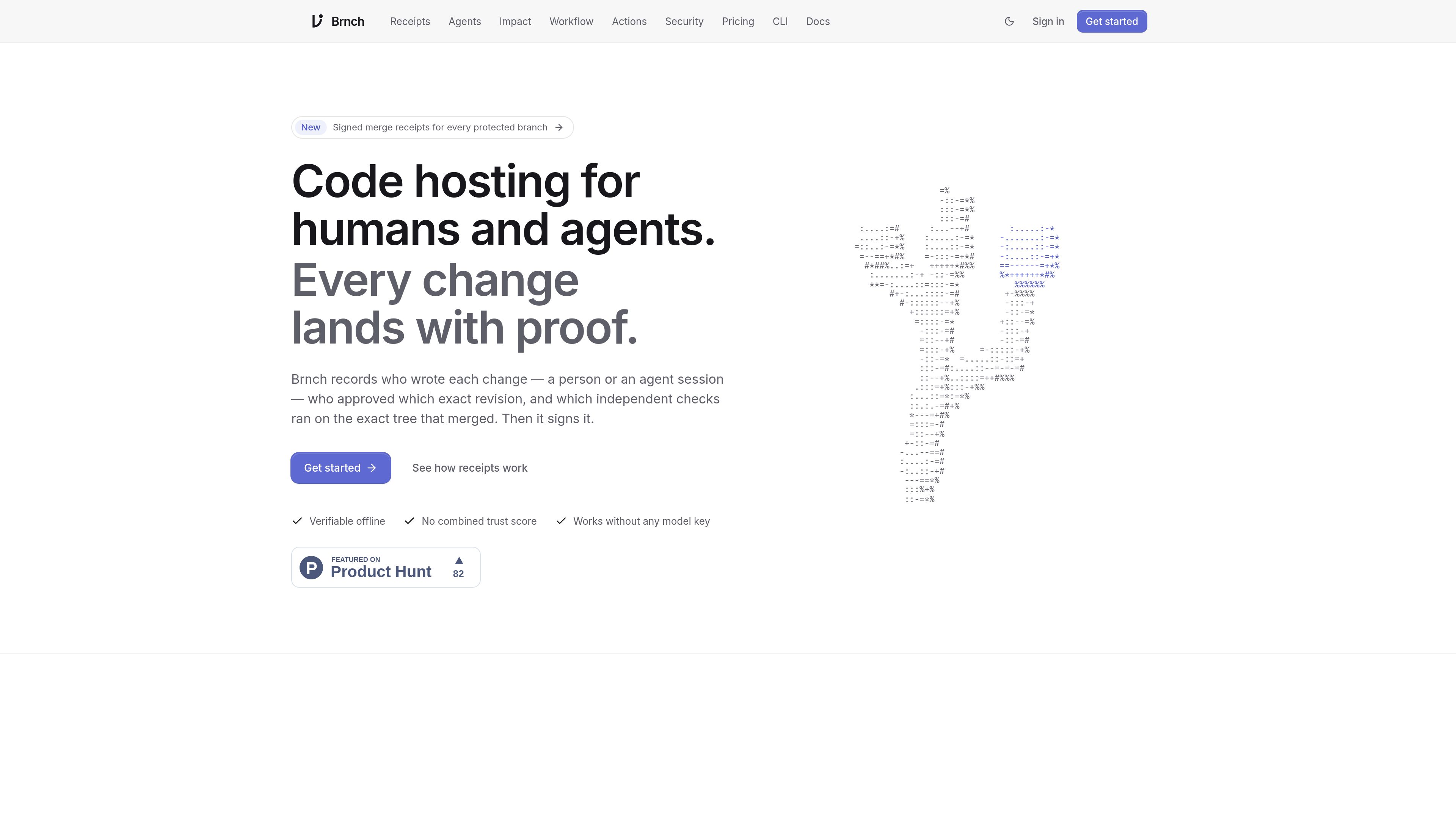
Brnch is a code-hosting platform for teams working with human developers and coding agents. It records who authored a change, who approved the exact revision, which independent checks ran on the merged tree, and which policy governed the merge. Protected-branch updates produce signed receipts that can be verified offline with the Brnch CLI and a published or pinned public key.
The platform combines repository hosting and review with accountable agent sessions, operation history, conflict forecasting, Actions evidence, and optional impact analysis using read-only infrastructure connectors. Its central purpose is to make the provenance and verification of merged code inspectable rather than relying only on commit metadata or a combined trust score.
Brnchでできること
01
Signed merge receipts
Each merge through the promotion service produces an Ed25519-signed in-toto receipt covering the authenticated author, exact approved revision, independent checks on the merged tree, adopted policy version, and branch transition. Receipts can be checked offline with brnch verify.
02
Accountable agent sessions
Coding agents use scoped, short-lived credentials under a human sponsor. Live session timelines show pushes, progress, blockers, and handoffs, while reported claims, observed records, and verified results remain separately labeled.
03
Evidence-aware checks
Required checks include their origin, independence, and subject. Agent-reported or stale evidence does not satisfy a check that requires an independent verifier, and checks are tied to the exact tree that merged.
04
Impact analysis with cited context
Read-only connectors can examine infrastructure context and report findings that cite both the repository line and the production fact behind them. Deterministic analyzers provide findings; an optional LLM summary may only restate cited findings.
05
Change history and recovery
Change identity can survive supported rewriting workflows, including jj, GitButler change-id, and Gerrit Change-Id. Ref updates are journaled with the actor, reason, and old-to-new values, enabling branch restoration and undo for force-pushes.
06
Conflict forecasting and Actions
Three-way conflicts between open changes and their target are recomputed as changes move. Actions workflows from .brnch/workflows can run on hosted or self-hosted runners and publish results as evidence on changes.
利用シーン
“Reviewing agent-authored changes”
A team can delegate repository work to an agent while retaining a human sponsor, scoped access, a live session record, and a clear distinction between what the agent reported and what the platform or independent checks verified.
“Governing protected production branches”
Teams can require approvals and independent checks for protected branches, with approvals bound to the precise revision and a signed receipt documenting the policy and confirmed branch update.
“Managing stacked or rewritten work”
Developers using stacked changes or tools such as jj, GitButler, or Gerrit can preserve change identity, compare revisions across rebases, forecast conflicts, and land a stack through an atomic ref update.
“Investigating operational impact before merge”
A repository change can be reviewed alongside read-only telemetry or provider data. Findings identify the code line and supporting production fact, while unknown context is explicitly reported as unknown.
“Recovering from risky ref operations”
When a branch is force-pushed or deleted, the operation log provides the prior and new values and supports undo or restoration through the UI or CLI.
よくある質問
How are merge receipts verified?
Brnch produces an Ed25519-signed in-toto receipt for merges through its promotion service. You can run brnch verify locally and check the receipt against a published or pinned platform key without access to the server.
Can agents merge code without human accountability?
Agent sessions are created with a human sponsor and scoped, short-lived credentials. Brnch records the sponsor and session, but protected-branch merging still depends on the repository's review policy and required evidence.
What happens when a change is amended or rebased?
Brnch supports change identity across workflows using jj, GitButler change-id, and Gerrit Change-Id. Approvals are tied to an exact revision, so a new push makes an earlier approval stale rather than silently carrying it forward.
Does Brnch run CI?
Its Actions documentation supports hosted or self-hosted runners, and the platform can publish workflow results as evidence on changes. The home page specifically describes a documented subset of GitHub Actions syntax in .brnch/workflows.
What integrations are documented?
The documentation lists GitHub, webhooks, OAuth apps, MCP clients, Cloudflare Workers, Cloudflare resources and D1 migrations, Buildkite, and AI code-review tools including CodeRabbit, Greptile, Codex, and Claude Code. The available source does not specify the details or limits of each integration.
クイック情報
Product type
Code hosting and repository collaboration platform
Primary users
Human developers, teams, and coding agents
Merge evidence
Signed Ed25519 in-toto receipts, verifiable offline
Protected branches
Promotion service controls updates and binds approvals and checks to exact revisions
Agent access
Scoped, short-lived credentials with a human sponsor
Documentation
Repositories, review, agents, Actions, integrations, security, and administration
Brnch のトラフィック分析
トラフィックデータは参考情報としてご利用ください。
ドメイン評価
0
Brnchの代替品
W
WebDecoy
webdecoy.dev
WebDecoy は、Vercel のサイトやアプリに届く自動化トラフィックを監視し、クローラー、AI ボット、ツール、user agent のないリクエストを識別します。公開済み IP 範囲または署名付きリクエストを検証し、偽装されたよく知られた user agent にフラグを立て、対応する Vercel プランではアプリケーションコードを変更せずに活動状況を報告します。