
Unified model access
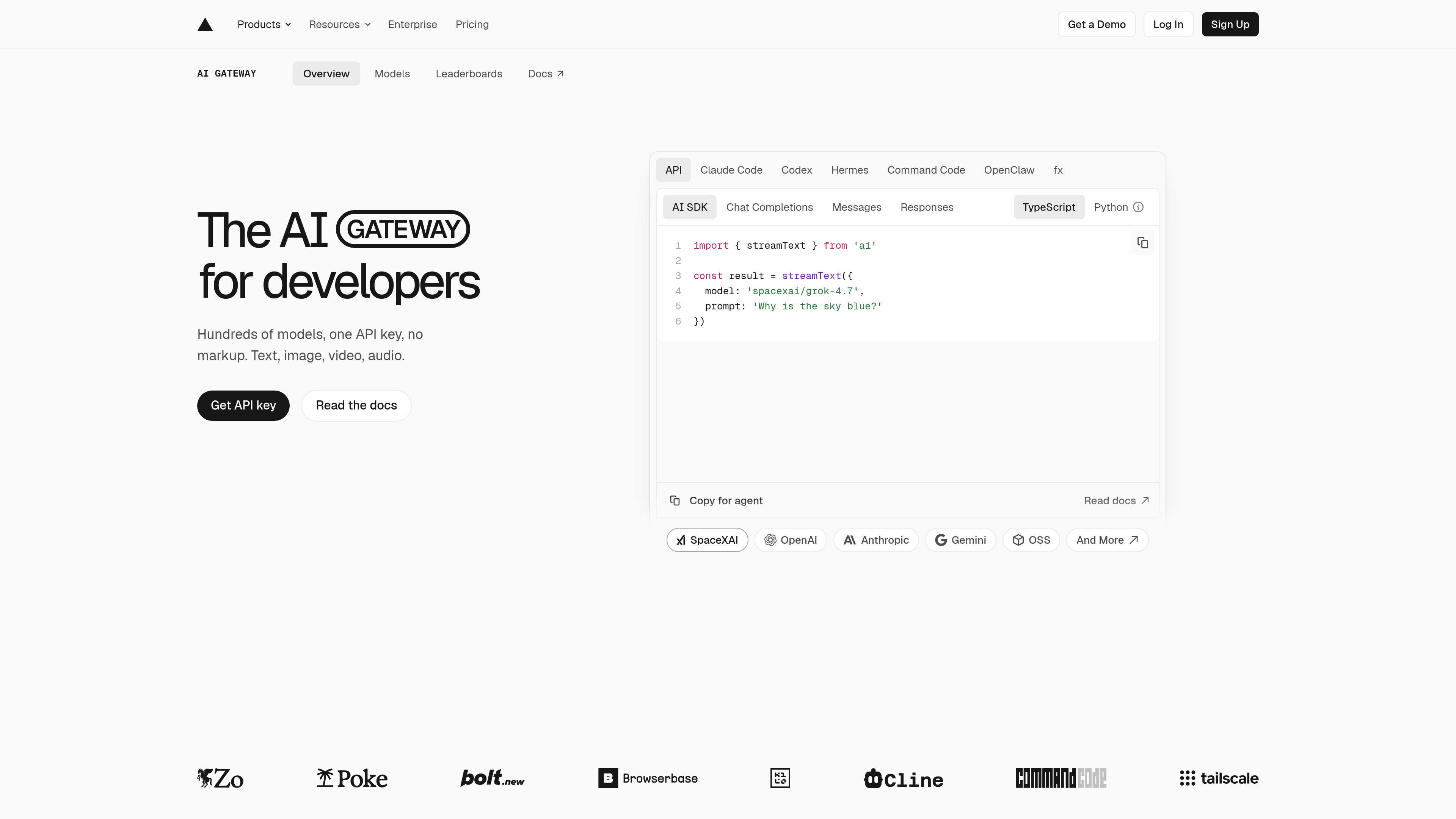
Use one API key and common gateway surface to access hundreds of models from providers such as OpenAI, Anthropic, Google, and open-model vendors. Supported modalities include text, image, video, and audio.

Vercel AI Gateway gives developers one API surface for hundreds of text, image, video, and audio models across multiple providers. It centralizes model access, routing, fallback, billing, and observability while supporting AI SDK, OpenAI, and Anthropic workflows.
Vercel AI Gateway is a hosted gateway for applications that use multiple AI model providers. It offers one API key and a common interface for hundreds of models spanning text, image, video, and audio workloads.
Developers can access the gateway through the Vercel AI SDK or compatible OpenAI Chat Completions, OpenAI Responses, and Anthropic Messages workflows. Existing OpenAI and Anthropic integrations can be migrated by changing the base URL rather than rewriting model calls.
Beyond access, the gateway combines provider routing, automatic fallback, billing, and observability. Requests can be directed according to availability, cost, or latency, while fallback can move a request to the same model through another provider when the primary provider degrades. The service states that it passes through provider pricing without token markups.
Use one API key and common gateway surface to access hundreds of models from providers such as OpenAI, Anthropic, Google, and open-model vendors. Supported modalities include text, image, video, and audio.
Use the Vercel AI SDK with TypeScript or Python, or work through Chat Completions, Messages, and Responses interfaces. Existing OpenAI and Anthropic SDK integrations can be moved by changing the base URL.
Route requests for availability, cost, or latency. The gateway describes patterns including cost-efficient models for routine requests, larger models for heavier work, and fast-responding models for latency-sensitive requests.
If a provider degrades, the gateway can fail over to the same model through another provider, helping applications continue serving requests without changing the application-level model choice.
View billing and observability across the AI stack in one place instead of managing each provider separately. The product page states that token prices are passed through without a markup.
Requests can be routed only to providers covered by a zero-data-retention agreement. The source describes this control as configurable per request or for an entire team.
A team with OpenAI or Anthropic SDK code can point its integration at AI Gateway with a base URL change, preserving the existing request style while gaining access to additional providers and models.
An application that depends on a particular model can configure provider fallback so requests use the same model through another provider when the primary provider degrades.
A product can use routing rules to send routine requests to a cost-efficient model, route latency-sensitive requests to the fastest responding option, and reserve larger models for more demanding work.
Engineering or product teams can use the model directory to compare capabilities, providers, input and output prices, latency, modalities, and listed data-handling attributes before selecting a model.
A team that requires zero data retention can configure routing to providers covered by a ZDR agreement, either for individual requests or across the team.
It is a gateway for accessing hundreds of AI models from multiple providers through one API surface and API key. It also provides routing, fallback, billing, and observability features.
The product page lists text, image, video, and audio models. The model directory also exposes filters for modalities including retrieval, evaluation, and tools.
Yes. Vercel states that existing OpenAI and Anthropic SDK integrations can be pointed at AI Gateway by changing the base URL, without rewriting the calls.
When a provider degrades, the gateway can fail over to the same model through another provider. The page presents this as a way to maintain availability while keeping the application-level model choice.
The product page says there is no markup on tokens and that users pay provider prices. It also says invoicing is available without payment-processing fees; current model pricing and promotions should be checked in the gateway documentation and model directory.

docs.litellm.ai
OpenAI互換のPython SDKまたはプロキシで100以上のLLMを呼び出し・管理。
aimlapi.com
AIMLAPI provides one API and billing key for accessing a catalog of AI models for chat, reasoning, image, video, audio, voice, search, embeddings, code, and related tasks. It is intended for developers and teams that want to compare and use models from multiple providers through a common platform.

zenmux.ai
複数モデル対応の統合APIと自動ルーティングを備えた企業向けLLMプラットフォーム

www.newapi.ai
New API is an open-source, self-hosted AI gateway for developers and teams. It provides a unified OpenAI-compatible endpoint for connecting multiple AI providers, selecting models, configuring channels, and monitoring usage on their own infrastructure.

router.com
Router by Ramp is an LLM gateway that gives applications one API endpoint for accessing models from multiple providers. It routes eligible requests based on cost, quality, and availability while providing usage and spend visibility.

cometapi.com
CometAPI is a unified, OpenAI-compatible API layer for accessing more than 500 text, image, video, and audio models through one key. It helps developers and teams compare models, centralize billing, and switch providers without maintaining separate vendor integrations.