
Cross-network transaction execution
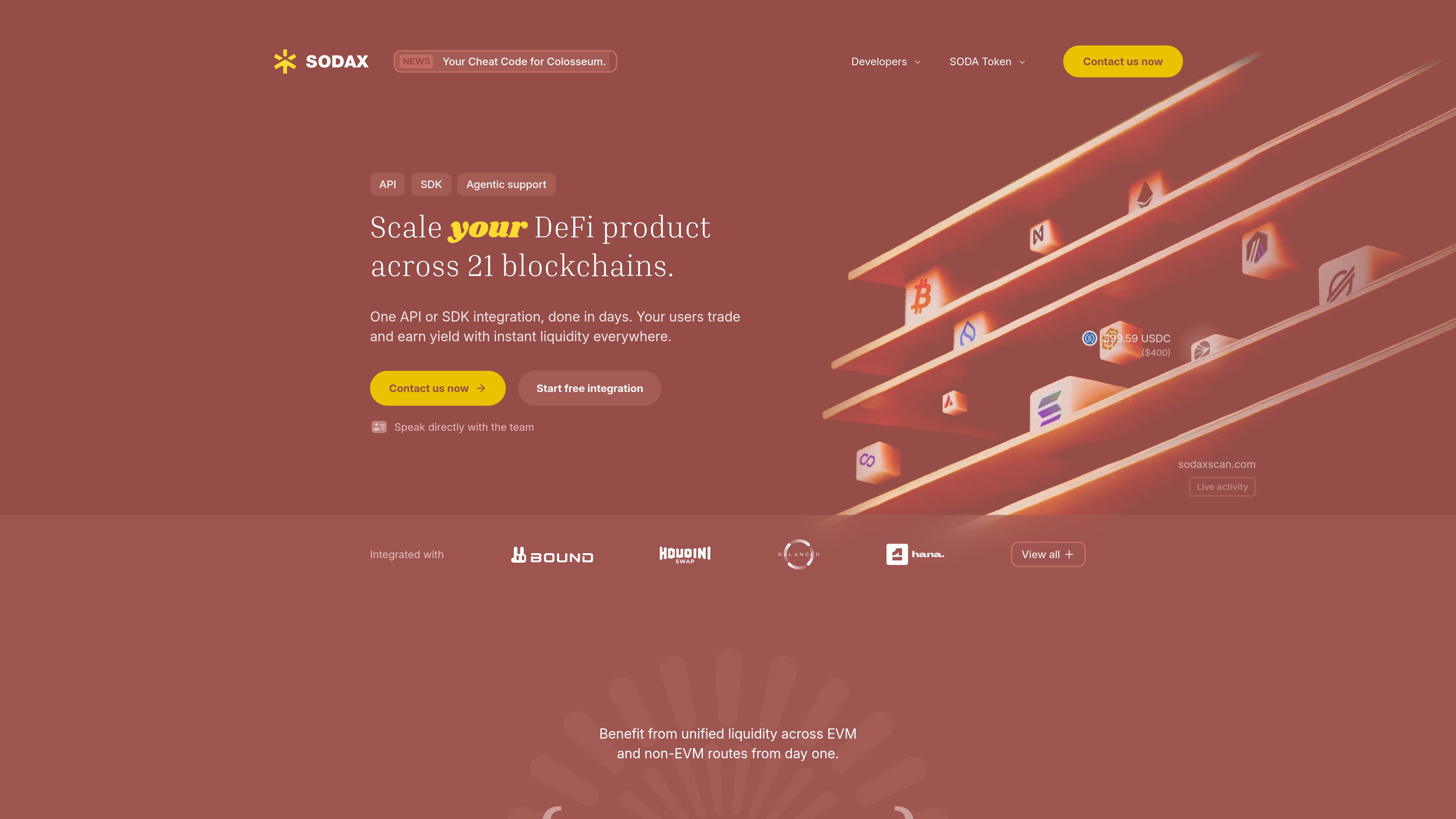
SODAX quotes and executes transactions across supported EVM and non-EVM routes, so an application can expose cross-network actions without implementing the underlying execution system itself.

SODAX is cross-network execution and liquidity infrastructure for applications that want to offer trading, lending, borrowing, and yield workflows across blockchain networks. It provides API, SDK, two-click API, and MCP-based integration options so product teams do not have to build cross-network infrastructure themselves.
SODAX is infrastructure for applications that need to offer financial actions across blockchain networks. It coordinates cross-network quoting and transaction execution, with liquidity routed through existing pools and unified pricing for supported routes.
The platform is aimed at wallets, DEXs, aggregators, protocols, and other financial applications. Teams can integrate through an API, SDK, two-click APIs for specific actions, or the SODAX MCP server for agentic development. Supported product experiences include trading, lending, borrowing, and yield workflows across EVM and non-EVM networks.
SODAX quotes and executes transactions across supported EVM and non-EVM routes, so an application can expose cross-network actions without implementing the underlying execution system itself.
Transactions are routed through pre-existing liquidity pools with unified pricing, helping applications access liquidity across networks rather than building and maintaining isolated pools for each route.
The platform supports application experiences for trading as well as lending and borrowing across networks. Its asset directory identifies assets that are available for trading, borrowing and lending, or building.
Teams can choose the full SDK, documented APIs, two-click APIs for specific actions, or the MCP server for agentic access. The site also provides SDK documentation, code examples, and integration guides.
SODAX publishes a directory showing asset availability by network and capability. The directory includes cryptoassets, stablecoins, tokenized assets, and yield-related assets, with direct availability varying by asset.
A wallet can use SODAX execution to let users trade assets that are not native to the wallet’s current network, while retaining the wallet as the primary product interface.
A decentralized exchange or aggregator can add quotes and execution across multiple networks instead of separately sourcing and maintaining route-specific liquidity infrastructure.
A lending application can connect users to lending pools across networks, enabling deposits and lending workflows backed by underlying capital distributed across supported markets.
The Bound case shows how a Bitcoin-focused application used the SDK to expose native BTC across 18 or more networks for trading and money-market lending without wrapping BTC or using a centralized exchange.
SODAX provides cross-network quoting, liquidity routing, and transaction execution infrastructure for applications. The site positions it for trading, lending, borrowing, and yield-oriented product experiences.
The documented integration options include the SODAX SDK, APIs, two-click APIs for specific actions, and an MCP server for agentic access. The site also offers integration guides and a way to generate a custom integration guide.
The homepage lists 21 networks, including Bitcoin, Ethereum, Solana, Sui, Avalanche, Base, HyperEVM, Stellar, Arbitrum, Polygon, BNB Chain, Sonic, Stacks, Injective, Optimism, LightLink, and Kaia, along with additional networks. The asset directory lists 135 assets, but direct availability and capabilities vary by asset and network.
The product is designed to route transactions through pre-existing pools and provide unified liquidity access, reducing the need for an application to build and maintain separate cross-network liquidity pools. The available route and asset coverage should still be checked in the directory.
トラフィックデータは参考情報としてご利用ください。

runalloy.com
Integration infrastructure for internal workflows and customer-facing SaaS integrations.

deplo.build
Deplo is a self-hosted deployment platform that builds, deploys, and serves applications on servers you own. It provides repository-based deployments, HTTPS, managed data services, access controls, and optional AI-assisted infrastructure operations.